Old city · Marrakech food guide
Mellah Food Guide: Spice Market & Marrakech's Jewish Quarter
The Mellah is Marrakech's old Jewish quarter, founded in the 16th century in the shadow of the royal Kasbah and long the city's centre of trade in spices, jewellery and preserved foods. Today it is best known to food lovers for its covered spice market and its stalls of preserved lemons, cracked olives and dried fruit — the building blocks of the Moroccan pantry, sold in one dense, aromatic warren beside Place des Ferblantiers.
- Character
- Historic, aromatic, trade-focused
- Best for
- Spices, preserves & olives
- Typical spend
- Cheap (shopping)
- Food heart
- The Mellah spice market
The food character of the Mellah
The Mellah (from the Arabic for salt, sometimes linked to the old trade of salting goods) was the walled Jewish quarter, and for centuries its merchants dominated the spice and preserved-food trades. Even as the community dwindled through the 20th century, the quarter kept its role as the city's larder: this is where cooks and restaurants come to buy spices by the kilo, olives by the scoop and preserved lemons by the jar.
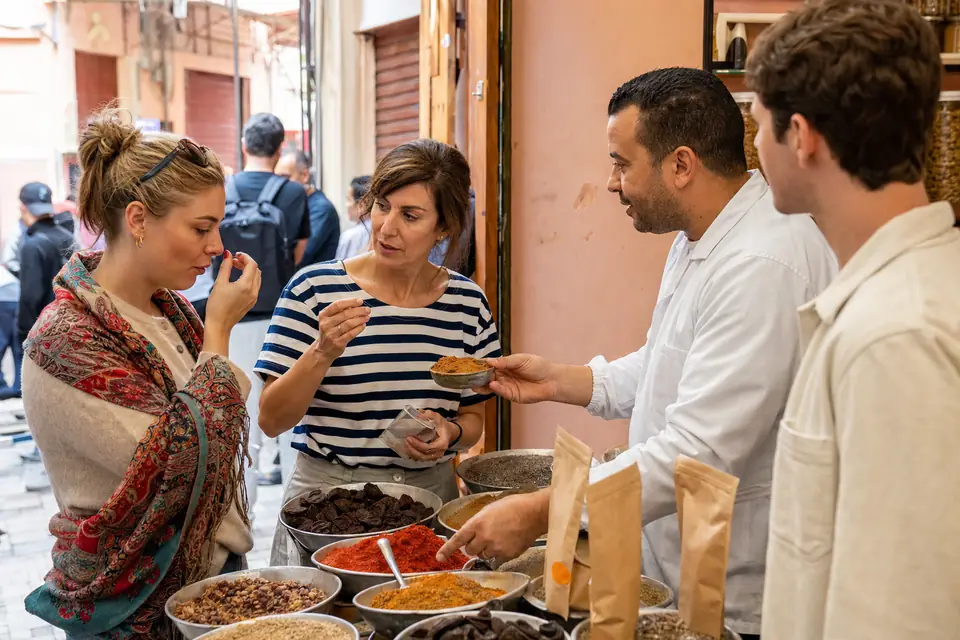
The heart of it is the covered spice market — a tight, lantern-lit run of stalls piled with ras el hanout, cumin, saffron, dried rosebuds, henna and every apothecary curiosity — spilling out onto Place des Ferblantiers, the metalworkers' square where the lantern-makers hammer copper and brass. It is more workaday and less performative than the tourist souks further north, which makes it a rewarding place to actually shop.
The quarter also carries a distinct Judeo-Moroccan culinary heritage — dishes like slow-cooked skhina (dafina), preserved and pickled vegetables, and a particular love of the sweet-savoury and the preserved. Much of that tradition now lives in home kitchens and memory rather than restaurants, but the ingredients that define it are still sold here every day.
What to eat & buy in the Mellah
- Preserved lemons
- Whole lemons cured in salt and their own juice until soft and intense — the salty-citrus soul of Marrakech tagines. Buy them loose here; read preserved lemons and smen.
- Cracked olives
- Barrels of green, violet and black olives cured with herbs, garlic and chilli — the classic partner to preserved lemon, sold by weight to taste before you buy.
- Spices & ras el hanout
- The market's reason for being: whole and ground spices and the flagship blend, ras el hanout, mixed to each merchant's own recipe. See ras el hanout.
- Dried fruit & nuts
- Dates, figs, apricots and almonds heaped high — Marrakech's sweeteners and snacks, and the stuffing for many pastries and tagines. See our dates buyer's guide.
- Spice-heavy tagines nearby
- Small eateries around Ferblantiers cook the classics using exactly the market's preserves — a chance to taste the ingredients you have just been shopping for.
Markets & souks nearby
- Mellah spice market The covered heart of the quarter — spices, preserved lemons, olives, dried fruit and apothecary stalls, generally fairer-priced than the tourist souks.
- Place des Ferblantiers The lantern-makers' square at the market's edge, and a gateway between the Mellah and the Kasbah.
- Souk Ableuh (olive souk) For an even bigger olive selection, the dedicated olive souk near Jemaa el-Fna is a short walk north.
Cooking classes & food tours here
- Cooking classes in the Mellah Cook near the spice market and shop it for your ingredients — an efficient, aromatic base for a hands-on class.
- Mellah market tour A guided walk through the spice market and preserved-food stalls, learning what each is and how to buy it well.
- Spice souk tour A deeper dive into the spices themselves — smelling, comparing and understanding ras el hanout and the tagine base notes.
Local tips for eating in The Mellah
- Taste before you buy. Olive and preserved-food sellers expect you to sample; try a few cures and buy the one you like, by weight.
- Buy spices whole where you can. Whole spices keep their punch far longer than pre-ground; grind at home. See how to shop the spice souk.
- Fair-priced but still negotiate. The Mellah is less touristy than the northern souks, but agreeing a price by weight before buying still avoids the visitor markup.
- Ras el hanout is never identical. Every merchant blends their own — smell a couple and pick the one you prefer rather than assuming a fixed recipe.
- Combine with the Kasbah. The royal quarter and its tanjia are next door; do the market in the morning and eat lunch nearby.
Frequently asked questions
What is the Mellah in Marrakech known for?
It is the city's historic Jewish quarter and its traditional trading centre for spices, preserved lemons, olives and dried fruit. Today its covered spice market beside Place des Ferblantiers is one of the best places in Marrakech to buy pantry ingredients.
Where can I buy preserved lemons and olives in Marrakech?
The Mellah spice market and the nearby olive souk (Souk Ableuh) are the classic spots, with barrels of cured olives and jars of preserved lemons sold by weight. Taste before buying, and agree the price by weight to avoid overpaying.
Is the Mellah spice market cheaper than the tourist souks?
It is generally more workaday and fairer-priced than the heavily touristed souks further north, because locals and restaurants shop here. You should still confirm the price by weight before buying, especially for saffron and blended spices.
Does the Mellah have its own cuisine?
It carries a distinct Judeo-Moroccan heritage — slow-cooked skhina (dafina), pickled and preserved vegetables, and a love of sweet-savoury dishes. Much of that now lives in home kitchens, but the defining ingredients are still sold in the quarter daily.