Old city · Marrakech food guide
Medina Food Guide: Where & What to Eat in Marrakech's Old City
The Medina — the walled old city, a UNESCO-listed labyrinth of derbs and souks radiating from the great square of Jemaa el-Fna — is where Marrakech eats its most traditional food. This is the land of the tanjia, of pit-roast mechoui, of snail soup ladled at dusk and of cook-shops that make one pot and sell it until it runs out. Learn its rhythms and you eat superbly for a few dirhams.
- Character
- Ancient, dense, traditional
- Best for
- Street food & souk snacks
- Typical spend
- Cheap to mid-range
- Food heart
- Jemaa el-Fna & the souks
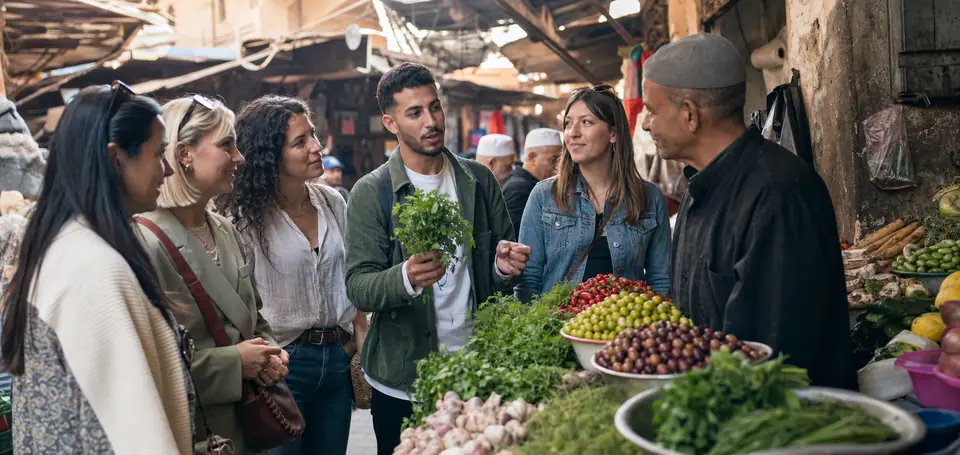
The food character of the Medina
The Medina is the historic core of Marrakech, enclosed by red pisé walls and pierced by monumental gates like Bab Agnaou and Bab Doukkala. Inside, the streets narrow into a covered maze of souks, and food is woven through all of it — a bread oven sharing a wall with a coppersmith, a snack counter opposite a carpet dealer, a spice merchant beside a butcher. The great open square of Jemaa el-Fna is the theatrical centre, but the real everyday eating happens in the lanes and small squares around it.
This is the most traditional part of the city to eat in, and often the cheapest, but it is also where the sharpest tourist pricing lives. The rule of thumb is the opposite of a guidebook's instinct: a plain counter with a queue of Moroccan workmen and a single bubbling pot is a far better sign than a beautiful terrace with photo menus and a tout at the door. For the fuller playbook, read how to eat like a local in Marrakech.
Lunch (roughly 1–3pm) is the main meal, when cook-shops sell the day's tanjia, lentils or roast lamb at their freshest; the square's famous food stalls, by contrast, are an evening affair. Time your eating to the local clock and you catch each thing at its best.
What to eat in the Medina
- Tanjia marrakchia
- Marrakech's own signature — beef or lamb with preserved lemon, garlic, cumin and smen, sealed in a clay urn and cooked for hours in the embers of a hammam furnace. Deeply savoury and falling apart. See the tanjia guide.
- Mechoui (pit-roast lamb)
- Whole lambs slow-roasted in underground pit ovens off the square and sold by weight from breakfast onward, eaten with bread, cumin and salt. The classic address is the lane locals call Mechoui Alley near the olive souk.
- Harira
- The tomato, lentil and chickpea soup that opens the day for many and breaks the fast in Ramadan. Cheap, filling, and often paired with sticky chebakia or a few dates.
- Grilled brochettes & kefta
- Skewers of lamb, chicken or spiced kefta grilled over charcoal at snack counters and, in the evening, the square's stalls — pick a busy one turning food over fast.
- Babbouche (snail soup)
- A dusk-and-onward Medina ritual: small snails simmered in a peppery, herb-laced broth, sipped from a bowl with a pin to winkle them out. An acquired but beloved taste.
- Fresh bread & msemen
- Round khobz from the neighbourhood ferran and flaky folded msemen from griddle stalls — the Medina's edible cutlery. Our bread guide tells them apart.
Markets & souks nearby
- Rahba Kedima (spice square) The open spice-and-apothecary square just off Jemaa el-Fna — ras el hanout, dried rosebuds, herbs and preserved goods, plus baskets of dates and olives.
- Souk Semmarine The Medina's grand covered artery running north from the square, threading past food stalls, dried-fruit sellers and the entrances to the specialist souks.
- Souk Ableuh (olive souk) Pyramids of cracked green, violet and black olives with preserved lemons — the pairing at the heart of Marrakech tagines, and the lane beside Mechoui Alley.
- Souk el-Attarine The historic perfumers' and spice merchants' souk, good for buying spices loose by weight; read how to shop the spice souk first.
Cooking classes & food tours here
- Cooking classes in the Medina Cook a tagine in a restored riad courtyard steps from the souks — most classes start with a guided market shop for the ingredients.
- Medina street food tour A guide handles the ordering and pricing while you graze the counters and stalls tourists usually walk straight past.
- Where locals eat tour Deliberately steers away from the terraces to the cook-shops and snack joints Marrakchis actually queue at.
- Spice souk tour A walk through the attarine and Rahba Kedima to learn the spices by smell before you cook or shop.
Local tips for eating in The Medina
- Eat lunch as your main meal. Cook-shops prepare a limited quantity each morning and sell out by mid-afternoon; arrive around 1pm for the best of the tanjia and roast lamb.
- The square is an evening thing. Jemaa el-Fna's food stalls set up in the late afternoon and fill by nightfall — go hungry after dark, not at noon.
- Agree a price before you sit. The commonest overcharge happens when there is no visible price and you did not ask. Say the number out loud first and there is nothing to argue later.
- Right hand, bread not forks. Traditional dishes are shared from one plate and eaten with bread in the right hand — see food etiquette and customs.
- Carry small change. Snack counters and stalls deal in coins and small notes; nobody wants to break a large bill for a bowl of soup.
Frequently asked questions
Is it safe to eat street food in the Marrakech Medina?
Generally yes, if you use common sense: choose busy stalls with high turnover where food is cooked fresh in front of you, favour hot, thoroughly cooked dishes, and go where locals eat. See our street-food safety guide for the full checklist.
Where is the best food in the Medina?
For traditional Marrakech food, look for tanjia and mechoui near the souks, the cook-shops around the square at lunch, and the Jemaa el-Fna stalls in the evening. The plainest counters with local queues, not the photo-menu terraces, serve the best value.
What should I not miss eating in the old city?
Tanjia marrakchia (the hammam-cooked clay-urn stew) and mechoui (pit-roast lamb) are the two things Marrakech does better than anywhere else. Add a bowl of harira, some fresh msemen, and — if you are brave — the evening snail soup.
Is the Medina cheaper than Gueliz for food?
The Medina has both the cheapest local cook-shops and the most tourist-priced terraces, side by side. Gueliz is more consistently mid-range with cafés and modern restaurants. For rock-bottom authentic eating, the Medina's back-lane snack joints win.