Market · Mellah (old Jewish quarter)
Mellah Market Food Tour
The Mellah — Marrakech's historic Jewish quarter beside the Bahia Palace and royal kasbah — holds the city's most serious spice and preserved-goods market, plus butchers and stalls that once served a distinct culinary tradition. It is less touristed than the central souks and more about pantry ingredients than snacks: this is where you understand preserved lemons, khlii (cured meat), pickles and the deep spice bins that stock local kitchens.
- Duration
- 1.5–2 hours
- Best time
- Morning, when the market is liveliest
- Pace
- Easy walking, busy market lanes
- Area
- Mellah (old Jewish quarter)
Overview
The Mellah sits in the southern Medina near the Bahia Palace, the Badii ruins and the Saadian Tombs, so a food walk here pairs naturally with sightseeing. Historically home to the city's Jewish community, the quarter developed its own market traditions, and its spice market is regarded by many local cooks as the best and best-value in Marrakech.
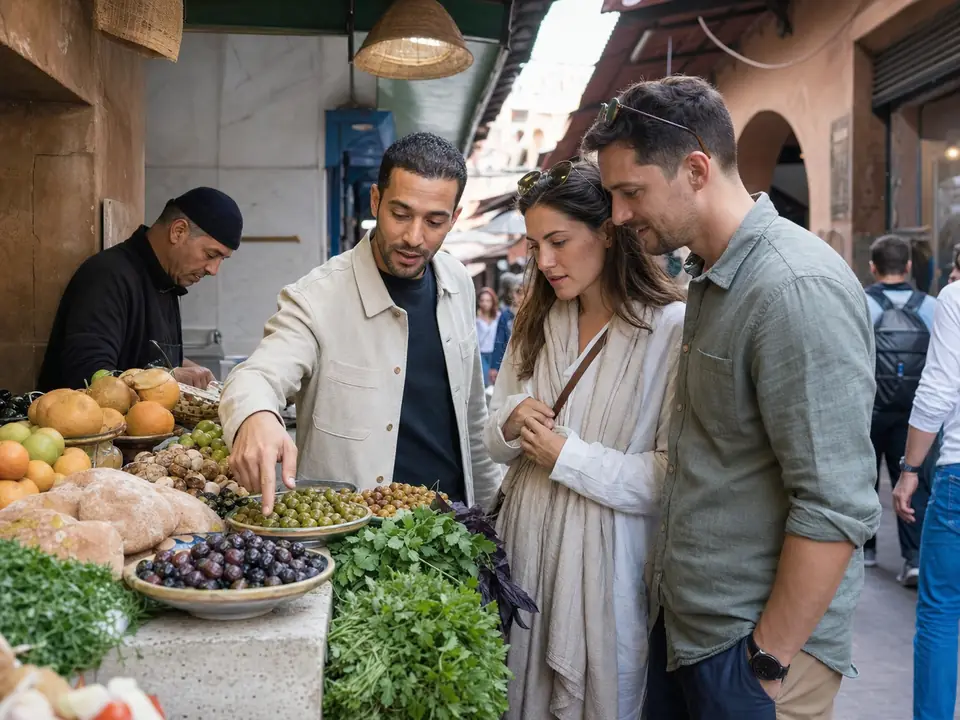
This is a pantry tour more than a snack crawl. You come to see how a Moroccan kitchen is stocked: barrels of olives and preserved lemons, sacks of pulses and semolina, deep bins of spice, cured and dried meats, and pickled vegetables. It is the supply room behind every tagine you will eat elsewhere in the city.
What you'll taste
- Preserved lemons — Salt-fermented lemons in every stage; the rind is the prize, sliced into tagines for a bright, funky tang.
- Khlii — Strips of beef cured with spices and preserved in fat — deeply savoury, fried with eggs for a rich breakfast.
- Olives — Barrels of green, black, violet and chilli-cured olives, sold by the scoop after a taste.
- Pickled vegetables — Turnips, carrots and chillies in brine — the sharp counterpoint on a Moroccan table.
- Bulk spices — Deep, well-priced bins of cumin, paprika, turmeric and ras el hanout that stock local kitchens.
- Dried pulses & semolina — Chickpeas, lentils and couscous grades sold loose — the staples behind soups and Friday couscous.
The route
- 1
Place des Ferblantiers
Start at the tinsmiths' square on the Mellah's edge, then pass under the arch into the market lanes.
- 2
The spice market
The Mellah's covered spice market — deeper bins and keener prices than the central souks, favoured by home cooks.
- 3
Preserved-goods barrels
Preserved lemons, olives and pickles by the barrel; taste a rind and an olive or two before buying.
- 4
Butchers & khlii
The meat lane, where cured khlii and fresh cuts are sold — a window into how meat is preserved without refrigeration.
- 5
Dried goods
Sacks of pulses, semolina and dried fruit that make up the everyday pantry.
- 6
Bahia Palace edge
Emerge near the Bahia Palace to pair the food walk with the neighbourhood's grand sights.
When to go & what it costs
Mornings are best — the market is fully stocked, the butchers are fresh, and it is cooler for walking. The Mellah is quieter than the central souks any time of day, which makes it a calmer, more local-feeling food walk. Pair it with the Bahia Palace and Saadian Tombs, which are a short stroll away.
Cost & cash: Pantry goods sold by weight and generally cheaper than the tourist souks; carry small cash.
Insider tips
- This is the value spice market — buy your bulk cumin, paprika and ras el hanout here rather than the tourist souks.
- Taste preserved lemon rind and olives before you commit; quality varies barrel to barrel.
- Khlii keeps well and travels — a small sealed pack makes an unusual edible souvenir.
- Combine the walk with the Bahia Palace and Saadian Tombs next door for a full morning.
- Bring a tote; loose pulses and spices come in thin bags that split easily.
Etiquette & how to eat like a local
- This is a working local market — keep out of the way of shoppers and porters with handcarts.
- Taste what is offered, but do not help yourself from open barrels uninvited.
- Dress a little more modestly here than in the tourist core; it is a residential quarter.
- Ask before photographing butchers and their stalls.
- Small talk and a greeting in Arabic or French warms up any transaction.
Frequently asked questions
Why is the Mellah spice market cheaper than the souks?
The Mellah market serves local home cooks rather than tourists, so prices for bulk spices, pulses and preserved goods are keener and less negotiable-by-necessity. It is where many Marrakchis actually buy their pantry staples.
What is khlii and how do you eat it?
Khlii is beef (or sometimes lamb) cured with spices, dried, and preserved in its own fat. It keeps for months without refrigeration and is typically fried and served with eggs for a rich, savoury breakfast, or stirred into rice and lentils.
Is the Mellah worth visiting for food?
Yes, especially if you want pantry ingredients and a calmer, more local market than the central souks. Pair it with the Bahia Palace, Badii Palace and Saadian Tombs, which are all a short walk away in the same southern quarter.
Can I buy preserved lemons to take home?
Yes — they are sold loose from barrels. Ask for a small sealed tub or bag. They travel reasonably well, though check liquid limits for carry-on and consider packing them in checked luggage.
Cook what you tasted
Loved something on the walk? Take it home. Learn the dish hands-on with a Marrakech chef, or follow a free step-by-step recipe.