Market · Souk Ableuh & the olive stalls
Olives & Preserved Lemons Souk Tour
Two ingredients define the tang of Moroccan cooking above all others: olives and preserved lemons. This focused tour is a deep dive into the olive souk — the pyramids of green, violet, black and chilli-marinated olives at Souk Ableuh — and the barrels of salt-fermented lemons beside them. You taste across the spectrum, learn how each is cured, how they are used, and how to buy the good ones to carry the flavour of Marrakech home.
- Duration
- 1 hour
- Best time
- Late morning or afternoon
- Pace
- Easy, standing at stalls
- Area
- Souk Ableuh & the olive stalls
Overview
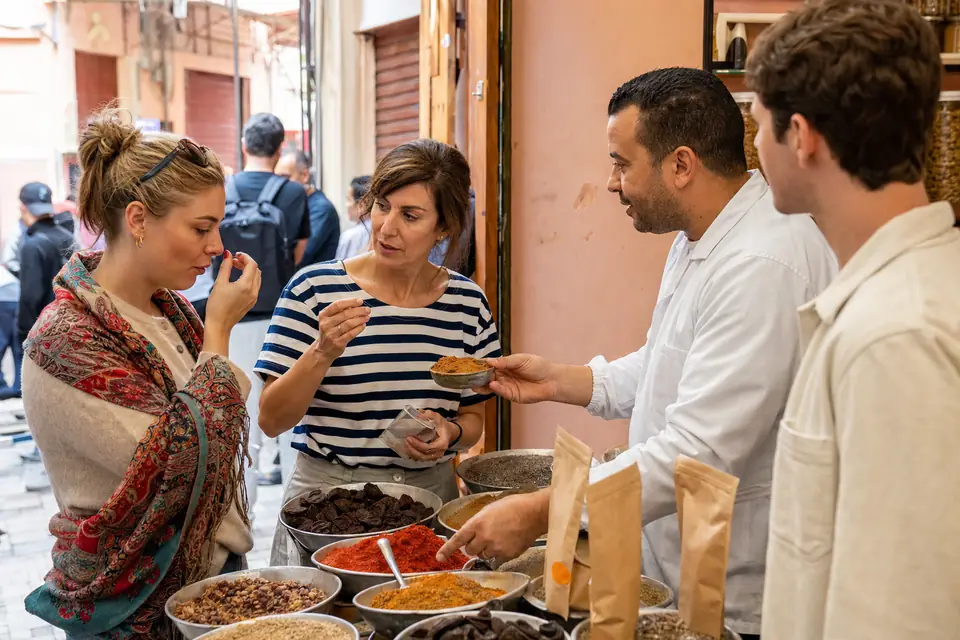
Souk Ableuh, tucked just off Jemaa el-Fnaa, is the olive souk — a short, intense lane of stalls banked with glistening pyramids of olives in every cure and colour, alongside barrels of preserved lemons and jars of harissa. It is one of the most photogenic and delicious corners of the Medina, and a masterclass in a single ingredient family.
Olives and preserved lemons are the acid-and-salt backbone of Moroccan food. Cracked green olives and the rind of salt-cured lemons are what give a chicken tagine its unmistakable tang; oil-cured black olives enrich salads and breads. Learning to taste and choose them — and understanding that the lemon's prized part is the rind, not the salty pulp — unlocks a huge amount of Moroccan flavour.
What you'll taste
- Cracked green olives — Firm, bright and slightly bitter — the classic tagine olive, rinsed of brine before cooking.
- Violet & pink olives — Semi-ripe olives with a mellow, buttery bite, often the middle ground on the pyramid.
- Oil-cured black olives — Wrinkled, intense and salty — for salads, breads and eating out of hand.
- Chilli & herb-marinated olives — Green olives tossed with harissa, garlic, preserved lemon and herbs — the souk's snacking olives.
- Preserved lemons — Whole lemons fermented in salt and their own juice; the soft, tangy rind is sliced into tagines and salads.
- Harissa — The fiery chilli paste sold alongside — a smear of heat for sandwiches, soups and grills.
The route
- 1
Enter Souk Ableuh
Step off Jemaa el-Fnaa into the olive lane — the pyramids of colour are unmissable and endlessly photogenic.
- 2
Green-olive tasting
Start with cracked green olives, the tagine classic; taste plain and chilli-marinated versions side by side.
- 3
Black & violet olives
Compare the mellow violet olives with the intense, oil-cured black ones for salads and eating.
- 4
Preserved-lemon barrel
Taste a sliver of preserved-lemon rind — soft, salty, intensely citrus — and learn why the rind, not the pulp, is used.
- 5
Harissa & pickles
A dab of harissa and the pickled chillies and vegetables that share the stalls.
- 6
Buy and pack
Choose a mix by weight; ask for preserved lemons in a sealed tub for the journey home.
When to go & what it costs
Late morning or afternoon works well; the olive souk is busy and fully stocked through the day and largely shaded. It sits right beside Jemaa el-Fnaa, so it pairs naturally with a square visit or the start of a wider Medina street-food walk.
Cost & cash: Olives and preserved lemons are sold by weight and inexpensive; taste before you buy.
Insider tips
- Taste widely before buying — sellers expect it, and cures vary a lot between stalls.
- For tagines, buy cracked green olives; rinse the brine before cooking so the dish is not too salty.
- With preserved lemons, the rind is the prize — discard the salty pulp when you cook.
- Chilli-and-herb marinated olives are the best for snacking straight away.
- Ask for preserved lemons in a sealed container for travel, and pack them in checked luggage.
Etiquette & how to eat like a local
- Tasting is welcome and expected, but buy something after grazing a stall.
- Do not dig into the pyramids or barrels with your fingers — let the seller offer a taste.
- A friendly haggle by weight is normal on olives.
- Ask before photographing the beautiful stalls and their keepers.
- Handle only what you intend to buy.
Frequently asked questions
What is Souk Ableuh?
Souk Ableuh is Marrakech's olive souk, a short lane just off Jemaa el-Fnaa lined with stalls of olives in every cure and colour, alongside barrels of preserved lemons, harissa and pickles. It is one of the Medina's most photogenic and delicious corners.
How are preserved lemons used in cooking?
The prized part is the soft, salty, intensely citrus rind, which is rinsed and sliced into chicken tagines, salads and dressings for a bright, funky tang. The salty pulp is usually discarded. A little goes a long way — it is one of the defining flavours of Moroccan cooking.
Which olives should I buy for a tagine?
Cracked green olives are the classic choice for chicken-and-preserved-lemon tagine. Rinse off the brine before cooking so the dish is not over-salted. Oil-cured black and marinated olives are better for salads, breads and snacking than for the braise.
Can I take olives and preserved lemons home?
Preserved lemons travel well in a sealed tub — pack them in checked luggage because of liquid limits. Olives can be bought vacuum-packed or in sealed containers; check your home country's rules on importing food and declare where required.
Cook what you tasted
Loved something on the walk? Take it home. Learn the dish hands-on with a Marrakech chef, or follow a free step-by-step recipe.