Savoury pastry & pies
Moroccan M'hanncha
M'hanncha means 'the snake', and it looks the part: a long rope of warqa pastry filled with cinnamon-and-orange-blossom almond paste, coiled into a spiral, baked until crisp and golden, then glazed with honey and dusted with sugar and almonds. It's one of Morocco's most beautiful sweets — a centrepiece pastry for celebrations and the tea table.
محنشة · mḥanncha
- Origin
- Across Morocco (Andalusi roots)
- Type
- Coiled almond pastry
- Eaten at
- Celebrations, tea time, guests
- Key flavour
- Almond, cinnamon, orange blossom
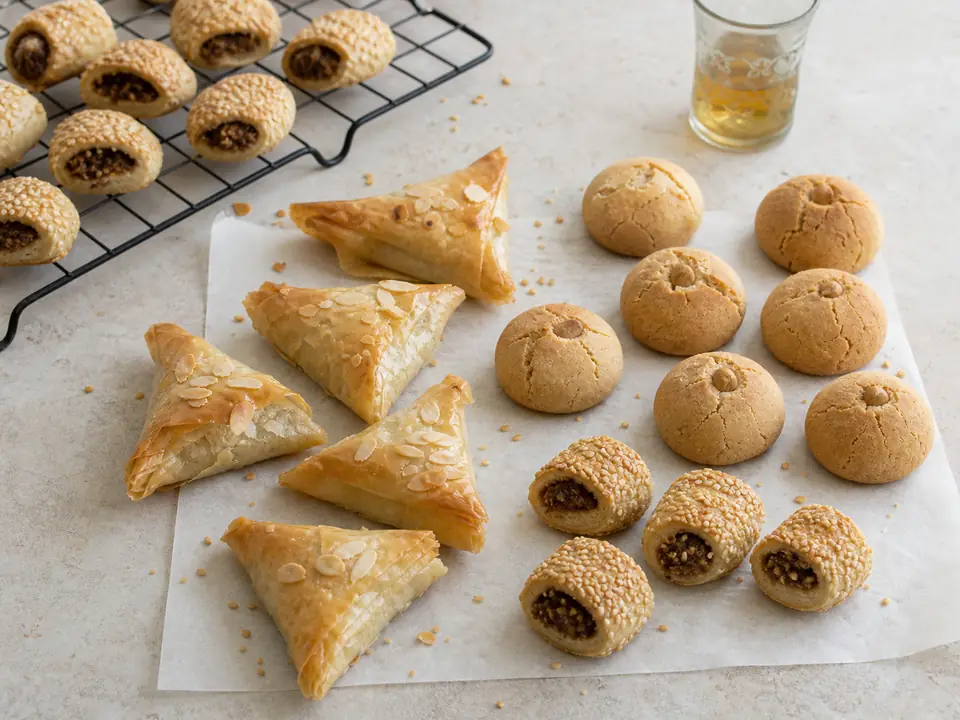
What M'hanncha is
M'hanncha is built by spreading a rope of almond paste along strips of fine warqa pastry, rolling them into a long filled cylinder, and then winding that into a flat spiral — the coil that gives it its snake name. It's baked until the pastry is deep gold and crisp, then brushed with honey and finished with icing sugar, cinnamon and chopped almonds.
The filling is a fragrant almond paste — ground almonds bound with sugar, butter, cinnamon and orange blossom water, sometimes with a hint of mastic or lemon. The contrast of crackling pastry against soft, perfumed almond within is the whole appeal.
Origin & story
Like pastilla, m'hanncha carries the Andalusian inheritance of almonds, orange-flower water and thin pastry that shaped Moroccan sweet-making. It's a celebration and hospitality sweet — served to guests, at weddings, at Eid and across the tea table — where its dramatic coiled form makes it a natural centrepiece.
It's the kind of pastry a household makes to impress, and it keeps well, so it's often prepared ahead for a gathering. Its beauty and its almond richness put it among the most prized of Moroccan sweets.
Key ingredients at a glance
- Warqa or filo pastry strips
- Ground almonds and sugar for the paste
- Butter and cinnamon
- Orange blossom water
- Honey to glaze
- Icing sugar and chopped almonds to finish
This is a flavour snapshot, not a recipe.
When & how it's eaten
M'hanncha is served as a sweet, cut into wedges or slices from the coil, most often with mint tea in the afternoon or at the end of a celebration meal. It's a sharing centrepiece — set out whole so guests can admire the spiral before it's cut — and eaten by hand or fork.
Because it's rich with almond and honey, portions are modest. It's a fixture of the pastry platter at weddings and Eid, alongside kaab el ghazal and chebakia.
Regional variations
The main variations are size (individual small coils versus one large one) and the finish — some are heavily honeyed, others lightly sugared. Fillings sometimes swap in a little pistachio, dates or a different flower water. The almond-paste core, though, stays constant.
It belongs to the almond-pastry family with kaab el ghazal, and shares warqa technique with briouat and pastilla.
Where to try it in Marrakech
M'hanncha is found at good pastry shops and on the sweet trays of traditional restaurants and celebrations — a sweets and pastry crawl is the surest way to taste a well-made one and compare makers. It's often boxed as a gift, too.
To make the coil yourself, a Moroccan pastry class or a dessert class teaches the warqa-and-almond method. Serve it with Moroccan mint tea and explore the pastry world in the guides.
Frequently asked questions
What does m'hanncha mean?
'The snake' — named for its coiled, spiral shape. A rope of almond-paste-filled pastry is wound into a flat coil, baked crisp and glazed with honey.
What is m'hanncha filled with?
A fragrant almond paste of ground almonds, sugar, butter, cinnamon and orange blossom water, wrapped in fine warqa pastry and finished with honey and sugar.
When is m'hanncha served?
As a celebration and tea-time sweet — at weddings, Eid and to honour guests — usually with mint tea. Its dramatic coiled shape makes it a natural centrepiece.