Sweets · Medina & Gueliz
Moroccan Sweets & Pastry Crawl
Moroccan pastry is a world unto itself — almond, honey, sesame and orange-blossom worked into gazelle horns, chebakia, briouat and ghriba, sold from glass cases in the souks and from smart Gueliz patisseries alike. This crawl is a guided sugar rush through the classics: what each pastry is, when Moroccans eat them (tea time, weddings, Ramadan), and how to tell handmade from factory-made. Bring a sweet tooth and a box to fill.
- Duration
- 2 hours
- Best time
- Afternoon tea time
- Pace
- Easy walking
- Area
- Medina & Gueliz
Overview
Moroccan sweets are built on a small set of ingredients — almonds, honey, sesame, orange-blossom and rosewater, semolina and dates — endlessly recombined. They are tied to hospitality and occasion: a plate of pastries always accompanies mint tea for guests, and specific sweets belong to Ramadan, weddings and religious feasts.
A crawl teaches you to read a pastry case. You learn which are almond-paste luxuries and which are honey-soaked everyday treats, how chebakia is folded and fried for Ramadan, and how to spot the handmade article — irregular, fragrant, freshly made — from the uniform factory version. You taste a range small, so you can find your favourites before buying a box.
What you'll taste
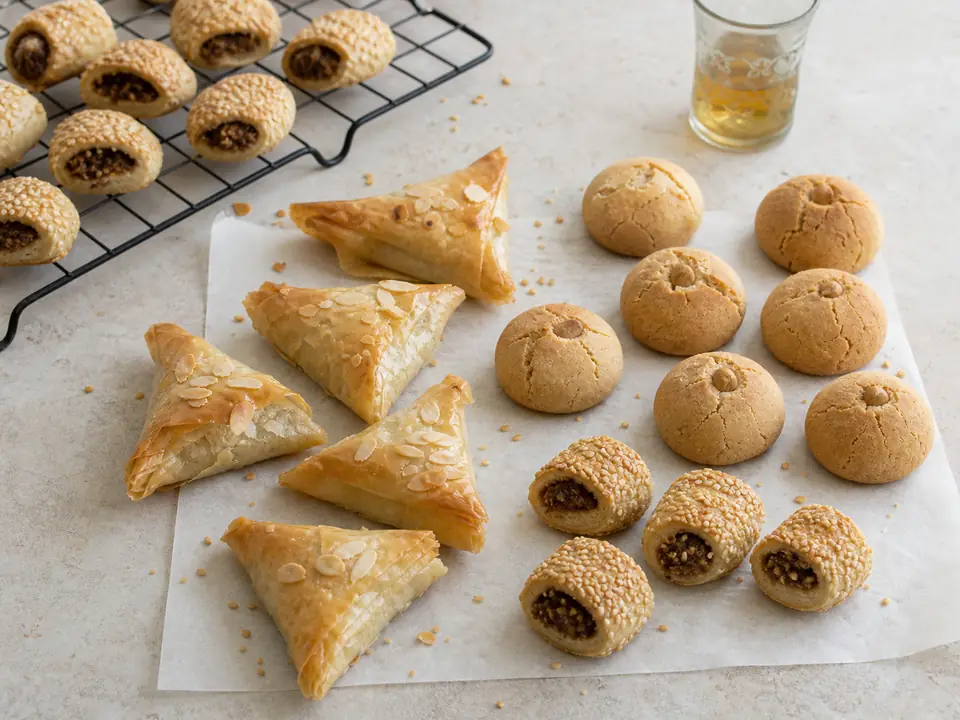
- Kaab el ghzal — 'Gazelle horns' — crescents of thin pastry packed with orange-blossom almond paste, the queen of Moroccan sweets.
- Chebakia — Sesame-coated, flower-shaped dough deep-fried and drenched in honey — the essential Ramadan sweet, eaten with harira.
- Briouat — Little triangular or cigar pastries of almond or peanut in crisp warqa, fried and dipped in honey.
- Ghriba — Crumbly, cracked-top shortbread-style cookies — almond, coconut or semolina, the classic tea-time biscuit.
- Fekkas — Twice-baked, biscotti-like slices studded with almonds, anise and sesame, made for dunking in tea.
- Sellou / sfouf — A rich, unbaked blend of toasted flour, almonds, sesame and honey — energy-dense, eaten at Ramadan and celebrations.
The route
- 1
A souk pastry case
Start at a Medina sweet shop's glass counter to learn the classics side by side — point, ask, taste one of each.
- 2
Almond-paste specialist
Find a maker known for kaab el ghzal to taste the benchmark almond-and-orange-blossom filling.
- 3
Honey-fried sweets
Chebakia and briouat, ideally fresh — see how they are folded, fried and bathed in honey.
- 4
Tea-time biscuits
Ghriba and fekkas, the dunking cookies, bought by weight for a mixed bag.
- 5
Mint tea pairing
Sit for a glass of sweet mint tea — pastries are designed to be eaten with it, not alone.
- 6
Gueliz patisserie (optional)
Cross to a modern patisserie for a French-Moroccan take — same flavours, refined technique.
When to go & what it costs
Afternoon tea time is the natural moment — Moroccans take pastries with mint tea in the late afternoon, and shops are freshly stocked. Ramadan is the pastry high season, when chebakia and sellou appear everywhere for breaking the fast, though daytime shops keep shorter hours in the fasting month.
Cost & cash: Pastries are sold by weight; a mixed box is inexpensive in the souks, more at smart patisseries.
Insider tips
- Buy a mixed box by weight so you can taste widely before deciding on favourites.
- Handmade kaab el ghzal is fragrant and slightly irregular; uniform, scentless ones are factory-made.
- Chebakia is at its best fresh and just-honeyed — a little sticky, never hard.
- Pastries are made to be eaten with sweet mint tea; the pairing is the point.
- Sweets travel well as gifts — ask for a sturdy box and eat the most delicate ones first.
Etiquette & how to eat like a local
- When offered pastries and tea as a guest, accept at least one — refusing outright can seem cold.
- Take with the right hand from a shared plate.
- Tasting one before buying a box is normal at sweet shops; buy something after.
- Ramadan daytime: be discreet about eating in public out of respect for those fasting.
- Ask before photographing behind the counter.
Frequently asked questions
What is the most famous Moroccan pastry?
Kaab el ghzal, or 'gazelle horns' — delicate crescents filled with orange-blossom-scented almond paste. It is the benchmark Moroccan sweet, served for guests, weddings and special occasions alongside mint tea.
What sweets do Moroccans eat during Ramadan?
Chebakia — sesame-coated, honey-drenched fried dough — is the signature Ramadan sweet, eaten with harira soup to break the fast. Sellou (a rich toasted-flour, almond and honey blend) and briouat are also Ramadan staples for their energy and keeping quality.
How do I tell handmade pastries from factory ones?
Handmade sweets are slightly irregular, freshly fragrant and made in smaller batches — kaab el ghzal should smell of orange blossom and almond. Uniform, scentless, long-shelf-life versions are factory-made. Ask the shop and buy where locals buy.
Do Moroccan pastries travel well as souvenirs?
Many do — ghriba, fekkas and briouat keep for days and pack well in a sturdy box. The more delicate kaab el ghzal is best eaten sooner. Ask for a proper box and cushion the fragile ones for the journey.
Cook what you tasted
Loved something on the walk? Take it home. Learn the dish hands-on with a Marrakech chef, or follow a free step-by-step recipe.