Night tour · Jemaa el-Fnaa
Jemaa el-Fnaa Night Food Tour
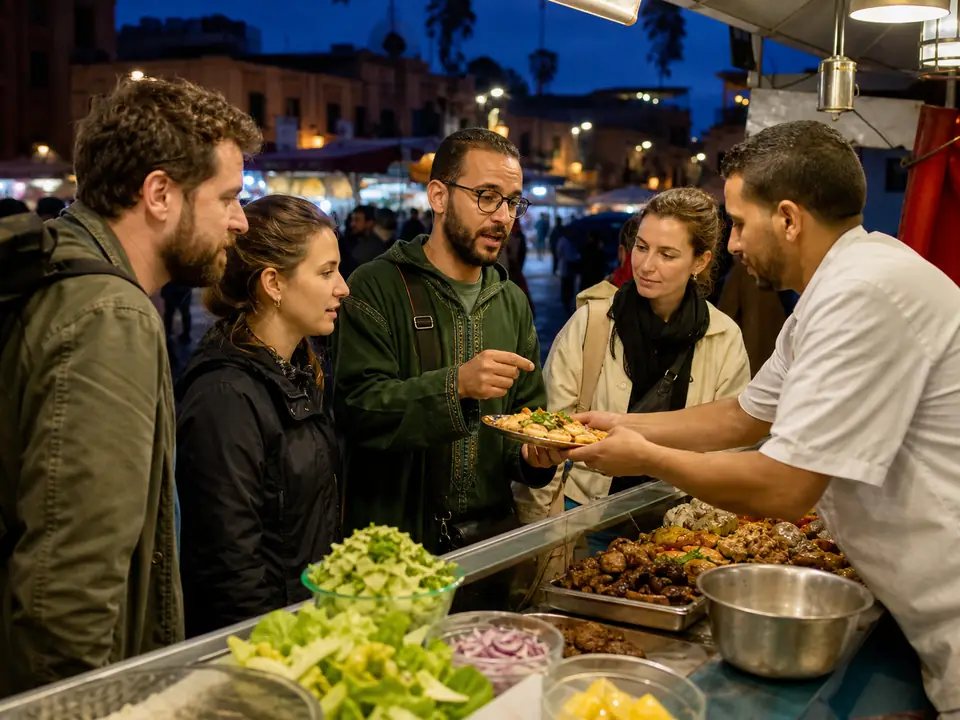
At dusk the great square empties of snake charmers and fills with food: rows of numbered stalls throw up canopies, fire up grills, and turn Jemaa el-Fnaa into one enormous open-air canteen under strings of bare bulbs and clouds of aromatic smoke. This tour is about navigating that chaos with confidence — knowing what to order at which cart, from grilled brochettes and merguez to sheep's-head, snail broth and the fried-fish stalls, and finishing with the square's famous orange juice.
- Duration
- 2–3 hours
- Best time
- After sunset, from ~7pm
- Pace
- Standing and short walks, dense crowds
- Area
- Jemaa el-Fnaa
Overview
Jemaa el-Fnaa is a UNESCO-listed square precisely because of this nightly transformation. The food stalls are numbered, semi-permanent operations that appear as the sun drops and are packed away before dawn. Touts will call you over hard — that is theatre, not a threat — and the trick is to slow down, walk a full lap first, and choose by what is busy with locals rather than who shouts loudest.
Order in small rounds across several stalls rather than committing to one big plate at the first canopy that grabs you. Grilled meats at one, a bowl of snails at another, a fried-fish plate at a third, then juice to finish. Confirm the price of each item as you order so the bill matches the food.
What you'll taste
- Brochettes — Skewers of lamb, beef, chicken and kefta (spiced mince) grilled over charcoal, served with bread and cumin-salt.
- Merguez — Fiery little lamb-and-beef sausages seasoned with harissa and spices, blistered on the grill.
- Babbouche — Snails simmered in a peppery, aniseed-and-thyme broth, eaten with a pin and the broth drunk from the bowl — a local cure-all.
- Fried fish — Whitebait, calamari and small fish floured and flash-fried, served by the plate with a wedge of lemon.
- Tête de mouton — Steamed sheep's head, pulled and salted with cumin — the adventurous local delicacy, sold by the piece.
- Khoubz & harira — Bread and a warming bowl of harira soup round out the plate for a few dirhams.
- Fresh orange juice — Pressed to order at the ring of numbered juice carts that circle the square — the classic finish.
The route
- 1
Walk the perimeter first
Do one slow lap of the stall rows before you commit — note which canopies the local families are crowded around.
- 2
Grill row
Start with brochettes and merguez while the grills are hottest; ask for a mixed plate with bread and cumin.
- 3
Snail cart
Find a babbouche vendor with a steaming cauldron; order a small bowl, use the pin, and drink the broth.
- 4
Fried-fish stall
A plate of mixed fried fish and squid with lemon — light and moreish between the heavier grills.
- 5
Sheep's-head stand
For the curious, a small portion of tête de mouton with cumin salt — a genuinely local, not touristy, order.
- 6
Juice ring
Close at the orange-juice carts on the square's edge; watch it pressed fresh and confirm the price first.
When to go & what it costs
Arrive around sunset to watch the square change over, then eat from about 7pm as the grills hit temperature. It runs late into the night, but the food is freshest in the first couple of hours before the busiest crush. Ramadan shifts everything after the evening iftar. Avoid the very peak of the crowd if you dislike crowds — an hour after sunset is lively but navigable.
Cost & cash: Stalls are inexpensive but do add up if you order broadly; agree what you want before it is cooked and pay in cash.
Insider tips
- Always confirm the price of each dish before it is cooked; agree the plate, not a vague order.
- Order in small rounds across stalls rather than one giant plate — variety is the point.
- Bread and extra sides sometimes land on your table uninvited; you can wave them away or accept and pay.
- Keep valuables zipped and close in the crush; it is safe but very crowded.
- The snail broth is genuinely soothing for a scratchy throat — locals swear by it.
Etiquette & how to eat like a local
- Touts calling you over is normal banter — a polite 'la, shukran' (no, thanks) is all you need.
- Sit at the communal benches shoulder to shoulder; it is meant to be sociable.
- Tip modestly if a stall has been generous — it is appreciated but not expected.
- Photograph the food and stalls freely, but ask before close-ups of cooks or diners.
- Pay attention to the numbered stall you are at so you settle the right bill.
Frequently asked questions
Are the Jemaa el-Fnaa food stalls a tourist trap?
Some of the flashiest, hardest-selling stalls cater to tourists, but plenty are packed with locals every night. Walk a lap, pick the busy ones with Moroccan families eating, confirm prices before ordering, and you will eat well and cheaply.
What should I order first at the night stalls?
Start with the charcoal grills — brochettes and merguez — while they are hottest, then branch into snails, fried fish and, if you are game, sheep's head. Finish at the orange-juice carts on the edge of the square.
Is it safe for solo travellers and women?
Jemaa el-Fnaa at night is busy, well-lit and heavily frequented by families, which makes it one of the more comfortable places to eat alone. Keep bags zipped in the crowd and confirm prices as you order, the same as anyone should.
What time do the food stalls open and close?
They set up around sunset and serve into the late evening, typically until around midnight. The food is freshest in the first couple of hours. During Ramadan the timing shifts to after the iftar meal.
Cook what you tasted
Loved something on the walk? Take it home. Learn the dish hands-on with a Marrakech chef, or follow a free step-by-step recipe.