Weekly rituals
Friday Couscous: The Weekly Gathering
There is one meal you can set your calendar by in Morocco. Every Friday, at midday, in homes and cook-shops from the Rif to the Sahara, a great mound of hand-steamed couscous crowned with vegetables and meat appears on the table. It is the most reliable rhythm in Moroccan food — a weekly gathering that binds faith, family and generosity into a single shared platter.
- When
- Every Friday, at midday
- After
- Jumu'ah (congregational prayer)
- The dish
- Seven-vegetable couscous
- The spirit
- Family & charity
At a glance
- Friday is Islam's day of communal prayer; couscous is the family meal that follows it.
- The standard Friday dish is seven-vegetable couscous, hand-steamed three times.
- It feeds many from one pot and carries a strong tradition of sharing with the poor.
- Friday is the easiest day to find couscous made the slow, traditional way.
Why Friday
Friday, al-jumu'a, is the holiest day of the week in Islam, built around the midday congregational prayer at the mosque. Men traditionally attend Jumu'ah prayer, and the extended family gathers afterward for the week's most important shared meal. Over generations, couscous — a dish that feeds a crowd from a single pot and only gets better for being made slowly — became the fixed centrepiece of that gathering.
There is a charitable thread running through it too. Friday is associated with generosity, and in many communities extra couscous is cooked to share with relatives, neighbours and those in need; in some places it was distributed near the mosque after prayers. The weekly couscous is, quietly, an act of community as much as a meal. We explore the tradition in depth in our Friday couscous guide.
What lands on the table
The Friday standard is couscous aux sept légumes — seven-vegetable couscous. A fluffy mountain of steamed semolina is crowned with vegetables simmered in a golden, saffron-and-ginger-tinted broth: usually carrots, turnips, courgettes, pumpkin, cabbage, tomatoes and chickpeas, with a piece of lamb, beef or chicken hidden beneath. The 'seven' is more a symbol of abundance and blessing than a fixed count — cooks use whatever the season provides.
The broth is ladled over the mound at the table and passed around, and a small dish of the fiery harissa or a spoon of sweet, cinnamon-spiced tfaya onions may go alongside. Follow the full method in our seven-vegetable couscous recipe, and see how it contrasts with Morocco's other icon in couscous vs tagine.
- Seven-vegetable couscous: the Friday standard, with a saffron-ginger broth.
- Tfaya: sweet caramelised onions and raisins, often over chicken couscous.
- Harissa & broth: served on the side to spoon over to taste.
- L'ben: tangy buttermilk, drunk alongside couscous in many homes.
The technique that makes it sacred
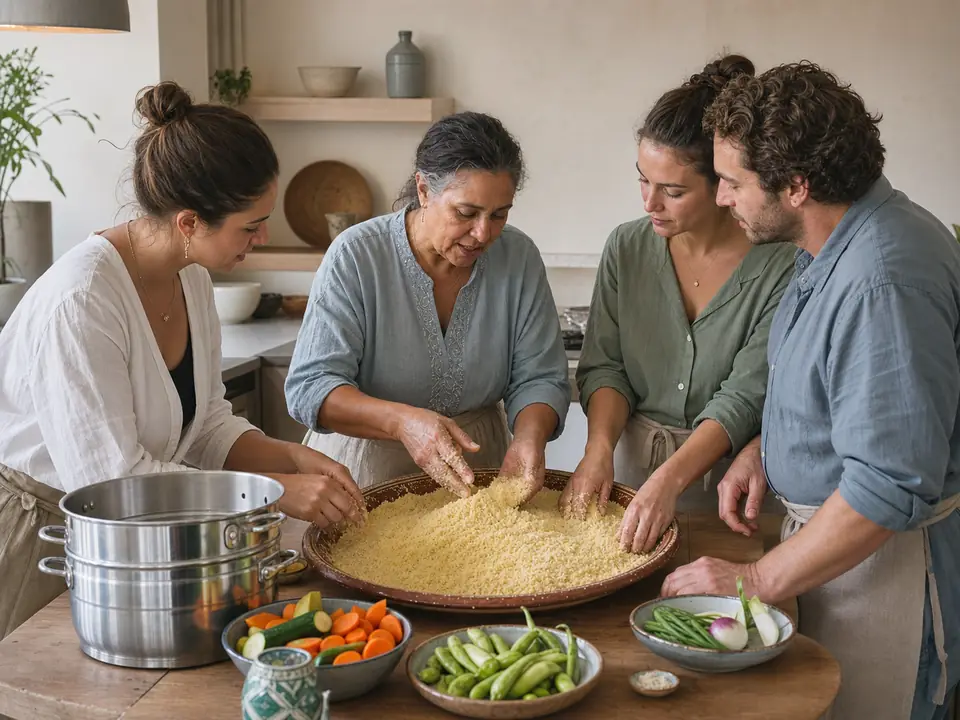
Real couscous is not boiled — it is steamed, again and again, over the simmering stew in a two-part pot called a couscoussier. The grain is moistened, rubbed between the hands to separate, steamed, tipped out, raked, sprinkled with water and steamed again, usually three times in all. Each cycle hydrates the semolina gradually so the finished grains are light, separate and airy rather than a heavy clump. It is slow, tactile work, and someone in the household spends the Friday morning doing it.
That labour is part of the meaning. The instant, just-add-water couscous sold abroad is a genuinely different food; the Friday version is a gift of time. Because so many homes and cook-shops make it the traditional way specifically on Fridays, it is by far the best day for a visitor to eat couscous as it is meant to be — a good reason to time a food tour or cooking class for a Friday.
How it is shared
Couscous arrives as one great communal platter set in the middle of the table. Traditionally it is eaten by hand from the section directly in front of you: you gather a little, roll it into a neat ball with the fingers of the right hand, and pop it in — a skill that takes practice and that Moroccan children learn young. Many households now offer spoons, especially to guests, and the meat and vegetables in the centre are shared out by the host toward each diner.
As with every Moroccan meal, the etiquette of the shared plate applies — eat from your wedge, use your right hand, leave the centre for others; our etiquette guide has the details. And, as always, sweet mint tea closes the meal. For how the whole weekly and daily rhythm fits together, see Moroccan breakfast customs and the wider occasions collection.
The dishes of the occasion
The specific plates that belong to this moment in the Moroccan calendar.
Frequently asked questions
Why do Moroccans eat couscous every Friday?
Friday is the Muslim day of communal prayer (Jumu'ah), and couscous is the traditional family meal eaten afterward. It feeds many from one pot, carries a spirit of sharing and charity, and has become the fixed centrepiece of the week's most important gathering.
What makes it seven-vegetable couscous?
The Friday classic is crowned with an abundant mix of vegetables — commonly carrots, turnips, courgettes, pumpkin, cabbage, tomatoes and chickpeas. The 'seven' symbolises abundance and blessing rather than being a strict count, so cooks use whatever is in season.
Is Friday the best day to eat couscous in Morocco?
Yes. Because tradition ties couscous to Friday, many homes, cook-shops and restaurants make it the slow, hand-steamed way specifically on that day. On other days good couscous can be harder to find made properly, so time your visit for a Friday if you can.
How is couscous traditionally eaten?
From one shared platter, by hand, using the right hand to gather and roll a small amount into a ball before eating it. You eat from the section in front of you, and the host shares out the meat and vegetables from the centre. Many households now also provide spoons for guests.