Ramadan & holy days
Eid al-Fitr Foods in Morocco
After thirty days of fasting, you might expect Morocco to mark the end of Ramadan with a great savoury blowout. Instead, Eid al-Fitr — Eid es-Seghir, 'the small feast' — opens with sweetness: a breakfast table of honeyed griddle breads, almond-rich sellou and buttery cookies, taken with glass after glass of mint tea as the family moves from house to house. It is one of the gentlest, most generous mornings of the Moroccan year.
- When
- 1 Shawwal — the day after Ramadan
- Also called
- Eid es-Seghir (the small feast)
- Style
- A sweet morning of visiting
- Centrepiece
- Sellou, cookies & mint tea
At a glance
- Eid al-Fitr is 'the small feast', marking the first day one eats after Ramadan.
- The day opens with a sweet breakfast, not a savoury one — sellou, msemen, baghrir and cookies.
- Honeyed and almond cookies (kaab el ghazal, ghriba, fekkas) are baked in advance for visitors.
- It is a day of visiting; every home offers sweets and mint tea to arriving guests.
The small feast that ends the fast
Eid al-Fitr falls on the first day of Shawwal, the month after Ramadan, and marks the breaking of the long fast. Moroccans call it Eid es-Seghir, 'the small feast', to distinguish it from the larger Eid al-Adha later in the year. The day begins early with a communal Eid prayer, new or best clothes, and the giving of zakat al-fitr, a charitable donation traditionally made so that everyone, however poor, can share in the celebration.
Then the eating begins — and it begins, tellingly, with sweetness. After a month in which the first food each day was a date, the first proper breakfast of Eid is a celebration of everything the fasting body missed: butter, honey, almonds, warm bread and sweet tea, taken slowly and at leisure with the whole family awake and together.
The sweet Eid breakfast
The Eid morning table is a spread of the folded and griddle breads eaten with honey and butter, alongside the dense almond-and-sesame sellou, and a bakery's worth of home-made cookies. Baghrir — the spongy 'thousand-hole' semolina pancake — soaks up a warm butter-and-honey syrup; msemen and meloui are torn and dipped; and in many homes fresh sfenj, the ring-shaped Moroccan doughnuts, are fried and dusted with sugar for the children.
Mint tea flows without pause, poured from a height into small glasses, and the sweetness is the point: it is the joyful opposite of the disciplined month just finished. Make the centrepieces yourself with our msemen recipe, sfenj recipe and mint tea recipe.
- Sellou (sfouf): toasted flour, almonds, sesame and honey, pressed into a rich mound.
- Baghrir: honeycomb semolina pancakes drenched in honey and butter.
- Msemen & meloui: folded and coiled griddle breads with honey.
- Sfenj: airy fried doughnuts, a treat for the children.
- Mint tea: poured continuously, the thread that runs through the morning.
The cookie tins come out
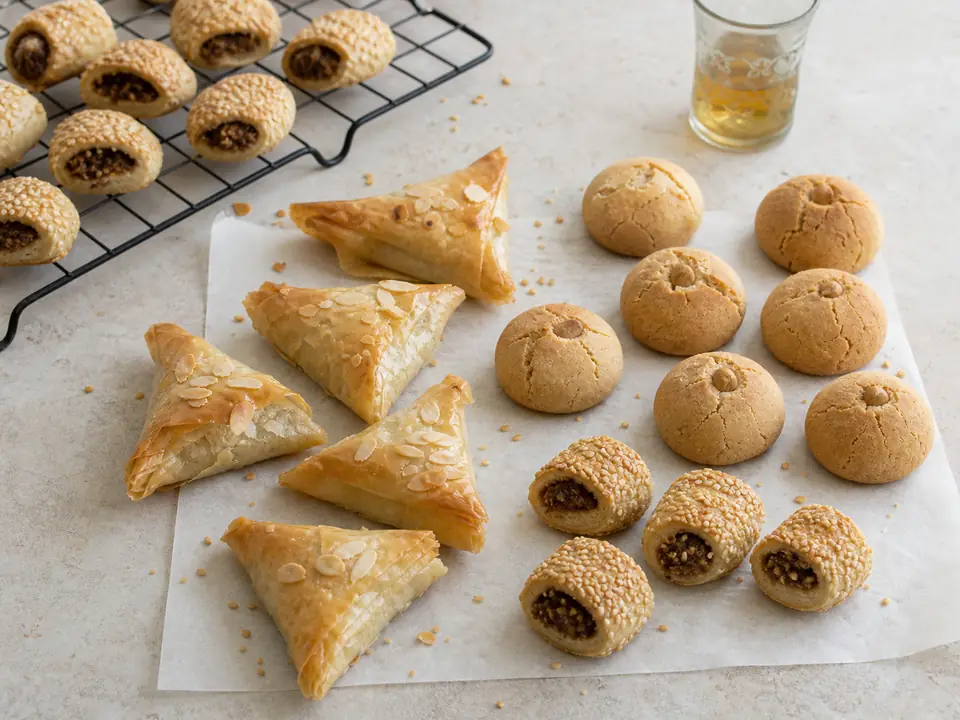
No Moroccan Eid is complete without the boxes and tiered plates of home-baked cookies (halwa) prepared in the final days of Ramadan specifically for the visitors who will arrive. These are the jewels of the Moroccan sweet kitchen, almond-heavy and delicately perfumed with orange-blossom water and cinnamon.
The classics recur in every home: kaab el ghazal ('gazelle horns'), crescents of thin pastry packed with almond paste and orange-blossom; ghriba, crumbly cookies of almond, coconut or semolina; fekkas, twice-baked slices studded with almonds and raisins; and briouat bil louz, honey-dipped almond triangles. See the full range in our Moroccan pastries guide and desserts and sweets guide.
Visiting, and the meal that follows
Eid al-Fitr is above all a day of family and neighbourly visiting. People call on parents, grandparents, relatives and friends in turn, and at every stop the same ritual repeats: sit, take sweets, drink tea, exchange the greeting 'Eid Mubarak', and move on. Children receive small gifts or money. The generosity is relentless and lovely, and by mid-morning most people have eaten sweets in three or four houses.
Later in the day the cooking turns savoury for a family lunch — often a chicken tagine with preserved lemon and olives, a couscous, or another celebratory dish, since it is, after all, the first proper daytime meal in a month. It is a smaller, homelier feast than the great meat-centred Eid al-Adha; the joy of Eid al-Fitr is in the sweetness and the company. Read how the larger sacrifice feast differs in our Eid al-Adha and mechoui piece.
The dishes of the occasion
The specific plates that belong to this moment in the Moroccan calendar.
Frequently asked questions
Why is Eid al-Fitr breakfast sweet rather than savoury?
After a month of fasting, Moroccans celebrate with the foods the disciplined body missed — honey, butter, almonds and sugar. The sweet breakfast of sellou, griddle breads, cookies and mint tea is a joyful contrast to Ramadan, and its abundance welcomes the stream of visitors the day brings.
What is sellou?
Sellou (also called sfouf or zmita) is a dense, unbaked Moroccan sweet made from toasted flour, ground and fried almonds, toasted sesame, butter or oil, honey and warm spices. It is energy-rich and keeps well, which is why it is made for both Ramadan suhoor and the Eid al-Fitr table.
What cookies are served at Moroccan Eid?
The classics are kaab el ghazal (almond-filled 'gazelle horns'), ghriba (crumbly almond, coconut or semolina cookies), fekkas (twice-baked almond-and-raisin slices) and briouat bil louz (honey-dipped almond triangles). They are baked in the last days of Ramadan for the visitors who arrive on Eid.
What is the difference between Eid al-Fitr and Eid al-Adha?
Eid al-Fitr ('the small feast') ends Ramadan and centres on sweets, visiting and a homely family lunch. Eid al-Adha ('the great feast') comes about two months later, commemorates Abraham's sacrifice, and centres on the ritual slaughter of a sheep and days of meat-focused cooking.