Main dish
Moroccan Tagine
The tagine is Morocco's most recognisable dish — and also its cooking vessel. The word refers both to the shallow clay pot with a tall conical lid and to the slow-braised stew of meat, vegetables, fruit and spices cooked inside it. The cone traps rising steam and returns it to the food, so a tagine braises in its own juices with almost no added liquid. The result is intensely flavoured, fall-apart tender, and aromatic in a way no other cooking method quite achieves.
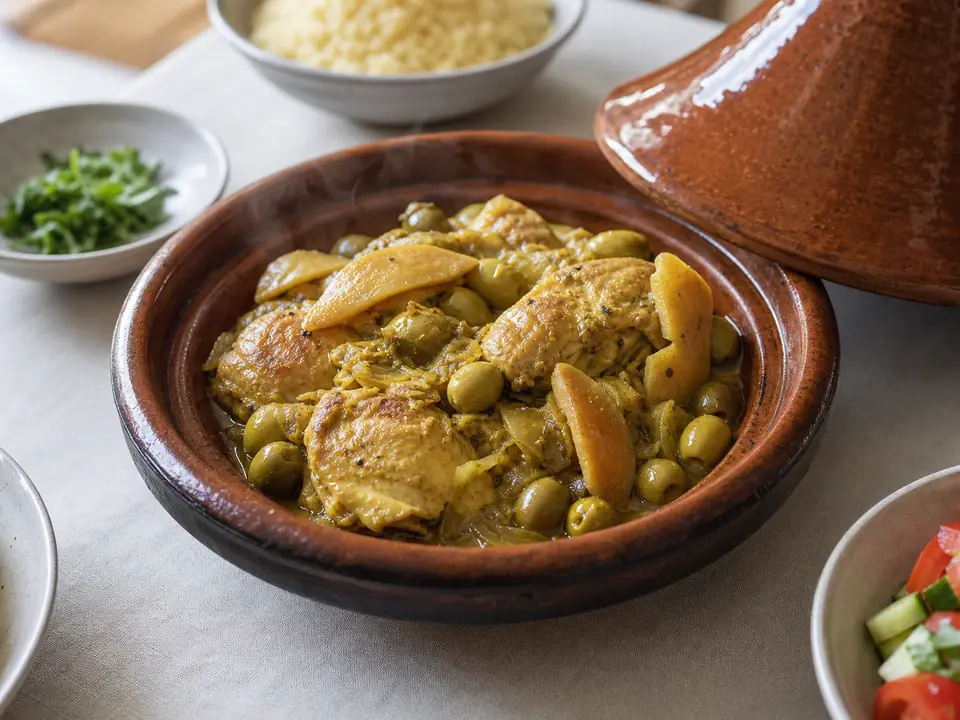
Every region of Morocco has its own tagine tradition. Coastal cities favour fish tagines with chermoula; the interior mountains lean on lamb with prunes and almonds; Marrakech is famous for chicken with preserved lemon and olives. A tagine can be a simple weeknight supper or the centrepiece of a celebratory meal — the principle stays the same: low heat, patience, and good clay.
For travellers, tagine is usually the first Moroccan dish encountered and the last one forgotten. Understanding what makes a great tagine — the balance of sweet and savoury, the quality of the clay, the slow cooking — is the key to understanding Moroccan food itself.
Varieties of Tagine
Chicken tagine with preserved lemon and olives
Region: Marrakech / Fes
The most famous Moroccan tagine. Bone-in chicken braised with cracked green olives, wedges of preserved lemon, saffron, ginger and fresh coriander. The sauce is golden, tart and intensely savoury.
Lamb tagine with prunes and almonds
Region: Marrakech / Middle Atlas
Sweet-savoury lamb shoulder slow-cooked with onion, cinnamon, honey, pitted prunes and toasted almonds. The sauce caramelises and darkens. Often dusted with sesame seeds.
Kefta tagine with eggs
Region: Nationwide
Hand-rolled meatballs of spiced minced beef or lamb simmered in a cumin-heavy tomato sauce. Eggs are cracked on top to poach in the last few minutes. Served with bread for scooping.
Fish tagine (Hout tagine)
Region: Essaouira / Atlantic coast
Firm white fish — often monkfish, sea bass or John Dory — baked on a bed of sliced potatoes, tomatoes, peppers and olives with a chermoula marinade of coriander, cumin, garlic and paprika.
Vegetable tagine
Region: Nationwide
A seasonal mix of root vegetables — carrot, turnip, courgette, potato — braised with chickpeas, saffron and ras el hanout. Lighter, sweeter and naturally vegan.
Lamb tagine with artichokes and peas
Region: Fes / Meknes
A spring tagine: tender lamb stewed with baby artichoke hearts, fresh green peas and a generous handful of fresh herbs. Lighter and greener than the prune version.
Beef tagine with quince
Region: Middle Atlas / Fes
Autumn speciality pairing slow-braised beef with halved quince that softens and caramelises into the sauce. The quince adds a floral, honeyed sweetness.
How to eat tagine
A tagine arrives at the table in its cooking pot, lid still on. The host lifts the cone to release a cloud of aromatic steam — this is part of the ritual. Everyone eats from the communal pot using pieces of khobz (bread) to pinch and scoop. You eat from your own section, nearest to you, working inward. The bread is your utensil; forks are optional. The concentrated sauce at the bottom is the prize — mop it up with bread.
Where to try it in Marrakech
In Marrakech, every restaurant and riad serves tagine, but quality varies wildly. The best tagines are usually found in home-style settings: small riad restaurants in the medina, family-run dars, and home-cook experiences. Avoid tourist-strip restaurants along Jemaa el-Fnaa where tagines are often pre-cooked and reheated. The derbs (alleyways) of the Mouassine and Bab Doukkala quarters have excellent neighbourhood tagine spots. For hands-on experience, Marrakech cooking classes teach you to build a tagine from scratch in a traditional clay pot.
How tagine is made
A traditional tagine is built in layers. Sliced onions line the bottom. Marinated meat goes on top. Vegetables, fruit and olives are arranged around and over the meat. A splash of water or stock, a drizzle of olive oil, and the cone goes on. The pot sits over very low charcoal — or the gentlest gas flame — for one to two hours. The key is patience: the lid stays on, the heat stays low, and the steam does the work. Modern Moroccan cooks use a diffuser plate on a gas stove; rural cooks still use a majmar (clay brazier) fuelled with charcoal. The clay must be seasoned before first use by soaking in water overnight.
History and origin
The tagine pot has Berber (Amazigh) origins and is at least a thousand years old. The conical lid design is an elegant solution to cooking with minimal water in arid climates — every drop of moisture recycles. The sweet-savoury combinations (meat with fruit, honey with spice) reflect centuries of Arab, Andalusian and Amazigh culinary cross-pollination. The Moors brought refined spice blends and the taste for dried fruit from Al-Andalus; the Amazigh contributed the clay-pot technique and the mountain herbs. By the medieval period, the tagine was the defining vessel of Moroccan cooking and remains so today.
Insider tips
- Ask for a 'tagine beldi' (traditional/country-style) — this means cooked in clay on charcoal, not a stainless-steel pot.
- If ordering in a restaurant, expect 30-45 minutes minimum. A genuine tagine is cooked to order, not reheated.
- Chicken tagine with preserved lemon is the best first tagine for newcomers — balanced, not too rich, universally well-made.
- In a riad, tagine is often the highlight of the dinner menu. Book a table and ask the cook what they recommend that day.
- If buying a tagine pot to take home, choose unglazed clay from Safi or Salé — the glazed decorative ones are for serving, not cooking.
- Pair tagine with Moroccan mint tea or a glass of Moroccan grey wine for an authentic combination.
Related recipes
Frequently asked questions
Is tagine spicy hot?
No. Moroccan tagines are warmly spiced — saffron, ginger, cinnamon, cumin — but almost never chilli-hot. The heat level is gentle; the flavour complexity is high. If you are sensitive to spice, tagine is one of the safest choices.
What is the difference between a tagine pot and a Dutch oven?
Both are slow-braising vessels, but a tagine's conical lid condenses steam and returns it more efficiently, cooking with far less liquid. A Dutch oven uses a flat lid and retains moisture through a tight seal. The tagine's clay also imparts a subtle earthy flavour.
Can you cook a tagine without a tagine pot?
Yes. A heavy casserole or Dutch oven with a tight lid works as a substitute. The flavour will be very close, though you lose the visual theatre and the slight clay-earth note. Many Moroccan restaurants use stainless-steel pots for volume and transfer to clay for serving.
How long does a tagine take to cook?
Between 1 and 2.5 hours over low heat. Chicken tagines are fastest (about 1 hour). Lamb shoulder or beef need 2 or more hours. The key is very low, gentle heat — never a rapid boil.
What sides go with tagine?
Khobz (bread) is essential — it is your utensil. Cooked salads (zaalouk, taktouka) are common starters. A simple green salad with orange and olives, or a bowl of olives, might sit alongside. Tagine is almost never served with couscous — that is a separate meal.