Main dish
Moroccan Merguez
Merguez is the fiery red sausage of North Africa — a thin, uncured lamb or beef sausage heavily spiced with harissa, cumin, coriander and paprika. Unlike European sausages, merguez contains no pork and little filler, making it intensely meaty and spicy. It is grilled over charcoal until the casing blisters and splits, releasing a rush of smoky, spiced fat.
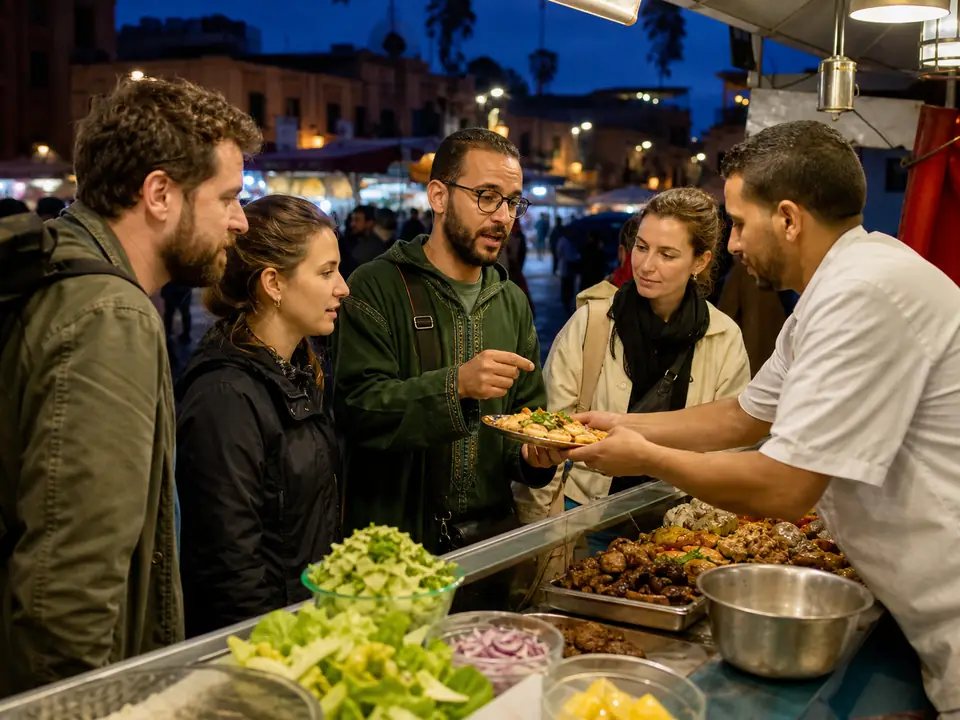
In Morocco, merguez is street food and grill food — eaten in sandwiches, alongside grilled vegetables, or as part of a mixed grill plate. It is also the sausage of choice for outdoor gatherings, picnics and celebrations. The deep red colour comes from harissa paste and paprika, not artificial colouring.
Merguez has crossed borders more successfully than almost any other Moroccan food — it is a fixture in France, Belgium and increasingly the UK — but the original, charcoal-grilled in a Moroccan medina, remains the benchmark.
Varieties of Merguez
Lamb merguez
Region: Nationwide
The traditional version: pure lamb with harissa, cumin, coriander, fennel seed and garlic. Rich, fatty and intensely spiced.
Beef merguez
Region: Urban areas
A leaner alternative using beef. Slightly less rich but still heavily spiced. Common in urban areas where beef is more affordable.
Khlii-spiced merguez
Region: Fes / Meknes
A variation incorporating khlii spices (fenugreek, coriander seed) for a deeper, more complex flavour. Less common but found in traditional butchers.
How to eat merguez
Merguez is almost always grilled — over charcoal in Morocco, under a grill or on a barbecue elsewhere. It is eaten in a bread roll with harissa, chopped onion and tomato; as part of a mixed grill plate with kefta, chicken and grilled vegetables; or on its own with bread and a simple salad. The casing should be blistered and slightly charred; the inside should remain juicy.
Where to try it in Marrakech
The evening food stalls of Jemaa el-Fnaa grill merguez alongside kefta and brochettes. Small grill shops throughout the Marrakech medina serve merguez sandwiches. For the freshest merguez, buy them from a butcher in the morning and ask your riad to grill them for lunch.
How merguez is made
Merguez is made by mixing finely minced lamb or beef with harissa paste, ground cumin, ground coriander, paprika, garlic, salt and sometimes fennel seed. The mixture is stuffed into natural lamb casings and twisted into links. To cook, merguez is grilled over very hot charcoal for 5-7 minutes, turned frequently. The sausages should char and blister but not dry out — the key is high heat and short cooking time.
History and origin
Merguez originated in the Maghreb — Morocco, Algeria and Tunisia all claim it. The name likely derives from the Berber 'amrguez'. It has been a North African staple for centuries, predating the colonial period. French colonists brought merguez back to mainland France, where it became one of the most popular sausages in the country. Today, merguez is produced industrially across Europe, but the hand-made, charcoal-grilled original remains a different product entirely.
Insider tips
- Buy merguez from a butcher, not a supermarket — the handmade version has vastly more flavour.
- Grill over very high heat for a short time — merguez should be charred outside and juicy inside.
- Do not prick the casing before cooking — the fat inside is the flavour.
- Merguez is one of Morocco's spicier foods — if you are sensitive to heat, order a kefta sandwich instead.
Related recipes
Frequently asked questions
Is merguez spicy?
Yes — merguez is one of the few genuinely spicy items in Moroccan cuisine. The harissa gives it a real chilli kick. Heat levels vary by maker, but expect moderate to high spice compared to a European sausage.
Is merguez halal?
Traditional merguez is always halal — it is made from lamb or beef, never pork. In Morocco, all butchers operate under Islamic dietary law. In Europe, check the label, as some mass-produced versions may contain pork.
Can you eat merguez raw?
No. Merguez is a fresh, uncured sausage and must be cooked before eating. It is not a charcuterie product like salami.