Main dish
Moroccan Couscous
Couscous is not a side dish in Morocco — it is the meal itself, the centrepiece of the Friday family lunch, and the food of celebration and mourning alike. Made from hand-rolled semolina granules steamed over a rich broth of meat and vegetables, Moroccan couscous bears little resemblance to the instant version sold in Western supermarkets.
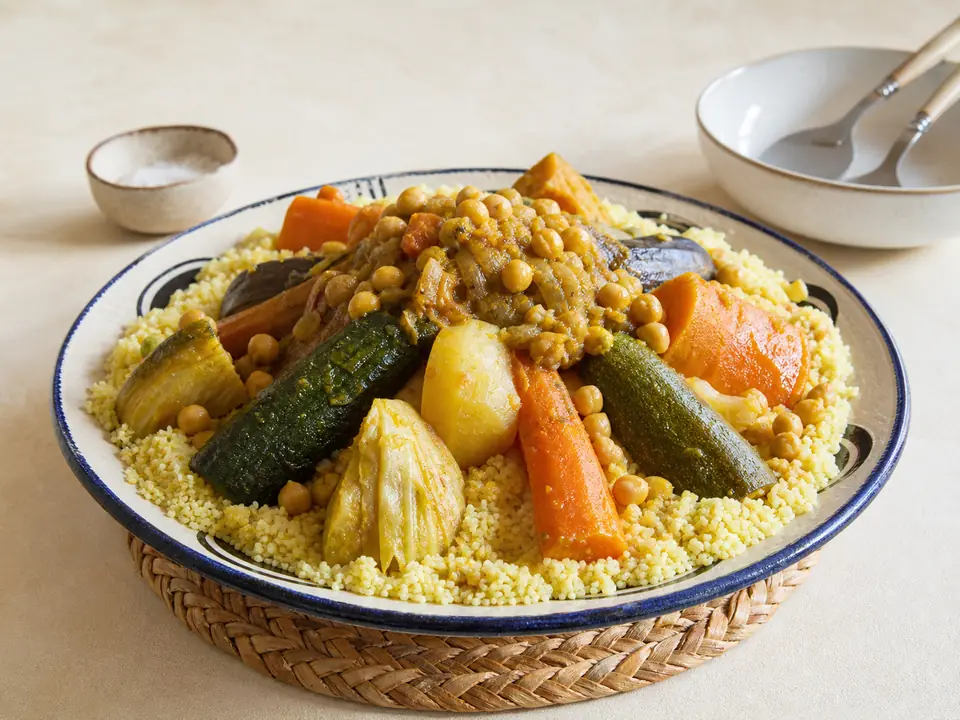
The dish is built in a couscoussier (a two-tiered steamer called a keskes in Darija): the broth simmers below, the grain steams above, absorbing flavour from the rising steam. The couscous is steamed, raked, dried, and steamed again — sometimes three times — until each granule is light, separate and tender. It is then mounded on a vast communal platter, the meat and vegetables arranged on top, and the broth ladled over at the table.
For Moroccans, couscous is identity. The Friday couscous after the midday prayer is a non-negotiable family institution. Guests are always welcome; refusing couscous is almost rude. It is the dish that connects every Moroccan to their mother's kitchen.
Varieties of Couscous
Seven-vegetable couscous (Couscous aux sept legumes)
Region: Nationwide
The most traditional version: steamed couscous served with lamb or chicken and at least seven seasonal vegetables — typically carrot, turnip, courgette, pumpkin, cabbage, onion and tomato — in a saffron-tinted broth.
Couscous tfaya
Region: Fes / Marrakech
Couscous topped with caramelised onions cooked to a dark, honeyed jam with cinnamon, raisins and toasted almonds. Sweet, rich and served at celebrations.
Sweet seffa (Seffa medfouna)
Region: Fes
A dessert or celebration couscous: fine-grain couscous mounded with butter, cinnamon, powdered sugar and toasted almonds. Sometimes a whole chicken is buried inside (medfouna means 'buried').
Barley couscous (Belboula)
Region: Rif / northern Morocco
Made with coarse barley grain instead of semolina. Nuttier and chewier, traditionally served in the Rif and rural areas with buttermilk (lben).
Couscous with raisins and chickpeas
Region: Nationwide
A simpler version with plump raisins, chickpeas, and caramelised onions. Often the weekday couscous when the Friday extravagance is scaled back.
Fish couscous
Region: Essaouira / Safi / Tangier
Coastal cities serve couscous with grilled or braised fish — often sea bass or shad — with a chermoula-spiced tomato broth and root vegetables.
How to eat couscous
Couscous is eaten from a large shared platter placed at the centre of the table. Each person eats from the section directly in front of them, using the right hand or a spoon to form small balls of grain with vegetables. The broth is ladled over as needed — ask for more if the couscous seems dry. The meat is traditionally carved and distributed by the host. In family settings, the best pieces are pushed toward the guest. Bread is not strictly needed with couscous but may be present. A glass of cold buttermilk (lben) is the classic pairing.
Where to try it in Marrakech
Friday is couscous day. Most riad guesthouses in Marrakech serve a Friday couscous lunch; book ahead. Some restaurants serve it daily, but Friday is when you get the real thing. Family-run restaurants in the Kasbah and Mouassine quarters are reliable. For the full experience, a cooking class will teach you the triple-steaming technique. Avoid tourist restaurants that serve instant couscous — the grains should be separate and fluffy, never clumped or waterlogged.
How couscous is made
Traditional couscous is steamed in a couscoussier (keskes) — a large pot topped by a perforated steamer basket. Raw semolina is moistened, raked with oil and salt, then spread in the steamer over a simmering broth. After 20 minutes, it is tipped out, broken apart by hand, moistened again, and returned for a second steaming. This is repeated a third time for the finest result. Each steaming makes the grains lighter and more separate. The broth below typically simmers for 2-3 hours with lamb or chicken, onions, chickpeas and root vegetables. The final mound is shaped by hand on the platter and anointed with broth and butter.
History and origin
Couscous is ancient — references appear in 13th-century North African cookbooks, and archaeological evidence from the Berber heartland of the Kabylie (Algeria) and Sous (Morocco) suggests it predates Islam. It was originally a Berber (Amazigh) staple, made from whatever grain was available: barley, millet, or hard wheat. The semolina version became dominant as wheat cultivation spread. In 2020, UNESCO inscribed couscous on its Intangible Cultural Heritage list, recognising it as shared heritage across Morocco, Algeria, Tunisia and Mauritania.
Insider tips
- Always eat couscous on Friday if you can — this is when families and riads make the real, triple-steamed version.
- If the couscous arrives as a clumped, heavy mass, it was probably instant or only steamed once — send it back or try a different restaurant.
- Ask for extra broth (merqa) on the side — the sauce is a large part of the experience.
- Pair with a glass of lben (buttermilk) for the traditional combination.
- At a cooking class, insist on learning the hand-rolling technique — it takes practice but is deeply satisfying.
Related recipes
Frequently asked questions
Is Moroccan couscous gluten-free?
No. Traditional Moroccan couscous is made from durum wheat semolina and contains gluten. Barley couscous (belboula) is also not gluten-free. There is no traditional gluten-free couscous in Morocco.
Why is couscous eaten on Friday in Morocco?
Friday is the Islamic day of congregational prayer. After the midday prayer, families gather for a large communal meal, and couscous is the traditional centrepiece. It is considered blessed food — sharing it brings baraka (divine grace).
What is the difference between Moroccan and instant couscous?
Instant couscous is pre-steamed and dried industrially — you just add boiling water. Moroccan couscous is steamed by hand two or three times over a flavoured broth, yielding light, separate, flavour-infused grains. The texture and depth of flavour are incomparable.
Can couscous be made vegan?
Yes. Replace the meat broth with a vegetable broth and increase the chickpeas and root vegetables. Many Moroccans make a simple vegetable couscous during the week. The tfaya topping (caramelised onions, raisins, almonds) is also naturally vegan if you omit the butter.