Breakfast · Medina & neighbourhoods
Marrakech Breakfast Tour
Moroccan breakfast is a spread, not a plate: a table of griddle breads, semolina cakes, honey and amlou, olives, cheese, eggs and endless mint tea. This early-start tour hits the breakfast specialists in their prime — the msemen and sfenj carts frying at dawn, the bissara counters, the baghrir stalls with their thousand-hole pancakes — and teaches you how Marrakech starts its day, sweet and savoury at once, dipped and drizzled and torn by hand.
- Duration
- 2 hours
- Best time
- Early morning, from ~8am
- Pace
- Easy walking
- Area
- Medina & neighbourhoods
Overview
The Moroccan breakfast is generous and communal — a low table crowded with small plates, both sweet and savoury, meant to be grazed with tea. At home it is bread, olive oil, honey, amlou, cheese, olives and eggs; on the street it is the griddle and fry carts turning out msemen, harcha, baghrir and sfenj hot to order.
Timing matters more than for any other food walk: the sfenj (doughnut) man and the msemen cart are morning-only, frying for the commuter crowd and packing up by mid-morning. Get out early and you catch them at their best — dough hitting hot oil, honey brushed on the spot, tea poured alongside.
What you'll taste
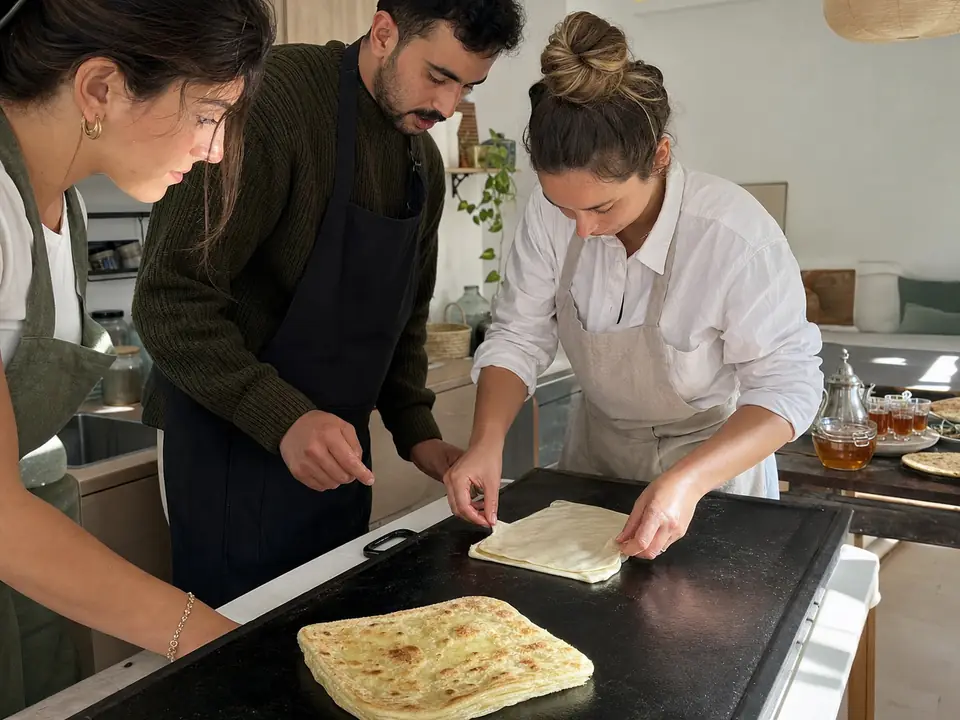
- Msemen — Square laminated flatbread, flaky and folded, eaten warm with honey and butter or plain to dip.
- Sfenj — Moroccan doughnuts — rings of airy dough deep-fried to order, sold on a loop of string, dusted with sugar or dipped in honey.
- Baghrir — 'Thousand-hole' semolina pancakes, spongy and lacy, soaked with honey-butter through their pores.
- Harcha — Semolina griddle bread with a crisp, sandy crust, split and filled with cheese, honey or jam.
- Bissara — Warm fava-bean soup with cumin and olive oil — the savoury, filling side of a Marrakech morning.
- Amlou — Argan-oil, almond and honey spread — 'Moroccan Nutella' — slathered on warm bread.
The route
- 1
The sfenj man
Start where the doughnut fryer works — dawn to mid-morning only — for hot, sugar-dusted sfenj on a string.
- 2
Msemen & harcha cart
A griddle cart for square flaky msemen and crisp harcha, eaten warm with honey or cheese.
- 3
Baghrir stall
The thousand-hole pancakes, soaked in honey-butter — spongy, sweet and unmistakably Moroccan.
- 4
Bissara counter
A savoury turn: fava-bean soup with cumin and oil, the working person's hot breakfast.
- 5
Amlou & bread
Warm khobz with amlou, honey and olive oil — the home-style spread in miniature.
- 6
Tea to finish
Mint tea or coffee to wash down a proper Moroccan breakfast graze.
When to go & what it costs
Start early — around 8am — because the sfenj and msemen carts are a morning-only affair and sell out or pack up by mid-to-late morning. Weekends see a more leisurely, family breakfast culture. Bissara is especially good and popular in the cooler months. Ramadan flips the pattern, with the pre-dawn suhoor replacing the usual breakfast.
Cost & cash: Breakfast street food is cheap — griddle breads and sfenj cost a few dirhams each.
Insider tips
- Get out early — the sfenj and msemen carts are morning-only and best straight off the griddle.
- Order sweet and savoury together; a Moroccan breakfast happily mixes honeyed bread with bean soup.
- Amlou (argan-almond-honey spread) is a must-try and makes a great edible souvenir.
- Sfenj is sold on a loop of palm-string; eat it hot, it stiffens as it cools.
- Pair any of it with mint tea rather than coffee for the authentic morning combination.
Etiquette & how to eat like a local
- Griddle and fry carts are cash-only and quick — have small coins ready and keep the queue moving.
- Tear and dip bread with your right hand.
- It is normal to eat standing at the cart or perched on a stool; lingering is for cafés.
- Ask before photographing the fryer at work — a purchase usually earns a yes.
- During Ramadan, be discreet about eating in public in the daytime.
Frequently asked questions
What is a typical Moroccan breakfast?
A spread of small plates grazed with mint tea: griddle breads like msemen, harcha and baghrir, plus khobz with olive oil, honey, amlou, cheese and olives, and sometimes eggs or a bowl of bissara soup. It mixes sweet and savoury freely and is meant to be shared.
What is the difference between msemen, sfenj and baghrir?
Msemen is a square, flaky, laminated griddle flatbread; sfenj is a deep-fried ring doughnut, airy and sold on a string; baghrir is a spongy, lacy semolina pancake full of holes that soak up honey-butter. All three are classic morning street foods.
What time is breakfast served in Marrakech?
The street breakfast carts — sfenj and msemen especially — run from early morning to mid-morning and then pack up, so go by 8am for the best of it. Cafés serve breakfast later and more leisurely, particularly at weekends.
What is amlou?
Amlou is a thick, sweet spread of roasted almonds, argan oil and honey, sometimes called 'Moroccan Nutella'. It is spread on warm bread and is a specialty of the argan-growing south. It makes an excellent, distinctly Moroccan edible souvenir.
Cook what you tasted
Loved something on the walk? Take it home. Learn the dish hands-on with a Marrakech chef, or follow a free step-by-step recipe.