Bread & pastry
Moroccan Msemen
Msemen (also spelled rghaif or m'semen) is Morocco's most popular flaky flatbread — a square, layered griddle bread made by stretching and folding semolina dough until it develops dozens of buttery, crispy-chewy layers. It is eaten for breakfast with honey and butter, as a snack filled with kefta or vegetables, or alongside soups and tagines as an alternative to khobz.
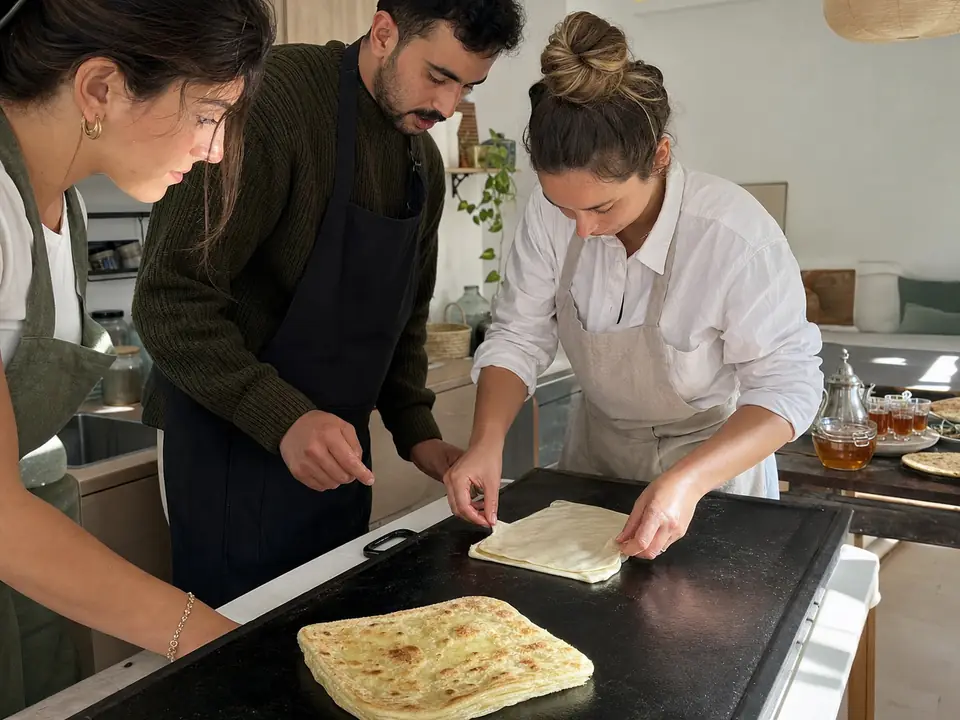
The technique is mesmerising to watch: a ball of dough is stretched impossibly thin on an oiled surface, folded into a square, and cooked on a flat griddle until golden and puffed. The layers shatter when you tear them apart, releasing steam and the scent of toasted semolina. Street vendors sell them from dawn, stacked high and kept warm in cloth-lined baskets.
For many Moroccans, msemen is the taste of childhood — the bread their mother or grandmother made every morning.
Varieties of Msemen
Plain msemen
Region: Nationwide
The classic: flaky, buttery, square. Torn apart and eaten with honey, jam, or cheese. The breakfast default across Morocco.
Stuffed msemen (msemen farci)
Region: Nationwide
Msemen filled before folding with a mixture of onions, tomatoes, peppers, spices and sometimes kefta. A complete meal in a flatbread.
Rghaif (round version)
Region: Northern Morocco
Essentially the same dough and technique, but folded into a round or rectangular shape instead of square. The names are interchangeable in many regions.
Sweet msemen
Region: Urban areas
Msemen sprinkled with sugar and cinnamon before folding. Served as a dessert or teatime snack. Often drizzled with melted butter or honey after cooking.
How to eat msemen
Tear msemen apart with your hands, layer by layer, and dip in honey, butter, soft cheese (jben) or amlou (almond-argan butter). For breakfast, msemen is paired with mint tea. Stuffed msemen is a self-contained snack or light meal. Alongside soup (harira or bissara), msemen replaces khobz as the bread course.
Where to try it in Marrakech
Street vendors throughout Marrakech sell msemen from dawn. Look for the griddle — a large, flat, round pan (maaqla) — and a stack of ready msemen beside it. Early morning outside neighbourhood mosques and near markets is the best time. Some riads include fresh msemen in their breakfast spread. A cooking class that includes Moroccan breakfast will teach you the folding technique.
How msemen is made
A soft dough of flour, semolina, salt, yeast and water is kneaded until smooth, then divided into balls. Each ball is rested, then stretched paper-thin on an oiled surface using the hands and fingertips. The sheet is folded into thirds one way, then thirds the other way, creating a layered square. The square is cooked on a lightly oiled flat griddle (maaqla) over medium heat, flipped once, until golden-brown on both sides. The layers puff and separate during cooking. Butter or oil between the layers adds richness.
History and origin
Msemen is a Berber bread tradition that predates written culinary records. The technique of stretching and folding dough to create layers is ancient and is shared across North African and Middle Eastern cultures (compare with Turkish gozleme, Indian paratha, Malaysian roti canai). In Morocco, msemen has been a daily breakfast bread for centuries and remains one of the most commonly eaten foods in the country.
Insider tips
- The best msemen has many thin, distinct layers — if it looks like a single thick pancake, it was not properly stretched.
- Eat msemen hot from the griddle — the layers lose their crispness as they cool.
- Pair with amlou (argan-almond butter) for the quintessential Moroccan breakfast combination.
- At a cooking class, the stretching technique takes practice — do not worry if your first attempt tears.
- Msemen freezes well. Moroccans often make a batch and freeze them, reheating on a dry griddle.
Related recipes
Frequently asked questions
What is the difference between msemen and baghrir?
Msemen is a layered, flaky, square bread cooked on a griddle. Baghrir is a spongy, one-sided pancake with a honeycomb surface, made from a thin batter. They are completely different textures: msemen is crispy-chewy; baghrir is soft and spongy.
Is msemen the same as a crepe?
No. A crepe is a thin, flat, single-layer pancake. Msemen is a multi-layered, folded flatbread with a flaky, chewy texture. The technique is closer to puff pastry than to crepe-making.
Can msemen be made gluten-free?
Not easily. The stretching technique depends on gluten development to achieve the thin layers without tearing. Gluten-free flours do not stretch in the same way.