Bread & pastry
Khobz (Moroccan Bread)
Khobz is not just bread in Morocco — it is the table, the utensil, and the soul of every meal. The round, dense, semolina-crusted loaf is the one food no Moroccan meal can exist without. It is used to scoop tagines, mop up sauces, pinch couscous, tear and share. In many households, forks and spoons are optional; khobz is not.
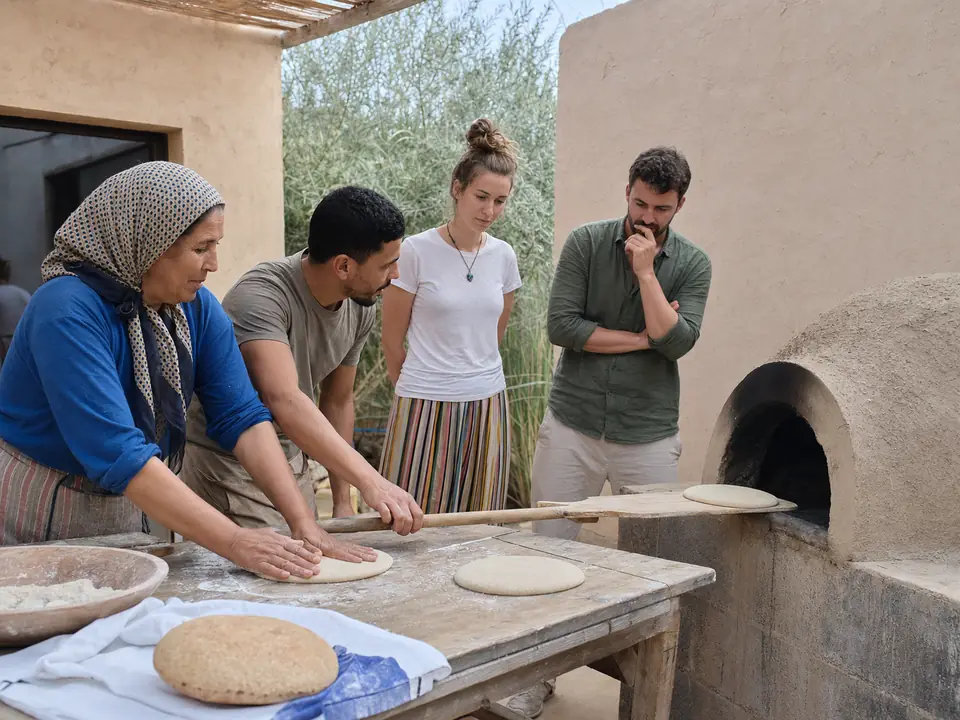
Most Moroccan families still make their own dough at home and send it to the neighbourhood communal oven (ferran) to be baked. Children are sent with trays balanced on their heads, each loaf marked with a stamp or pattern so the baker knows whose is whose. The ferran is a social hub — a place to exchange news while the bread bakes.
The bread itself is a sturdy, slightly chewy round, about 20cm across and 4cm thick, made from a mix of white and wholemeal flour with semolina. It tears cleanly, holds up to wet sauces, and has a crust that ranges from soft to deeply toasted depending on the baker.
Varieties of Khobz
Khobz dyal dar (home bread)
Region: Nationwide
The standard round loaf, made at home and baked at the communal ferran. Dense, chewy and sturdy enough to scoop tagine without disintegrating.
Khobz dyal smid (semolina bread)
Region: Nationwide
Made with a higher proportion of fine semolina. Yellower, slightly grittier texture and a sweeter, nuttier flavour.
Khobz dyal zraa (wholemeal bread)
Region: Rural / Atlas Mountains
Made with wholemeal or barley flour. Denser, darker and more rustic. Traditional in rural areas and increasingly popular in health-conscious urban settings.
Pain maison (bakery bread)
Region: Urban areas
Baguette-style bread baked in commercial bakeries, a legacy of the French protectorate. Used for sandwiches but never for tagine — Moroccans are clear about this distinction.
How to eat khobz
Khobz is torn by hand into pieces, never cut with a knife at a traditional table. Each person tears pieces from the communal loaf and uses them to pinch and scoop food. Wasting bread is considered disrespectful — every piece should be eaten. Stale bread is recycled into bread soups (like tharid) or given to animals, never thrown away. Bread is held in the right hand.
Where to try it in Marrakech
Every restaurant, riad and household in Marrakech serves khobz. For the authentic experience, visit a neighbourhood ferran (communal oven) in the morning and watch loaves go in and come out. The medina quarters of Mouassine, Bab Doukkala and the Mellah all have working ferrans. Some food tours include a visit to a communal oven.
How khobz is made
Flour (often a mix of white and wholemeal with semolina) is combined with water, salt and yeast, and kneaded by hand for 15-20 minutes. The dough is shaped into a round, flattened slightly, and left to rise under a cloth. The risen loaf is scored with a pattern (for identification at the communal oven) and dusted with semolina. It bakes on the floor of a wood-fired oven at very high heat for 20-30 minutes. The crust should be firm and golden; the interior dense but not dry.
History and origin
Bread is central to Moroccan culture, identity and religion. The communal ferran system dates back centuries and reflects the social organisation of the medina: each neighbourhood had its own oven, often funded by a religious endowment (habous). Wasting bread is considered haram (forbidden) in Islamic tradition, and Moroccan culture takes this seriously — stale bread is always repurposed. The bread stamp (tabaa), used to mark loaves for the communal oven, is a minor art form, often handmade from wood.
Insider tips
- Visit a ferran in the morning — watching the bread go in and come out is one of the most authentic Marrakech experiences.
- If you see a bread stamp (tabaa) in the souk, it makes an excellent souvenir and is actually still used by many families.
- Khobz is best within a few hours of baking — by evening, it starts to harden.
- Never step on bread, place bread on the ground, or throw bread away in Morocco — it is deeply disrespectful.
- Ask your riad if their bread is home-baked — many still send their dough to the ferran daily.
Related recipes
Frequently asked questions
What is a ferran?
A ferran (also ferrane or farran) is a communal wood-fired bread oven, found in every neighbourhood of a traditional Moroccan medina. Families prepare dough at home and bring their loaves to the ferran for baking. The baker (fernatchi) manages the oven and returns each loaf to the correct family. A small fee is charged per loaf.
Is Moroccan bread different from pita?
Yes. Khobz is denser, thicker and chewier than pita. It does not have a pocket. It is designed to be torn and used as an edible utensil for scooping thick stews and sauces. Pita is thinner, softer and more pocket-like.
Can I buy khobz in Marrakech?
Yes. Every bakery and most grocery shops sell khobz. Street vendors also sell loaves. However, the best khobz is home-made and ferran-baked — ask your riad or guesthouse.