Souk
Souk des Teinturiers — the Dyers' Souk
Medina, west of the spice souks
The Souk des Teinturiers — the dyers' souk (Souk Sebbaghine) — is one of the most photographed corners of the medina, its narrow lanes roofed with hanks of wool and silk just out of the dye vats, dripping and drying in sheets of crimson, saffron, indigo and green. It's a working craft souk that connects directly to the textile and spice trades all around it.
Go here for
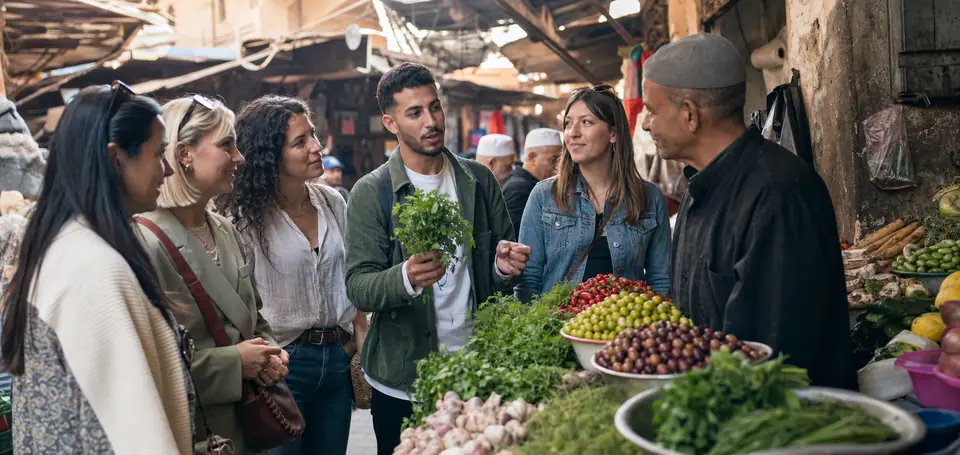
Colour overhead
In the dyers' souk, craftsmen dip skeins of wool and silk into vats of dye and hang them across the lanes to dry, so you walk under a moving ceiling of colour. Many of the dyes are still natural — indigo for blue, poppy and madder for red, saffron and turmeric for yellow, mint and pomegranate for green — the same pigments used in the tanneries and in cooking.
It's primarily a place to watch and photograph, but the surrounding stalls sell the results: scarves, shawls, throws and lengths of cloth in vivid, hand-dyed colour.
What to buy
Scarves and shawls are the natural buy — light, packable and genuinely useful. Look for the depth and slight unevenness of hand-dyeing versus the flat uniformity of printed synthetics. Silk-blend scarves have a sheen; pure cotton or wool feels softer and warmer.
For cooks and curious shoppers, the dyers' souk is a vivid reminder that the same natural ingredients — saffron, turmeric, indigo, pomegranate — colour both Morocco's textiles and its food.
How to shop like a local
- Buy hand-dyed scarves for the depth of colour; check for the subtle unevenness that separates natural dye from printed synthetic.
- Rub a corner of a 'silk' scarf — real silk warms in the hand and has a natural sheen; many 'silk' scarves are viscose.
- Go mid-morning when fresh skeins are being hung and the light filters through the colour for the best photos.
- Ask before photographing a dyer at work, and a small purchase or tip is a courteous thank-you.
- Benchmark scarf prices at the Ensemble Artisanal so you can bargain from a fair anchor.
Bargaining etiquette
- Scarves and textiles open high for tourists — counter low and bundle two or three for a better price.
- Be willing to walk; identical scarves hang at every second stall.
- Keep it warm and brief; textiles are a lower-stakes haggle than carpets.
What to avoid
- Don't pay a silk premium for viscose; the burn-and-smell test aside, real silk feels warmer and has an uneven, natural sheen.
- Avoid blocking the working lanes for photos; it's a busy craft souk, not a studio.
- Skip the 'genuine Tuareg indigo' hard sell unless you can feel the quality yourself.
Frequently asked questions
What is the Dyers' Souk in Marrakech?
The Souk des Teinturiers (Souk Sebbaghine) is the dyers' quarter of the medina, where craftsmen dye wool and silk in vats and hang the skeins across the lanes to dry, creating a famous ceiling of colour. Surrounding stalls sell scarves, shawls and textiles.
Are the dyes natural?
Many still are — indigo for blue, madder and poppy for red, saffron and turmeric for yellow, pomegranate and mint for green. These are the same natural pigments used historically in the tanneries and, in some cases, in cooking.
What should I buy at the Dyers' Souk?
Scarves and shawls are the best buy — light, packable and genuinely useful. Look for the depth and slight unevenness of hand-dyeing, and check whether a 'silk' scarf is real silk or viscose before paying a premium.
Keep exploring Marrakech food
Turn your market haul into dinner with a hands-on Marrakech cooking class, walk the souks with a guide on a market food tour, learn the Moroccan spices you just bought, or cook them at home with our Moroccan recipes. For the bigger picture, browse our food culture guides.