Buying guide
Where to Buy Saffron in Marrakech
Trusted herbalists at Rahba Kedima, the Mellah and Souk el Attarine
Saffron — the dried stigmas of the crocus flower — is the world's most expensive spice, and Morocco grows some of the finest, around Taliouine in the Souss. It perfumes tagines, couscous and pastries with a colour and aroma nothing else matches. It's also the spice most faked in the tourist markets, so buying real saffron takes a little knowledge.
Go here for
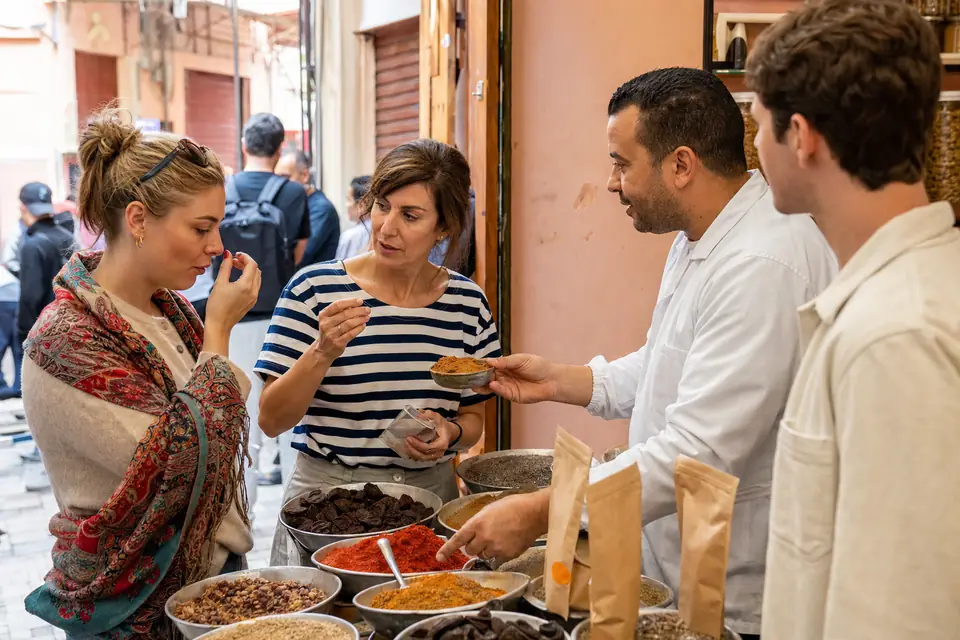
Real saffron vs the fakes
Genuine saffron is sold as whole dried threads — deep red, trumpet-shaped stigmas, each tipped slightly paler. It's costly and sold by the gram in tiny paper twists or small boxes. The common fakes are safflower (cheap, orange, floppy 'petals' passed off as saffron) and turmeric or dyed powders. If it's cheap, powdered and sold by the scoop, it isn't real saffron.
A simple test: drop a few real threads into warm water and they slowly release a golden-yellow colour while staying red themselves; dyed fakes bleed red or orange instantly. Real saffron also has a distinctive honeyed, hay-like aroma.
Where to buy it
Buy saffron from a reputable herboriste at Rahba Kedima, the Mellah or Souk el Attarine — ideally one who sells it by the gram in labelled twists and can talk about Taliouine, the saffron-growing region south of Marrakech. Morocco even holds a saffron festival there each autumn after the harvest.
Buy small — a gram goes a very long way, since a pinch of threads bloomed in warm water colours and perfumes a whole tagine. A little real saffron is a far better buy than a big cheap pouch of fake.
How to shop like a local
- Insist on whole threads, not powder; real saffron is deep-red trumpet-shaped stigmas sold by the gram.
- Do the water test if you can: real threads release golden-yellow slowly while staying red; fakes bleed colour instantly.
- Smell it — genuine saffron has a honeyed, hay-like aroma, not a flat or chemical one.
- Buy small; a pinch bloomed in warm water perfumes a whole dish, so a gram or two is plenty.
- Buy from a herboriste who can talk about Taliouine and sells it labelled by the gram.
Bargaining etiquette
- Real saffron is a fixed, high-value spice — there's little room to haggle, and a suspiciously negotiable 'saffron' is a red flag.
- Don't chase a cheap price; with saffron, cheap almost always means fake.
- Buy it alongside your other spices from a trusted stall for a fair overall deal.
What to avoid
- Never buy 'saffron' sold cheap by the fat pouch or scoop — it's dyed safflower, not saffron.
- Avoid powdered 'saffron'; it's easy to adulterate and hard to verify. Buy threads.
- Be wary of aggressive stalls pushing huge 'bargain' quantities; real saffron is expensive by nature.
Frequently asked questions
How do I know if saffron is real?
Real saffron is sold as whole deep-red threads by the gram and is expensive. Test it: dropped in warm water, genuine threads slowly release golden-yellow while staying red, and they smell honeyed and hay-like. Cheap, powdered, or scoop-sold 'saffron' that bleeds colour instantly is fake (usually safflower).
Where does Moroccan saffron come from?
Mainly from around Taliouine in the Souss region south of Marrakech, considered some of the world's finest. A good herboriste will sell genuine threads by the gram and can talk about Taliouine; the region even holds a saffron festival after the autumn harvest.
How much saffron should I buy?
Only a small amount — a gram or two. A pinch of threads bloomed in warm water colours and perfumes an entire tagine, so a little real saffron goes a very long way and is a far better buy than a large cheap pouch of fake.
Keep exploring Marrakech food
Turn your market haul into dinner with a hands-on Marrakech cooking class, walk the souks with a guide on a market food tour, learn the Moroccan spices you just bought, or cook them at home with our Moroccan recipes. For the bigger picture, browse our food culture guides.