Origins & influences
How Islam Shaped Moroccan Cuisine
More than any single ingredient or influence, Islam provides the framework within which Moroccan cuisine has developed. From the rules of what may be eaten to the great rhythms of fasting and feasting and the sacred duty of hospitality, the faith shapes not just what Moroccans cook but when, how and why they share it.
- Read
- 8 min
- Topic
- Origins & influences
- Updated
- 19 July 2026
At a glance
- Islam sets dietary rules: halal meat, and no pork or alcohol.
- Ramadan and the Eids give the year its great cycle of fasting and feasting.
- Hospitality and generosity carry religious weight, shaping the whole food culture.
Rules for the table
Islamic dietary law provides the basic framework of the Moroccan larder. Meat must be halal, slaughtered according to religious practice; pork is excluded entirely; and alcohol is forbidden, which is why wine sits outside mainstream life even though the country produces it. These rules are so deeply assumed that they simply define what Moroccan food is.
Within these bounds, the cuisine developed freely, drawing on Amazigh, Arab, Andalusi and other influences, but always inside the frame that the faith provides.
Fasting and feasting
Islam gives the Moroccan year its central rhythm through Ramadan and the festivals, and these shape eating more than any secular calendar. The alternation of restraint and celebration has generated whole categories of food.
- Ramadan: fasting from dawn to sunset, then breaking the fast at iftar with dates, harira and sweets.
- Eid al-Fitr: the joyful feast ending Ramadan, celebrated with pastries and family visits.
- Eid al-Adha: the feast of sacrifice, when a sheep is slaughtered and its meat roasted and shared.
- Breaking the fast with dates: following the Prophet's example, dates are the traditional first food.
Generosity as faith
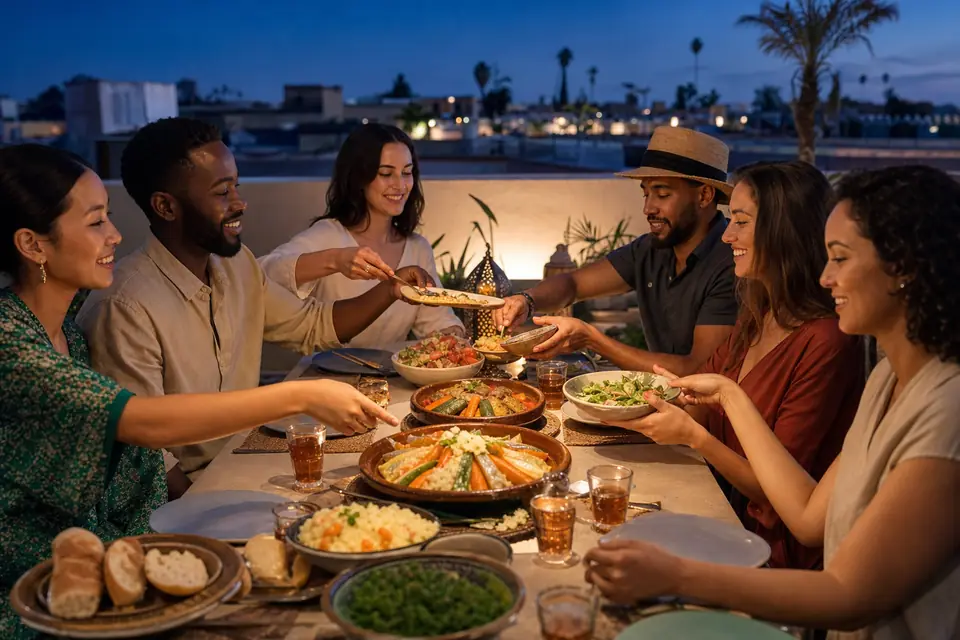
Islam strongly enjoins generosity, charity and care for the guest, and this gives Moroccan hospitality its religious depth. Feeding others — a traveller, a neighbour, the poor — is understood as a virtue, and the sharing of food is bound up with faith as much as with custom. The result is a cuisine oriented outward, toward giving and gathering.
This religious frame underlies many other threads of Moroccan food history. Read on with the history of Moroccan hospitality and diyafa and the Arab conquest and Moroccan cuisine.
Frequently asked questions
How did Islam shape Moroccan cuisine?
Islam provides the framework of Moroccan food: halal dietary rules with no pork or alcohol, the fasting and feasting of Ramadan and the Eids, and a religious duty of hospitality. It shapes not only what Moroccans eat but when, how and why they share it.
What are the main Islamic dietary rules in Morocco?
Meat must be halal, slaughtered according to religious practice; pork is excluded entirely; and alcohol is forbidden. These rules are so deeply assumed in Morocco that they effectively define what mainstream Moroccan food is.
How does Ramadan affect Moroccan eating?
During Ramadan Muslims fast from dawn to sunset, then break the fast at iftar with dates, harira soup and sweets like chebakia. The month's alternation of daytime restraint and evening feasting has shaped whole categories of Moroccan food.
Why is hospitality tied to religion in Morocco?
Islam strongly enjoins generosity, charity and care for the guest, giving Moroccan hospitality a religious depth. Feeding others is understood as a virtue, so the sharing of food is bound up with faith as much as with custom.