Sweet
Moroccan Snake Cake (M'hanncha)
M'hanncha (pronounced mm-HAHN-sha, meaning 'the snake' or 'the coiled one') is one of Morocco's most dramatic pastries — a long cylinder of warqa pastry filled with almond paste, coiled into a tight spiral and baked until golden. The result looks exactly like a coiled snake, which gives it its name. It is drizzled with honey and dusted with cinnamon and powdered sugar.
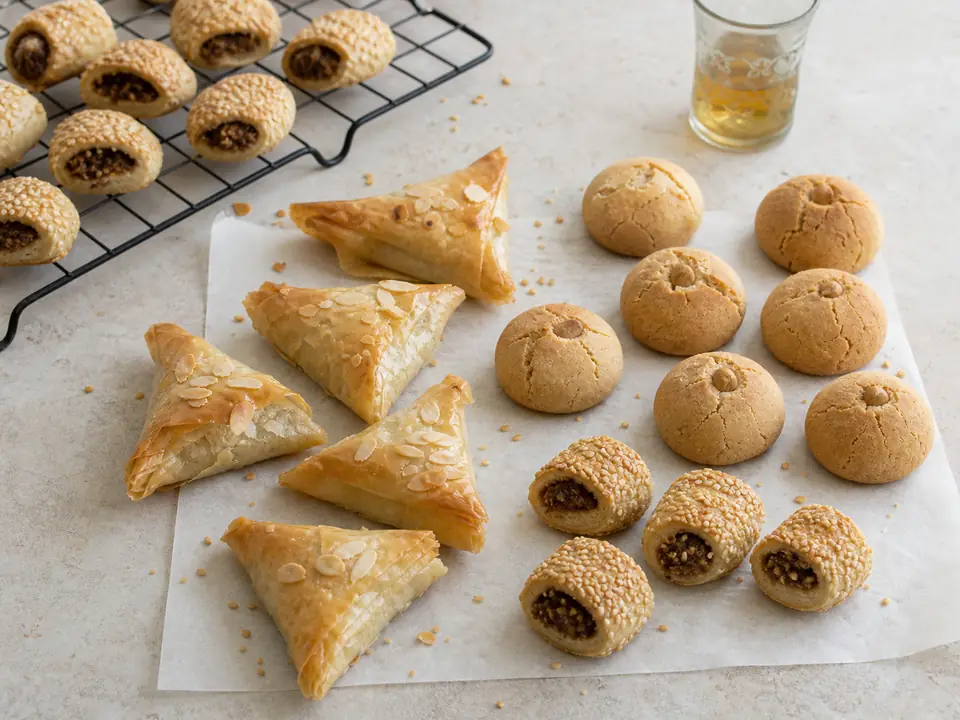
M'hanncha is celebration food — served at weddings, engagement parties, holidays and any occasion that warrants a spectacular centrepiece dessert. The combination of shatteringly crisp warqa, moist almond paste scented with orange-flower water and cinnamon, and the sweetness of honey makes it one of the most elegant Moroccan pastries.
The coiling technique requires patience: the filled pastry cylinder must be rolled tightly and then wound into a spiral without breaking. A well-made m'hanncha is a showpiece of the baker's skill.
Varieties of M'hanncha
Classic almond m'hanncha
Region: Nationwide
The standard: warqa pastry filled with ground almond paste (mixed with sugar, cinnamon, orange-flower water and egg), coiled and baked. The definitive version.
Individual m'hanncha rolls
Region: Urban areas
Smaller, single-serving coils made for easier portioning at large gatherings. Same filling and pastry, just scaled down.
Pistachio m'hanncha
Region: Casablanca / Marrakech (modern)
A modern variation using pistachio paste in place of or alongside almond. Green-tinted and slightly different in flavour. Found in upscale patisseries.
How to eat m'hanncha
M'hanncha is served at room temperature, cut into wedge-shaped slices like a cake. It is a dessert or tea accompaniment — served with mint tea at the end of a meal or during afternoon tea. The pastry should shatter when you bite into it, revealing the moist almond centre. The honey drizzle and cinnamon dusting on top are integral to the experience.
Where to try it in Marrakech
Traditional patisseries in the Marrakech medina sell m'hanncha by the slice or whole. Riads often serve it as part of a multi-dessert pastry plate at the end of a dinner. During holidays and celebrations, m'hanncha appears in bakery windows across the city. For the freshest version, order one in advance from a patisserie.
How m'hanncha is made
Ground almonds are mixed with sugar, cinnamon, orange-flower water and egg yolk to form a smooth paste. Sheets of warqa pastry (or filo brushed with butter) are laid out, and the almond paste is shaped into a long sausage along the edge. The pastry is rolled up around the filling to form a long cylinder, then the cylinder is carefully coiled into a tight spiral on a baking sheet. The top is brushed with egg wash and baked at 180C for 25-30 minutes until golden. While warm, it is drizzled with honey and dusted with cinnamon and powdered sugar.
History and origin
M'hanncha belongs to the tradition of Moroccan almond pastries that trace their lineage to Andalusian court cuisine. The Moors who settled in Fes and other Moroccan cities after the fall of Al-Andalus brought a rich tradition of nut-based pastries with them. The coiled form is uniquely Moroccan and has become one of the country's most recognisable celebration desserts.
Insider tips
- M'hanncha is best slightly warm from the oven, when the pastry is at its most crisp and the almond filling is soft.
- If making at home with filo pastry, brush each sheet generously with melted butter for the closest approximation to warqa.
- Ask your riad if they can arrange m'hanncha as a dessert — many will make one to order with a day's notice.
- M'hanncha keeps for 2-3 days in an airtight container but loses its crispness — reheat briefly in a low oven.
Related recipes
Frequently asked questions
Why is it called the snake cake?
M'hanncha means 'the coiled one' in Darija, referring to its spiral shape that resembles a coiled snake. The name is purely descriptive — there is no symbolic connection to snakes in Moroccan culture.
Does m'hanncha contain nuts?
Yes — the filling is primarily ground almonds. M'hanncha is not suitable for anyone with nut allergies.
What is the difference between m'hanncha and kaab el ghazal?
Both are almond-filled pastries, but m'hanncha is a large coiled spiral baked in the oven, while kaab el ghazal (gazelle horns) are small, individual crescent-shaped cookies. The almond paste filling is similar in both.