Themed classic · Medina & neighbourhood ovens
Moroccan Bread Tour
Bread is sacred in Morocco — never wasted, blessed as a gift, and present at every single meal as both food and utensil. This tour follows bread from dough to table: the round khobz families still carry to the communal wood-fired ferran to be baked, the semolina harcha, the flaky msemen, the pocket batbout and the village-style whole-wheat loaves. You see the neighbourhood oven at work, taste the range, and understand why a Moroccan meal is unthinkable without it.
- Duration
- 1.5 hours
- Best time
- Morning, when ovens are busiest
- Pace
- Easy walking
- Area
- Medina & neighbourhood ovens
Overview
In Morocco bread is khobz, and it is more than food. It is treated with reverence — never thrown away, and stray pieces are set aside rather than trampled. Every meal comes with it, and it doubles as the cutlery: you tear it to scoop tagine, mop sauce, lift grilled meat and pinch up salads. A table without bread is barely a table.
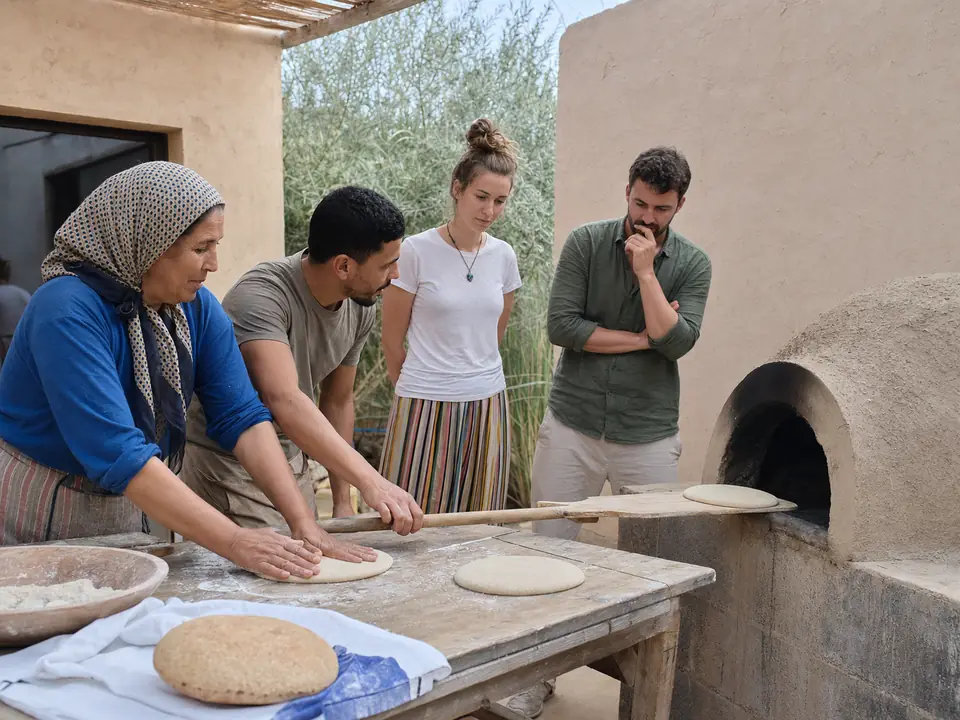
The most charming institution is the ferran, the communal wood-fired neighbourhood oven. Families still mix and shape their dough at home, mark it to tell it apart, and carry it on a board to the ferran to be baked alongside their neighbours' loaves. This tour visits an oven, watches the baker's peel at work, and tastes the spectrum from everyday khobz to griddle breads and country loaves.
What you'll taste
- Khobz — The round everyday loaf — crisp crust, soft crumb — baked at the ferran and torn to eat with everything.
- Harcha — A pan-cooked semolina bread with a sandy, biscuity crust, split and filled with cheese, honey or jam.
- Msemen — Square, flaky, laminated griddle flatbread, pulled apart in buttery layers.
- Batbout — A soft, pocketed griddle bread, like a Moroccan pita, used for stuffing with fillings.
- Country whole-wheat bread — Denser, rustic loaves of barley or whole wheat from village-style baking.
- Bread with argan or olive oil — Warm bread dipped in argan, olive oil or amlou — breakfast in its simplest, best form.
The route
- 1
The neighbourhood ferran
Visit a communal wood-fired oven and watch loaves brought by families slid in and out on the long peel.
- 2
Khobz fresh from the oven
Taste the round everyday loaf warm — crisp crust, soft crumb — the base of every Moroccan meal.
- 3
Griddle breads
Harcha and msemen from a cart, the semolina and laminated breads eaten with honey or cheese.
- 4
Batbout & country loaves
The pocketed batbout and denser whole-wheat village breads, each with its own use.
- 5
Bread as cutlery
Learn the technique of tearing and scooping — how bread does the work of a fork in Morocco.
- 6
Dip and finish
Warm bread with olive oil, argan or amlou to end — simple and sublime.
When to go & what it costs
Mornings are best — the ferran is busiest as families send dough to be baked for the day, and the griddle breads are fresh. Bread is bought and eaten all day, but the communal-oven ritual is a morning rhythm. Fridays and the run-up to festivals see extra baking.
Cost & cash: Bread is among the cheapest things you can buy — a round of khobz costs a dirham or two.
Insider tips
- Ask to see the ferran (communal oven) — the baker sliding loaves on a long peel is a highlight.
- Eat khobz warm and fresh; it stales fast, which is why Moroccans buy it daily.
- Harcha and msemen are best hot off the griddle with honey, cheese or oil.
- Bread is your utensil — practise tearing with the right hand and scooping without touching food with the left.
- Never throw bread away or put it on the floor; treat it with the respect locals do.
Etiquette & how to eat like a local
- Handle and eat bread with the right hand; the left is considered unclean at the table.
- Do not waste bread or discard it carelessly — it is regarded as sacred.
- Tear a piece for scooping rather than biting a communal loaf directly where sharing.
- Ask before photographing inside a working ferran; the heat and the peel make for a great but intrusive shot.
- A greeting to the baker and neighbours at the oven is good manners.
Frequently asked questions
What is a ferran?
A ferran is a communal wood-fired neighbourhood oven. Families mix and shape their own bread dough at home, mark each loaf to identify it, and carry it to the ferran to be baked alongside their neighbours' loaves. It is a living tradition in the Medina and central to daily bread.
Why is bread so important in Moroccan culture?
Bread (khobz) accompanies every meal as both food and utensil — torn to scoop tagine, mop sauce and lift meat. It is also treated as sacred: never wasted, never thrown on the floor, and stray pieces are set aside respectfully. A Moroccan meal is unthinkable without it.
What are the main types of Moroccan bread?
Khobz is the round everyday oven loaf. Harcha is a semolina griddle bread with a sandy crust; msemen is a flaky, square laminated flatbread; batbout is a soft pocketed griddle bread like pita; and there are denser whole-wheat and barley country loaves. Each has its own role at the table.
How is bread used as an eating utensil?
You tear a piece of khobz with your right hand and use it to scoop up tagine, meat, salads and sauce — no fork needed. It is both the plate-mopper and the fork of the Moroccan table. Eating this way, with the right hand, is the norm at home and at street counters.
Cook what you tasted
Loved something on the walk? Take it home. Learn the dish hands-on with a Marrakech chef, or follow a free step-by-step recipe.