Themed classic · Medina & homes
Friday Couscous Tour
In Morocco, couscous is Friday. After midday prayers, families gather over a mounded platter of hand-steamed semolina crowned with seven vegetables and tender meat in a saffron broth — the most important meal of the week. This tour times itself to that ritual, tasting proper three-times-steamed couscous (not the instant kind), understanding the Friday tradition, and learning why the grain's lightness is a point of real culinary pride.
- Duration
- 2–3 hours around Friday lunch
- Best time
- Friday, after midday prayers
- Pace
- Mostly seated
- Area
- Medina & homes
Overview
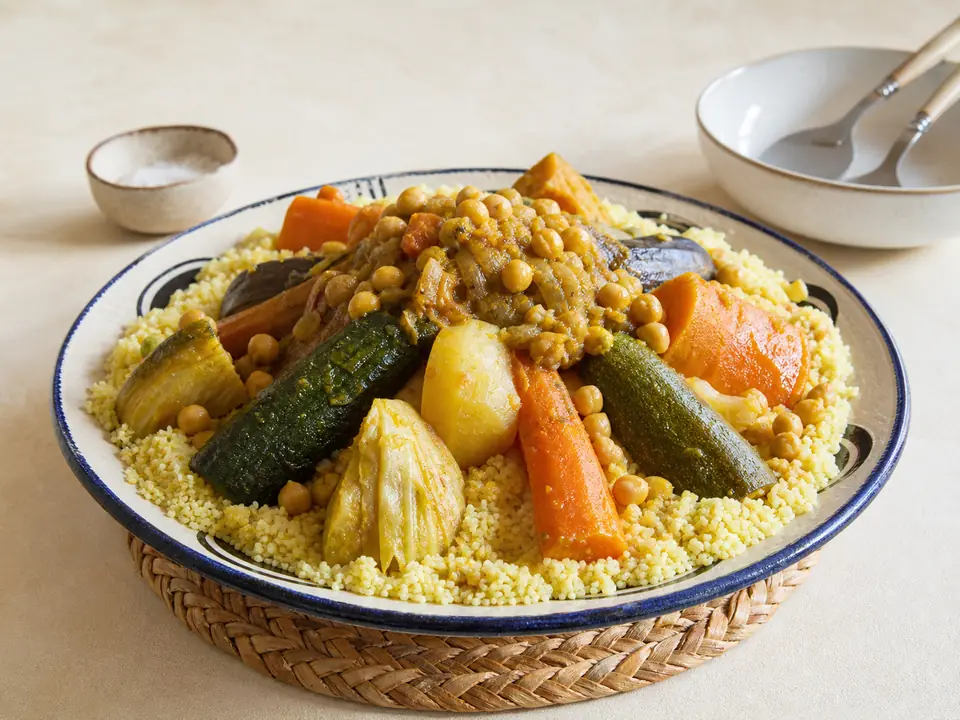
Couscous is the soul of the Moroccan week. Friday — the day of communal prayer — is couscous day, when families and neighbours gather around a single wide platter after the midday prayer. Restaurants and home tables alike serve it, and for many Moroccans abroad it is the dish that most says home.
The magic is in the steaming. Real couscous is not boiled but steamed over the simmering stew three separate times, raked and moistened between each, until the grains are light, separate and airy rather than a heavy clump. That labour is exactly what a good Friday couscous delivers and a shortcut instant version never can — this tour lets you taste the difference.
What you'll taste
- Seven-vegetable couscous — Hand-steamed semolina mounded with carrots, turnips, courgette, pumpkin, cabbage and chickpeas in a saffron-turmeric broth.
- Meat couscous — The same crowned with slow-cooked lamb, beef or chicken that has flavoured the broth.
- Tfaya couscous — A sweet-savoury version topped with caramelised onions, raisins and cinnamon over the vegetables.
- The broth (marqa) — The saffron-and-ginger vegetable broth ladled over and served on the side to moisten the grain.
- Buttermilk (lben) — The traditional cooling drink served with couscous — tangy, slightly fermented, cutting the richness.
- Smen-buttered grain — A knob of aged smen or butter melted through the couscous for depth and aroma.
The route
- 1
Understand the ritual
Learn why Friday is couscous day — the post-prayer family gathering that anchors the Moroccan week.
- 2
See the steaming
Where possible, watch or learn the three-times steam-and-rake method that makes the grain light and separate.
- 3
Seven-vegetable platter
Taste the classic — semolina crowned with a rainbow of vegetables in saffron broth, ladled to moisten.
- 4
Tfaya version
Compare a sweet-savoury tfaya couscous with caramelised onion and raisin against the savoury one.
- 5
Broth and lben
Sip the marqa broth and traditional buttermilk (lben) that accompany the meal.
- 6
Share the platter
Eat it the proper way — from a communal dish, your own wedge in front of you, moistened with broth.
When to go & what it costs
Friday, after the midday prayer, is the moment — that is when homes and many restaurants serve their couscous and when the ritual is alive. Some places do couscous only on Fridays, so plan around it. Other days you can still find it, but Friday is the authentic, communal occasion.
Cost & cash: A shared couscous platter is good value; the real cost is in the hours of steaming, not the ingredients.
Insider tips
- Aim for Friday lunch — that is when couscous is a genuine occasion, and some places make it only then.
- Real couscous is light and separate from three steamings; a heavy, gluey clump is the instant shortcut.
- Ladle the reserved broth (marqa) over your section to moisten it as you eat.
- Try the sweet-savoury tfaya version with caramelised onions and raisins alongside the plain.
- Buttermilk (lben) is the traditional pairing and cuts the richness beautifully.
Etiquette & how to eat like a local
- Couscous is eaten from a shared platter — take only from the wedge directly in front of you.
- Traditionally eaten by hand, rolling the grain into small balls with the right hand; a spoon is also fine for visitors.
- Wait for the meat and vegetables to be shared out from the centre rather than reaching across.
- Being invited to a family Friday couscous is an honour — bring a small gift of pastries or fruit.
- Compliment the lightness of the grain; the cook will know exactly what you mean.
Frequently asked questions
Why do Moroccans eat couscous on Fridays?
Friday is the Muslim day of communal prayer, and couscous became the dish families gather over after the midday prayer — a shared, celebratory meal to mark the day. It remains the most important weekly meal in Moroccan households, eaten from a single platter together.
Why is real couscous steamed three times?
Steaming the semolina over the stew three times, raking and moistening it between each round, hydrates the grains gradually and keeps them light and separate. Boiling or a single steam makes couscous dense and sticky. The three-times method is what makes a great couscous airy.
What is seven-vegetable couscous?
It is the classic Friday couscous crowned with a variety of seasonal vegetables — typically carrots, turnips, courgette, pumpkin, cabbage, tomato and chickpeas — cooked in a saffron and ginger broth. 'Seven' signifies abundance rather than a strict count.
How is couscous traditionally eaten?
From a communal platter, each person eating from the wedge in front of them. Traditionally it is eaten by hand, rolling the grain into small balls with the right hand, with the broth ladled over to moisten it. Buttermilk (lben) is the classic accompanying drink.
Cook what you tasted
Loved something on the walk? Take it home. Learn the dish hands-on with a Marrakech chef, or follow a free step-by-step recipe.