Markets & daily life
The Street Food Hierarchy in Morocco
Not all Moroccan street food vendors are equal. There is an informal but real hierarchy — based on skill, prestige, price and the complexity of what is prepared. Understanding it helps you navigate the stalls and appreciate the craft behind each one.
The elite: grill masters and tangia specialists
At the top sit the grill masters — the men who run the charcoal-fired brochette and kefta stalls, often in dedicated grilling lanes in the souk or medina. Their craft requires skill with fire, timing, and the ability to handle dozens of orders simultaneously. A good grill master has a loyal following. Tangia specialists — the men who prepare and slow-cook the Marrakech-specific tangia in the ashes of the hammam furnace — occupy a similar tier. Both command higher prices and genuine respect.
Fish grillers in coastal cities (Essaouira, Casablanca's port) are another elite category: they select, clean, grill and serve whole fish to order, and the best ones draw queues.
The middle tier: sandwich makers, soup sellers, msemen ladies
Sandwich makers (bocadillo or casse-croûte stalls) are everywhere and range from perfunctory to excellent. The best ones build layered, generous sandwiches with grilled meat, salad, sauces and egg, working at high speed. Soup sellers — particularly harira vendors during Ramadan — are respected for the quality and consistency of a product that everyone knows well enough to judge.
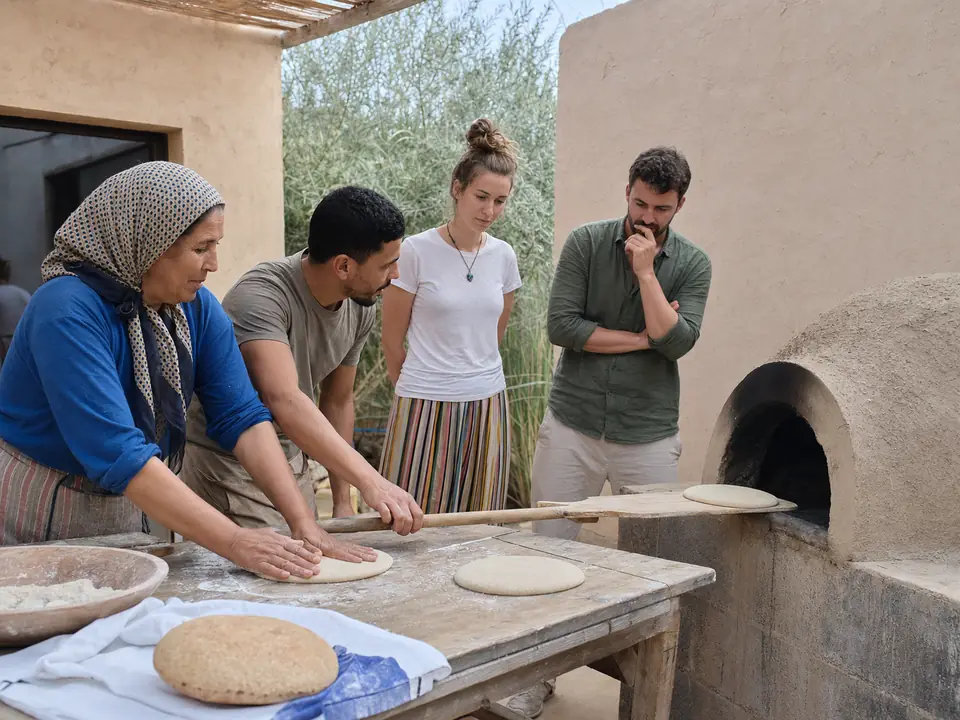
The msemen and harcha ladies — women who set up on a corner with a gas burner, a flat pan and a pile of dough — are a category of their own. Their product is simple but the skill is in the hands: the stretching, folding and cooking of msemen is a craft. They are a fixture of Moroccan mornings.
The humble: snails, eggs, nuts
Snail sellers (babbouche) occupy the entry level: a big pot of simmered snails in herbed broth, sold by the bowl with a toothpick. It is cheap, communal, and beloved, but it requires less culinary skill than grilling or bread-making. Hard-boiled egg vendors, roasted nut and chickpea sellers, and fruit-juice stands round out the base of the hierarchy.
None of this implies a quality judgment on the food itself — a bowl of snails from a good vendor can be more satisfying than a badly made brochette. The hierarchy is about perceived skill, prestige and price, not about enjoyment.
Good to know
- Seek out grill stalls with visible charcoal and high turnover — these are the elite vendors.
- Harira and soup stalls are best judged by the queue: locals know who makes it well.
- The msemen ladies are a fixture of Moroccan mornings — their skill is in the hands.
- Snail stalls are cheap and communal — a good introduction to Moroccan street food culture.
- Eat where the locals eat: turnover means freshness and quality.
Frequently asked questions
What is the best street food in Morocco?
It depends on the vendor, not the category. The best grilled brochettes, the best harira, the best msemen — each can be outstanding. Seek out vendors with high turnover and local customers.
Is Moroccan street food safe to eat?
Generally yes, if you follow basic rules: eat where there is high turnover, eat food that is freshly cooked in front of you, and drink bottled water. The busiest stalls are almost always the safest.
What is tangia?
A Marrakech speciality: meat (usually beef or lamb) slow-cooked in a sealed clay pot in the ashes of a hammam furnace for many hours. It is prepared by specialist vendors and is considered a working-man's feast.
From the kitchen
Explore the food behind the culture with these recipes: