Heritage & regions
Moroccan Street Food Heritage
Street food is not a modern novelty in Morocco but a deep-rooted tradition — the food of the working city, the market and the square, feeding people affordably and communally for generations. From the legendary open-air theatre of Marrakech's Jemaa el-Fnaa to the humble snail cart, Moroccan street food carries real heritage.
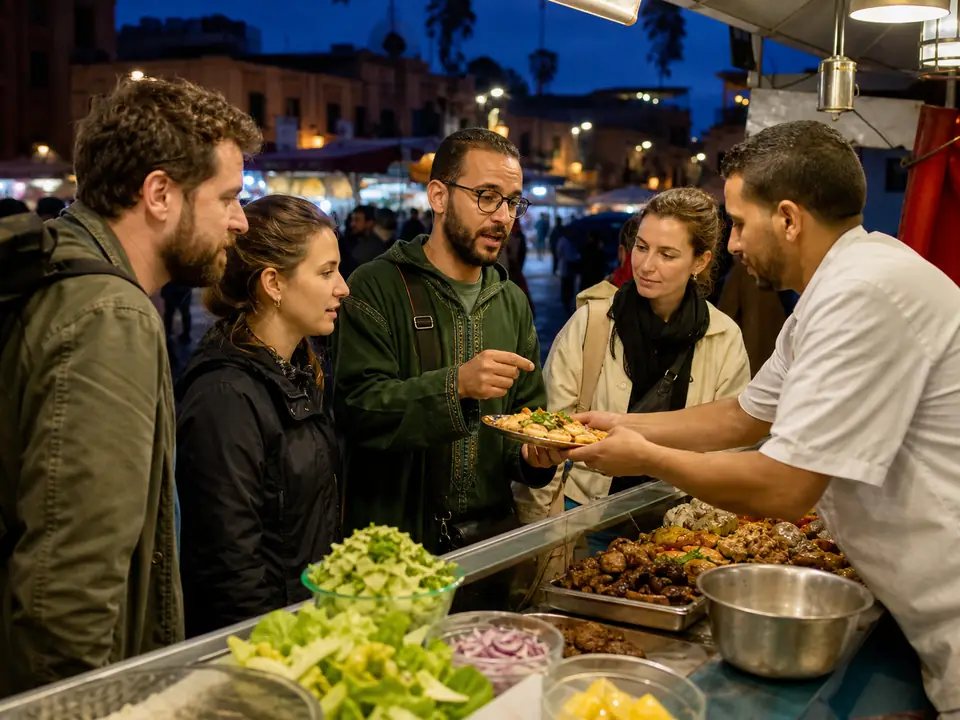
The Jemaa el-Fnaa
The most famous stage for Moroccan street food is the Jemaa el-Fnaa, the great square at the heart of Marrakech's medina, which for centuries has been a place of gathering, performance and food. Each evening it transforms into a vast open-air food court — rows of numbered stalls, clouds of grill smoke, and crowds eating shoulder to shoulder. It's a spectacle recognised by UNESCO for its cultural heritage of storytelling, music and food, and it embodies the communal, theatrical side of Moroccan street eating.
The square's food stalls serve grilled meats, brochettes, merguez, harira, snail soup, salads, fried fish, and more — a cross-section of Moroccan street cooking in one place, eaten in the open air amid the noise and life of the medina.
The dishes of the street
Moroccan street food has its classics. Snail soup (babbouche), ladled from steaming cauldrons and drunk from a bowl with a pin to extract the snails, is a beloved and traditional street food valued as much for its warming, spiced broth as the snails. Grilled meats and kefta skewers, merguez sausages, and sardines sizzle over charcoal. Maakouda (fried potato cakes), fried fish, harira, and bissara feed the everyday crowd. Sfenj doughnuts and other sweets cover the sweet side.
In Marrakech, the tanjia — meat slow-cooked in a clay urn in the embers of the hammam furnace — is a famous working-man's dish with real local heritage, historically the bachelor's or worker's meal prepared in the morning and collected cooked. These dishes are the food of ordinary working life, cheap, filling and full of character.
Food of the everyday city
Street and market food has always been the food of the working city — feeding labourers, market-goers, travellers and families affordably, cooked and eaten in the public spaces of the medina and the market. It's democratic, communal and unpretentious, and it reflects a long tradition of public eating that predates any modern 'street food' trend.
This heritage is alive today in every Moroccan town's grills, soup carts, snack sellers and squares. For a visitor, eating the street food — a bowl of snail soup, a skewer from a busy grill, a tanjia, a sfenj at breakfast — is to taste the everyday food heritage of Morocco, the cooking of the ordinary city rather than the celebratory feast. It's some of the most characterful and authentic eating the country offers.
Good to know
- The Jemaa el-Fnaa in Marrakech is the legendary open-air stage of Moroccan street food.
- Snail soup (babbouche) is a beloved traditional street food, drunk for its spiced broth.
- Grilled meats, kefta, maakouda, sardines, harira and bissara are street classics.
- Marrakech's tanjia is a famous working-man's slow-cooked dish with real heritage.
- Street food is the democratic, communal cooking of the everyday working city.
Frequently asked questions
Is street food traditional in Morocco?
Yes — it's a deep-rooted tradition, the food of the working city, market and square that has fed people affordably and communally for generations. It predates any modern 'street food' trend, from the Jemaa el-Fnaa food stalls to the humble snail cart.
What is the Jemaa el-Fnaa known for?
The great square at the heart of Marrakech's medina is famous for transforming each evening into a vast open-air food court of numbered stalls, grill smoke and crowds — a UNESCO-recognised cultural spectacle of food, music and storytelling.
What is snail soup in Morocco?
Babbouche — a warming, spiced broth of snails, ladled from steaming cauldrons and drunk from a bowl, using a pin to extract the snails. It's a beloved traditional street food, valued as much for its aromatic broth as for the snails themselves.
From the kitchen
Explore the food behind the culture with these recipes: