Comparison · Dishes & staples
Msemen vs Baghrir
Sit down to breakfast in Marrakech and two griddle breads keep appearing: a flaky, square, folded pastry and a pale, spongy, hole-pocked pancake. Msemen and baghrir are both loved, both eaten with honey and butter or a glass of mint tea — but they are made in completely different ways and offer opposite textures. Here is how to tell them apart and which to reach for.
- Read
- 6 min
- Comparing
- Msemen vs Baghrir
- Updated
- 20 July 2026
The short answer
In one paragraph
Msemen is a laminated flatbread: a firm dough folded and oiled into flaky square layers, then pan-fried crisp and chewy. Baghrir is a pourable semolina batter leavened with yeast, cooked on one side only into a light, spongy pancake covered in tiny holes that soak up honey-butter. Choose msemen for a rich, chewy bite; baghrir for a light, absorbent one.
The key difference: Msemen starts from a folded dough (flaky, chewy layers); baghrir starts from a pourable batter (spongy, hole-riddled sponge).
At a glance
A side-by-side of the differences that matter.
| Aspect | Msemen | Baghrir |
|---|---|---|
| Base | A firm, kneaded dough | A thin, pourable semolina batter |
| Leavening | None — the lift comes from folded layers | Yeast (and often a little baking powder) |
| Technique | Stretched thin, oiled, folded into a square, fried | Poured onto a hot pan, cooked on one side only |
| Texture | Flaky, layered, chewy, slightly crisp | Light, soft and spongy, full of holes |
| Appearance | Golden folded square | Pale round pancake covered in tiny holes |
| Eaten with | Honey and butter, cheese, or amlou | Honey-butter syrup poured into the holes |
| Difficulty | Moderate — the fold and stretch take practice | Easier — the challenge is getting the holes right |
When to choose msemen
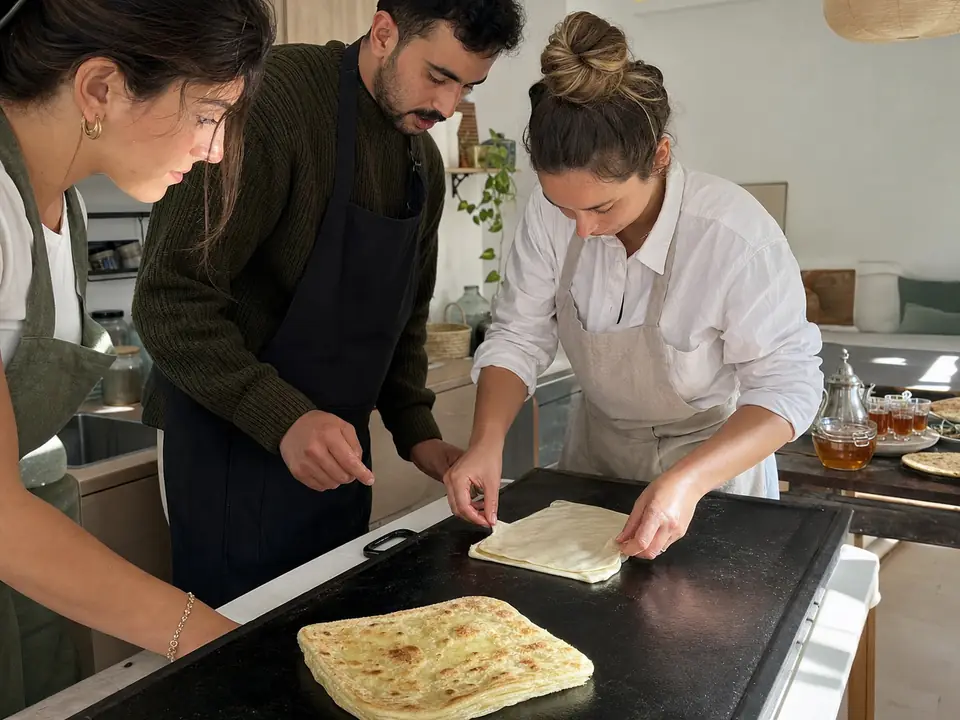
Choose msemen when you want something substantial and rich. The folding technique — stretching the dough almost translucent, brushing it with oil and semolina, then folding it into a square before frying — creates flaky layers that stay chewy inside and crisp at the edges. It is more filling than baghrir and holds up to savoury fillings; stuffed versions with onion, tomato and spiced meat are a street-food favourite.
It rewards practice, which is why it is a highlight of hands-on breakfast classes. Learn the fold with our msemen recipe, then read where it sits in the wider spread in the Moroccan breakfast explained guide. A bread and msemen workshop is the fastest way to get the technique into your hands.
When to choose baghrir
Choose baghrir when you want something light, soft and a little magical. The batter is leavened with yeast so that, as it hits the hot pan, hundreds of tiny bubbles rise and burst, leaving the surface riddled with holes — the reason it is called the 'thousand-hole pancake'. Cooked on one side only, it stays tender, and those holes exist to drink up a warm honey-and-butter syrup.
It is the gentler, sweeter option and an easier first project for a home cook, since there is no folding — just a well-mixed batter and a properly heated pan. Try our baghrir recipe, and taste it alongside msemen and sfenj on a Marrakech breakfast tour.
The bottom line
Neither is better — they are the two halves of a proper Moroccan breakfast. Order msemen when you want rich, chewy, flaky layers and maybe a savoury filling; order baghrir when you want a light, spongy pancake to flood with honey-butter. The most Moroccan answer, of course, is to have both, with a pot of mint tea.
Frequently asked questions
What is the main difference between msemen and baghrir?
Msemen is a folded, laminated flatbread made from a firm dough and fried until flaky and chewy. Baghrir is a spongy pancake made from a yeasted batter, cooked on one side and covered in tiny holes. Dough versus batter is the core difference.
Why does baghrir have holes?
The batter is leavened with yeast, so as it cooks, bubbles of gas rise and burst on the surface, leaving hundreds of small holes. Those holes soak up the honey-butter syrup it is served with.
Which is easier to make at home?
Baghrir is generally easier because there is no folding — you mix a batter and cook it on one side. Msemen takes practice to stretch and fold the dough into flaky layers.
Are they sweet or savoury?
Both are usually eaten sweet, with honey and butter. Msemen is also served savoury, either plain with cheese or stuffed with spiced onion, tomato and meat.