Breads & pastry
How to Fold Msemen (Square Moroccan Pancakes)
Msemen (also called rghaif) is the flaky, buttery square you smell on every Marrakech street in the morning, eaten hot with honey, amlou or cheese, or stuffed with spiced onion. Its distinctive layers are pure technique: the same dough that would fry into a flat disc becomes a stack of paper-thin sheets because of how you oil, stretch and fold it. Master the fold and you have breakfast for life.
- Difficulty
- Moderate
- Active time
- 40 min, plus resting
- Yields
- 8–10 msemen
- Best tool
- A large oiled worktop
What you need
- Strong flour with a little fine semolina worked in, water, salt, a touch of yeast (optional)
- A bowl of oil (and often a little melted butter) for the hands and surface
- Extra fine semolina for dusting between the layers
- A large smooth, well-oiled worktop or metal tray
- A flat griddle or heavy frying pan
Why it matters
Lamination — the trick of trapping thin films of fat between many thin sheets of dough — is what gives croissants and puff pastry their flakiness, and msemen is Morocco's hand-made version of exactly that. When the folded parcel hits the hot pan, the water in the dough turns to steam and pushes the oiled layers apart, so a single square puffs into dozens of tender, separate leaves.
The dough itself is soft and slack, almost too wet to handle dry — which is why the whole process happens on a heavily oiled surface with oiled hands. Nothing sticks, the dough stretches to translucency without tearing, and the oil you spread on it becomes the layers. Get the fold right and it does not matter that your dough looked unpromising in the bowl.
Step-by-step method
- 1
Make a soft, elastic dough
Mix strong flour with a little fine semolina, salt, a pinch of yeast if using, and enough warm water to make a soft, sticky dough. Knead it well — 8–10 minutes — until smooth and very elastic. It should be softer than bread dough.
- 2
Divide and rest in oil
Oil your hands and the worktop. Pinch the dough into smooth balls the size of a large egg, roll each in oil, and set them on an oiled tray. Cover and rest 15–20 minutes; resting relaxes the gluten so the dough will stretch without springing back.
- 3
Stretch it translucent
Working on the oiled surface, flatten a ball and push it outward from the centre with oiled fingertips, gradually stretching it into a large, thin, almost see-through sheet — the thinner the better. If it tears a little, do not worry; the folds will hide it.
- 4
Oil and dust the sheet
Smear the whole sheet with a film of oil (or oil-and-butter) and scatter a fine dusting of semolina over it. The semolina keeps the layers distinct so they flake apart rather than fusing back into one.
- 5
Fold into a square
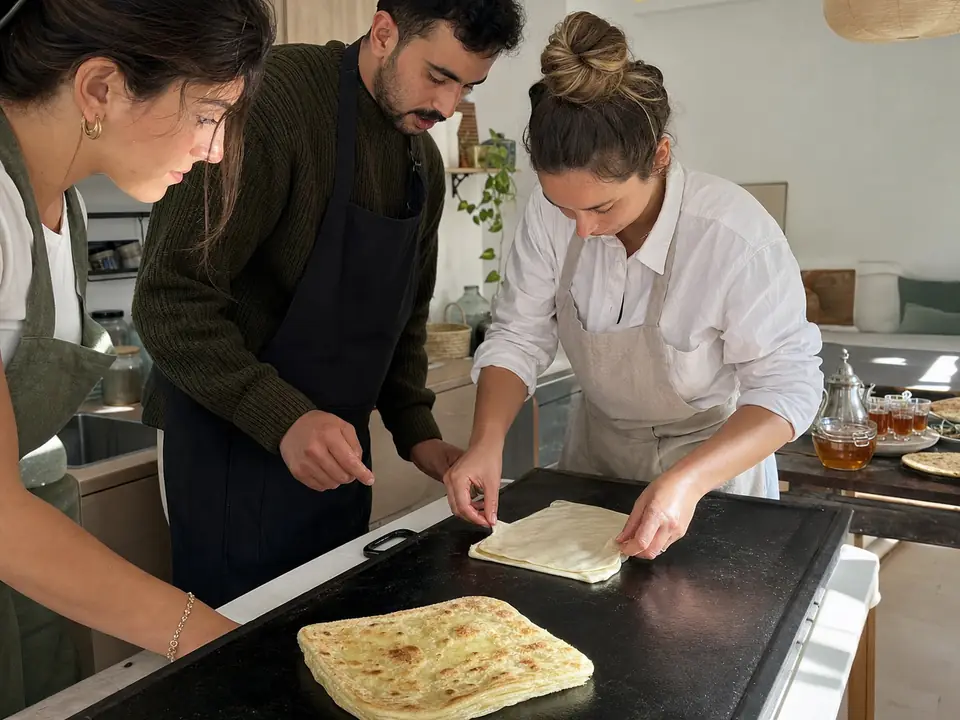
Fold the left and right thirds of the sheet into the middle to make a tall rectangle, then fold the top and bottom thirds in to make a neat square parcel several layers thick. This is the fold that builds the lamination.
- 6
Rest, then re-flatten
Let the folded squares rest a few minutes. Then, on the oiled surface, gently press and stretch each square out again to about double its size, keeping the square shape — thin enough to cook through, thick enough to hold its layers.
- 7
Griddle golden on both sides
Cook on a medium-hot dry (or barely oiled) griddle, pressing lightly, until golden-brown and crisp-edged on both sides, 2–3 minutes a side. You should see the layers puff. Eat hot with honey and butter, amlou, or a drizzle of both.
Common mistakes
- Working with a dry surface. Msemen dough needs oil, not flour, to stretch. A floured board makes it tear and stops the layers forming — keep everything generously oiled.
- Not resting the balls. Skip the rest and the gluten fights you; the dough snaps back and will not stretch thin. Give it 15–20 minutes.
- Stretching too thick. Thick sheets give you a heavy, bready pancake with few layers. Push it until you can almost see through it.
- Forgetting the semolina dusting. Without it the oiled layers can weld back together and you lose the flakiness. A light, even scatter keeps them separate.
- Pan too hot or too cold. Too hot and the outside burns before the layers cook; too cold and it dries into a cracker. Medium heat, and press gently for even contact.
- Folding without enough oil between layers. The fat is what steams the layers apart. A mean smear gives a dense square.
Tips
- For stuffed msemen, spread cooked spiced onion (or khlii, or cheese) over the sheet before folding, then seal the edges.
- Msemen freeze well raw after folding — griddle from frozen for a fast breakfast.
- A little melted smen mixed into the oil you spread gives a deeper, more savoury, very traditional flavour.
Recipes and dishes that use this
Keep exploring
Frequently asked questions
Why is my msemen not flaky?
Usually the dough was worked on flour instead of oil, not stretched thin enough, or missing the semolina dusting between layers. The flakiness comes from oiling and dusting a translucent sheet, then folding it into layers that steam apart in the pan.
What is the difference between msemen and meloui?
Both start from the same laminated, oiled dough. Msemen is folded into a square parcel; meloui is rolled into a long rope and then coiled into a flat spiral. The fold versus the coil is the only real difference.
Can I make msemen dough ahead?
Yes — you can rest the oiled balls for longer, or fold the squares and freeze them raw. Cook from fresh or straight from frozen on a medium griddle.