Seasonal cooking
Moroccan Spring Salad Season
Moroccan salads are not an afterthought but a whole category of cooking — a spread of small cooked and raw dishes, warm and cool, that opens a meal and covers the table. As winter gives way to spring and the first tender vegetables and wild greens appear, the salad season truly begins: the heavy stews of the cold months step back, and the table brightens with tomato, pepper, herbs and green things. It is the moment Moroccan cooking lightens.
- Read
- 7 min
- Season
- Seasonal cooking
- Updated
- 20 July 2026
At a glance
- Moroccan salads span cooked (warm) and raw (fresh) dishes, served together.
- Spring brings the first fresh vegetables and wild greens after winter.
- Zaalouk, taktouka and chopped salad are the everyday classics.
- A spread of several small salads typically opens a Moroccan meal.
The two families of salad
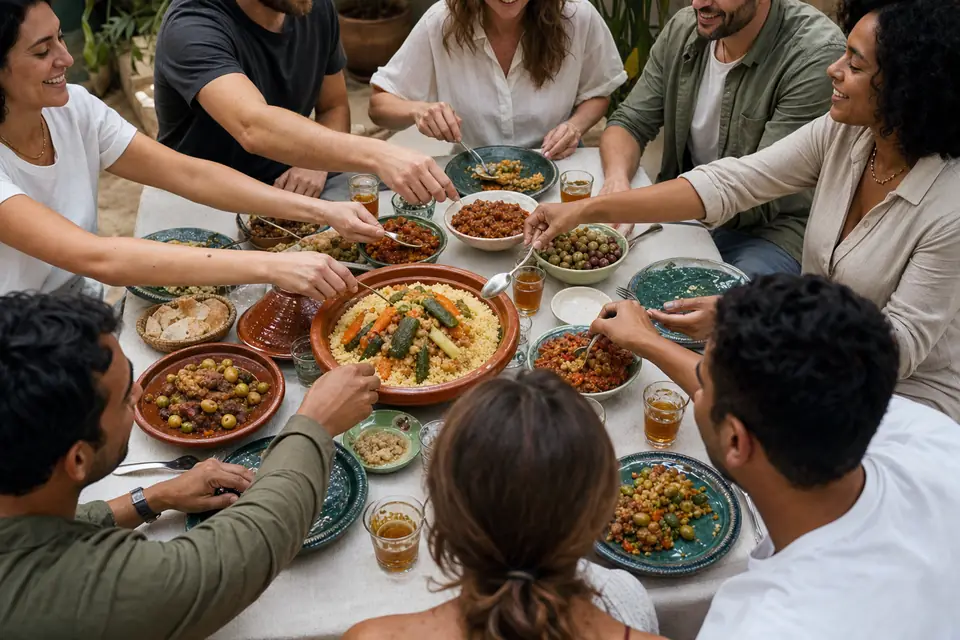
Moroccan salads divide broadly into two families. The cooked salads (salades cuites) are gently stewed vegetable dishes served warm or at room temperature — smoky aubergine, softened peppers and tomatoes, cooked down with garlic, cumin and olive oil. The raw salads are fresh and chopped — diced tomato and onion, grated carrot, sliced orange and radish — dressed simply and eaten cool. A typical meal opens with several of each, a mosaic of small bowls.
In spring, both families come alive. The winter reliance on cooked roots and pulses gives way to fresh tomatoes, tender young vegetables, wild greens gathered after the rains, and the herbs that flood the markets. The table becomes lighter, greener and more varied.
The spring spread
The salads of spring make the most of the season's fresh arrivals, from wild greens to the first good tomatoes.
- Zaalouk: smoky cooked aubergine and tomato with garlic, cumin and paprika.
- Taktouka: a cooked salad of grilled green peppers and tomatoes.
- Chopped salad: finely diced tomato, onion, cucumber and pepper with herbs.
- Carrot salad: grated or cooked carrot with cumin, orange-blossom or a hint of sweetness.
- Bakoula (khoubiza): cooked wild mallow greens with preserved lemon and olives — a true spring dish.
Building the table
The art of the Moroccan salad course is in the variety and balance — smoky against fresh, sweet against sharp, warm against cool. Several small dishes are set out together with plenty of bread for scooping, and they may open a meal or, in warm weather, make a light meal in themselves. Good olive oil, cumin, garlic, preserved lemon and fresh herbs are the constant seasonings that tie the spread together.
As spring turns to summer, the salads shift again toward the raw and cooling. For the wild greens of the season, see spring produce in Morocco; for the lighter summer versions, Moroccan summer salads and light meals.
Frequently asked questions
What are Moroccan cooked salads?
Cooked salads (salades cuites) are gently stewed vegetable dishes served warm or at room temperature — such as zaalouk (smoky aubergine and tomato) and taktouka (grilled peppers and tomato) — cooked down with garlic, cumin, paprika and olive oil. They are served alongside fresh raw salads to open a meal.
Why is spring a good salad season in Morocco?
Spring brings the first fresh tomatoes, tender young vegetables, wild greens gathered after the rains, and abundant fresh herbs. After a winter of cooked roots and pulses, the table lightens and brightens with a wider, greener variety of salads — the moment Moroccan cooking shifts toward freshness.
What is bakoula?
Bakoula (also khoubiza) is a cooked salad of wild mallow greens, gathered fresh in spring after the rains and stewed down with garlic, preserved lemon, olives, cumin and olive oil. It is a beloved seasonal dish that captures the green, foraged character of the Moroccan spring.
How many salads are served at a Moroccan meal?
A Moroccan meal often opens with several small salads at once — a mosaic of small bowls mixing cooked and raw, warm and cool, sweet and sharp. Three, five or more different salads may be set out together with bread for scooping, forming a generous and colourful first course.