Religious & festival
The Moroccan Engagement Party and Its Food
Before the great feast of a Moroccan wedding comes the quieter but no less meaningful ritual of the engagement — the khotba. This is the occasion on which the groom's family formally asks for the bride's hand, the two families meet, and the promise of marriage is sealed. The food and gifts exchanged are rich in symbolism: cones of sugar for a sweet life, milk and dates for blessing, and trays of pastries to mark the joy of the union.
- Read
- 7 min
- Season
- Religious & festival
- Updated
- 20 July 2026
At a glance
- The khotba is the formal Moroccan engagement, when the two families meet.
- Symbolic gifts include sugar loaves, dates, milk and pastries.
- Sweetness is the guiding theme — a sweet start to married life.
- Mint tea and trays of sweets are served as the promise is sealed.
The meeting of families
The khotba is the moment two families come together to agree a marriage. The groom's family visits the bride's home, bringing gifts, and the elders discuss and bless the union. It is a warm, formal occasion — respectful and celebratory rather than lavish — and the exchange of food and gifts is central to it. In many families the reading of the Fatiha marks the sealing of the engagement.
The gifts brought by the groom's family are laid out and admired, and hospitality flows the other way as the bride's family serves tea and sweets. It is a first knitting-together of two households, conducted over food.
The symbolic gifts
The gifts exchanged at a Moroccan engagement carry meaning beyond their value. Sweetness recurs throughout — a wish for a sweet and harmonious married life.
- Sugar loaves (qaleb sokkar): the tall cones of pressed sugar, symbolising a sweet life together.
- Dates and milk: the classic blessing, offered for prosperity and purity.
- Pastries: trays of kaab el ghzal, briouat and fekkas, beautifully arranged.
- Fruit and dried fruit: baskets of the season's best, signalling abundance.
- Perfume, henna and fabric: non-food gifts that accompany the food in the exchange.
Tea, sweets and the promise
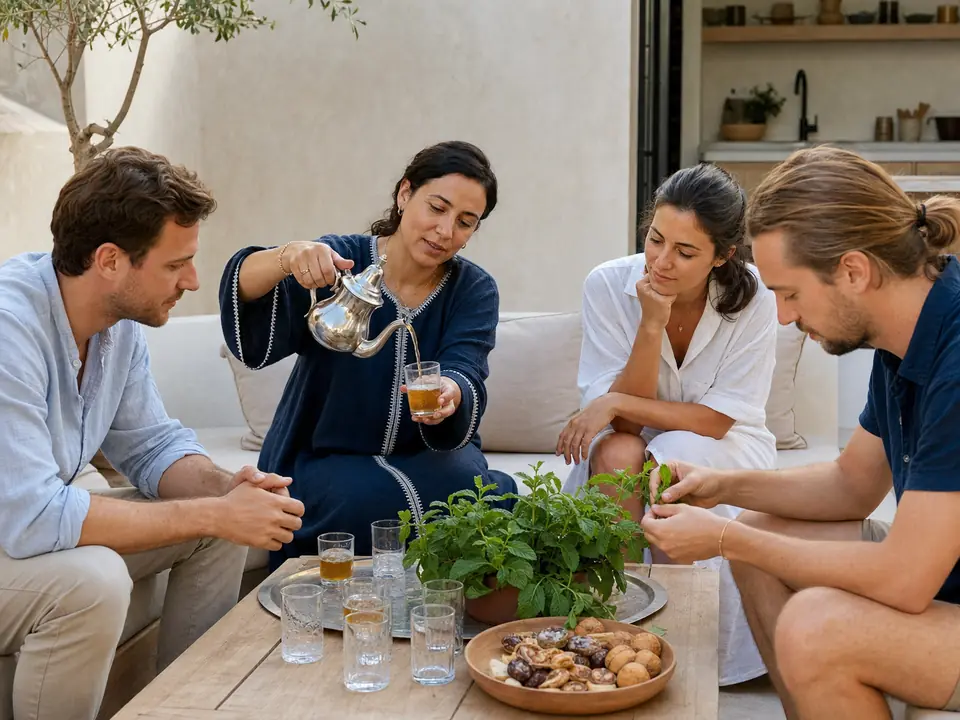
As the families talk and the engagement is agreed, mint tea is poured and trays of sweets passed round. The atmosphere is one of gentle celebration — this is a beginning rather than the great feast to come. In some traditions the henna and gift-laden trays (known as the tyafer) are presented with ceremony, each covered in embroidered cloth, and the bride receives them as a promise of the wedding ahead.
The engagement leads on to the wedding itself, with its far grander food. For that feast, see wedding feast foods in Morocco, and for the sweets that appear throughout, festive Moroccan desserts by season.
Frequently asked questions
What is a khotba in Morocco?
The khotba is the formal Moroccan engagement — the occasion on which the groom's family visits the bride's home to ask for her hand, the two families meet, and the promise of marriage is sealed, often with the reading of the Fatiha. Gifts of sugar, dates, milk and pastries are exchanged.
What gifts are given at a Moroccan engagement?
The groom's family typically brings cones of sugar (symbolising a sweet life), dates and milk for blessing, trays of pastries, baskets of fruit, and non-food gifts such as perfume, henna and fabric. The gifts are laid out and admired, and the bride's family reciprocates with tea and sweets.
Why is sugar important at a Moroccan engagement?
The tall cones of pressed sugar (qaleb sokkar) are among the most symbolic gifts, standing for the wish that the couple's married life will be sweet and harmonious. Sweetness recurs throughout the engagement — in the sugar, the pastries and the sweet mint tea served to the families.
How is the engagement different from the wedding?
The engagement (khotba) is the quieter first step — a meeting of families to agree and bless the union, marked with symbolic gifts, tea and sweets. The wedding itself is a far grander multi-day feast with couscous, festive tagines and elaborate celebration. The engagement sets the promise; the wedding fulfils it.