Markets & daily life
The Weekly Souk in Rural Morocco
Away from the permanent city souks, rural Morocco is served by the weekly souk — a travelling market that sets up in a different village on a fixed day each week, drawing farmers, herders and families from miles around. It is the economic and social heartbeat of the countryside, and its rhythm is so ingrained that many Moroccan towns are literally named after their market day.
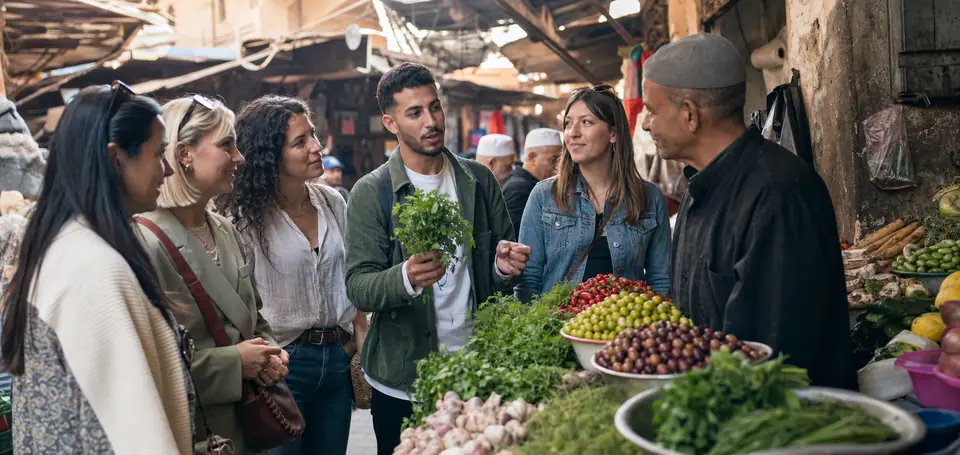
A market on the move
The rural souk rotates on a weekly cycle: each village or town holds its market on a set day, so traders travel a circuit, selling in one place on Monday, another on Tuesday, and so on. On souk day, an ordinary field or square on the edge of town fills with stalls, animals, produce and crowds, then empties again by evening. For scattered rural communities without daily shops, this weekly gathering is where you buy and sell almost everything.
You will find fresh produce, live animals (sheep, goats, chickens), grains and pulses, spices, olives, household goods, tools, clothes and street food — a one-stop supply for the week ahead. Farmers sell their crops and livestock and buy what they can't grow, making the souk a place of both commerce and community.
Named after market day
The weekly souk is so central that countless Moroccan towns take their names from their market day. 'Souk' plus the day of the week gives place names all over the country: Souk El Arba (Wednesday market), Souk Tnine (Monday), Souk Tleta (Tuesday), Souk Larbaa, Souk Sebt (Saturday), Khemis (Thursday) and more appear as town names across Morocco. The market didn't just serve the town — in many cases it created it.
This naming reflects how the souk anchored rural life: the settlement grew up around the regular gathering, and the day of trade became the town's identity.
Social heartbeat of the countryside
Beyond buying and selling, the weekly souk is a social event — a chance for people from remote farms and villages to meet, exchange news, do business, visit the barber or the traditional healer, and eat together. Street-food sellers grill meat and cook up dishes; men gather over tea; deals are struck and marriages sometimes arranged. It is as much a social institution as a market.
For a traveller, a rural weekly souk offers one of the most authentic windows into Moroccan food and country life — raw, unpolished and utterly genuine, far from the tourist-facing city stalls. Visiting on the right day rewards you with the real rhythm of how much of Morocco has always fed and organised itself.
Good to know
- Rural souks happen on a fixed weekly day — check which day the local market falls on.
- Many town names ('Souk Tnine', 'Souk El Arba') tell you their market day.
- Go early: the market fills in the morning and winds down by evening.
- Weekly souks offer an authentic, unpolished window into rural food and life.
- Expect livestock, produce, spices, street food and a strong social atmosphere.
Frequently asked questions
What is a weekly souk in Morocco?
A travelling market that sets up in a different rural village or town on a fixed day each week, serving scattered communities. Traders follow a circuit, and on souk day a field or square fills with produce, livestock, goods and street food before emptying by evening.
Why are Moroccan towns named after days of the week?
Because the weekly market was so central that settlements grew up around it, and the day of trade became the town's name — hence Souk El Arba (Wednesday), Souk Tnine (Monday), Souk Sebt (Saturday) and many more across Morocco.
Is a rural souk worth visiting?
For an authentic view of Moroccan food and country life, very much so — rural weekly souks are raw, genuine and social, far removed from tourist-facing city stalls. Just be sure to go on the correct market day for that town.
From the kitchen
Explore the food behind the culture with these recipes: