Rituals & etiquette
Mint Tea and the Rituals of Hospitality
Mint tea threads through every part of Moroccan social life — offered to guests, poured to seal a deal, shared among friends, and pressed on the newcomer in a shop. Beyond the tea ceremony itself, there is a whole web of customs around when tea is served and what accepting it signifies, and knowing them helps you move gracefully through Moroccan hospitality.
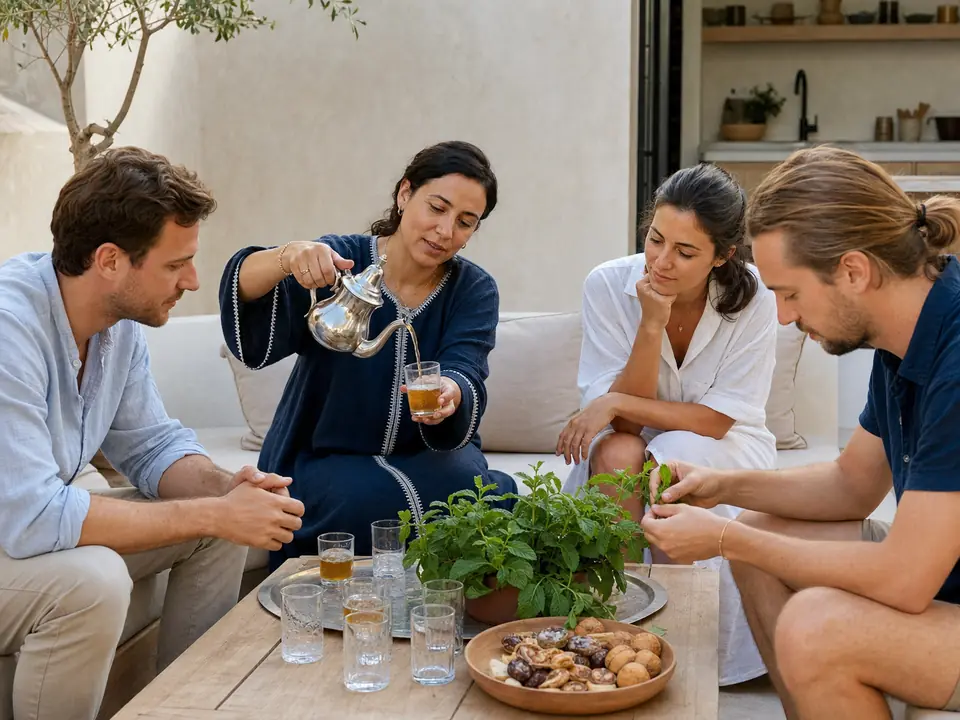
Tea everywhere, all day
Tea is not reserved for special occasions — it punctuates the whole day. It is drunk at home in the morning and afternoon, offered to visitors the moment they arrive, brewed for workers and shared among friends and family gatherings. In the souk, a shopkeeper may offer tea to a browsing customer, and it is part of the rhythm of doing business: negotiations happen over glasses of it.
This constant presence means tea is less an event than a social lubricant — the medium through which welcome, conversation and relationship happen throughout the day.
The meaning of the three glasses
Tea from a single pot is traditionally served in three rounds, and each is said to taste slightly different as the leaves continue to steep — the first mild, the second stronger, the third mellower. A well-known Maghrebi saying gives them meaning: the first glass is gentle as life, the second strong as love, and the third bitter as death. To stay for all three is to fully accept a host's hospitality.
Being offered a second and third glass is a mark of welcome, and accepting shows you value the host's company. There is no obligation to drink every glass to the last drop, but sharing in the ritual is appreciated.
Accepting the welcome
When tea is offered, accepting is the gracious response — it honours the host and opens the social exchange. In a shop, accepting tea does not commit you to buying, though it is part of the relationship-building of the souk; you can enjoy the hospitality and still decline to purchase, politely. In a home, sharing tea is the natural beginning of a visit.
For a visitor, the simplest etiquette is warmth: accept the tea, thank your host, sip and appreciate it, and take your time. Tea is an invitation to slow down and connect, and receiving it in that spirit is exactly what your host hopes for.
Good to know
- Accepting tea in a shop doesn't oblige you to buy — but it is part of the souk's hospitality.
- Being offered a second or third glass is a compliment; sharing in the ritual is appreciated.
- You needn't finish every glass, but joining the ritual honours the host.
- Tea is a reason to slow down and talk — receive it unhurried.
- Thank your host warmly; tea is an offering of welcome, not just a drink.
Frequently asked questions
What do the three glasses of Moroccan tea mean?
Served in three rounds from one pot, each tastes a little different as the leaves keep steeping. A famous saying calls the first glass gentle as life, the second strong as love, and the third bitter as death — staying for all three fully accepts a host's welcome.
If a shopkeeper offers me tea, do I have to buy something?
No — accepting tea is part of the souk's hospitality and relationship-building, but it does not commit you to a purchase. You can enjoy the tea and still decline to buy, politely and with thanks.
When is mint tea served in Morocco?
Throughout the day — at home morning and afternoon, to guests on arrival, among friends, and while doing business in the souk. It is a constant social ritual rather than something reserved for special occasions.
From the kitchen
Explore the food behind the culture with these recipes: