Getting started
How to Eat a Moroccan Meal
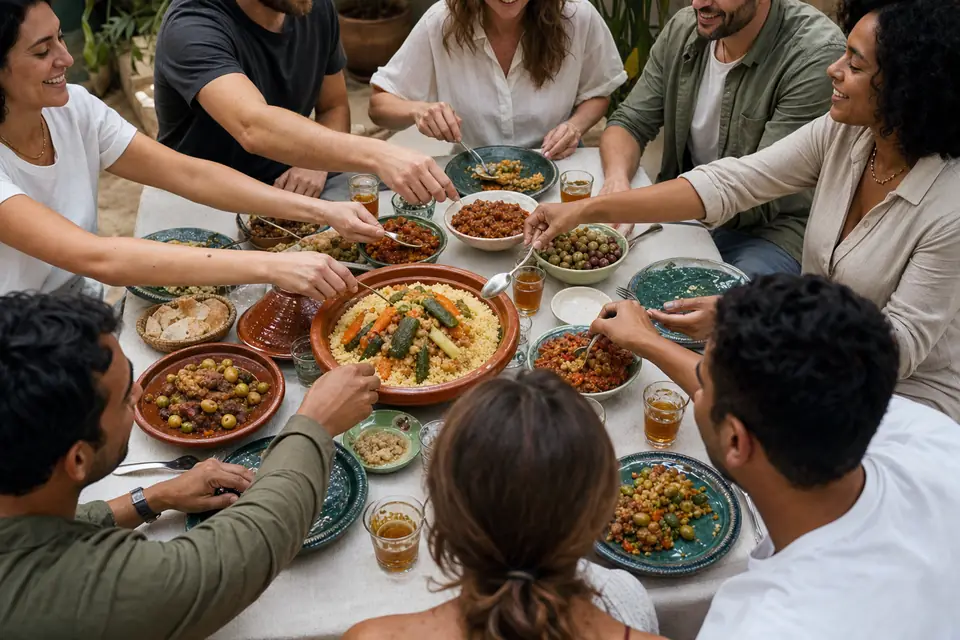
Eating a Moroccan meal has its own gentle etiquette, and knowing it helps you feel at home at the table and eat the food the way it's meant to be eaten. The essentials are simple: share from the central dish, use bread as your utensil, and eat with your right hand from the portion of the dish in front of you.
At a glance
- Meals are shared from a central dish — eat from the section directly in front of you
- Bread (khobz) is the main utensil for scooping; cutlery isn't the default
- Eat and pass with the right hand; the left is traditionally considered unclean
- Wash hands before eating, and accept mint tea when offered
Guide
Moroccan meals are communal — the tagine, couscous or platter is placed in the middle and everyone eats from the same dish rather than having individual plates. The custom is to eat from the section of the shared dish directly in front of you, working inward, rather than reaching across to pick at other areas. The host often nudges the best pieces of meat or vegetable toward guests. This shared eating is central to the culture of the meal, and going along with it is part of the pleasure.
Bread (khobz) is the primary utensil. You tear off a piece and use it to scoop up the food — the sauce, the meat, the vegetables — pinching and folding it to pick up a mouthful. Couscous is traditionally eaten by hand too in more traditional settings (rolled into a small ball with the fingers), though spoons are common now, especially with guests. Cutlery isn't the default in a traditional meal; the bread does the work, which is part of why khobz appears at every meal.
Two customs matter: use your right hand for eating and passing food, as the left is traditionally considered unclean, and it's polite to wash your hands before the meal (in traditional settings water is poured over the hands). Accept mint tea when it's offered — refusing hospitality can seem rude — and it's gracious to try a bit of everything and to compliment the food. You don't need to be perfect; hosts are warm and forgiving, but eating from your own side, scooping with bread and using your right hand will make you feel, and be treated, like a welcome guest.
Practical tips
- 1
Eat from your own wedge of the shared dish, working inward, not across the middle.
- 2
Tear bread and use it to pinch and scoop the food — that's the utensil.
- 3
Always use your right hand for eating and passing.
- 4
Wash your hands before the meal; in traditional settings water is poured over them.
- 5
Accept the mint tea — declining hospitality can come across as rude.
Frequently asked questions
How do you eat a Moroccan meal?
From a shared central dish, eating the section in front of you, scooping with torn bread instead of cutlery, and using your right hand. Wash your hands before the meal and accept mint tea when it's offered.
Do you eat Moroccan food with your hands?
Often, yes — bread is used to scoop, and in traditional settings couscous is eaten by hand (rolled into a ball with the fingers). Always use the right hand; the left is traditionally considered unclean. Spoons are common now, especially with guests.
Why is bread served at every Moroccan meal?
Because bread (khobz) is the primary utensil — you tear it and use it to scoop up sauce, meat and vegetables. It does the job cutlery does elsewhere, which is why it's always on the table.
Try the recipes
Put the tip into practice with these free step-by-step recipes: