Ingredients
Choosing Fine, Medium or Coarse Couscous
Couscous is not one product — it comes in different grain sizes, and Moroccan cooks choose the grade to match the dish. Picking the right one, and knowing that true Moroccan couscous is tiny rolled semolina rather than the large pearls sold as 'giant' couscous, sets you up for the proper texture.
At a glance
- Medium grain is the everyday default for savoury couscous
- Fine grain suits delicate and sweet dishes like seffa
- Coarse grain gives a chewier bite for hearty, rustic dishes
- 'Pearl'/'giant' couscous is a different product — toasted pasta, not rolled semolina
Guide
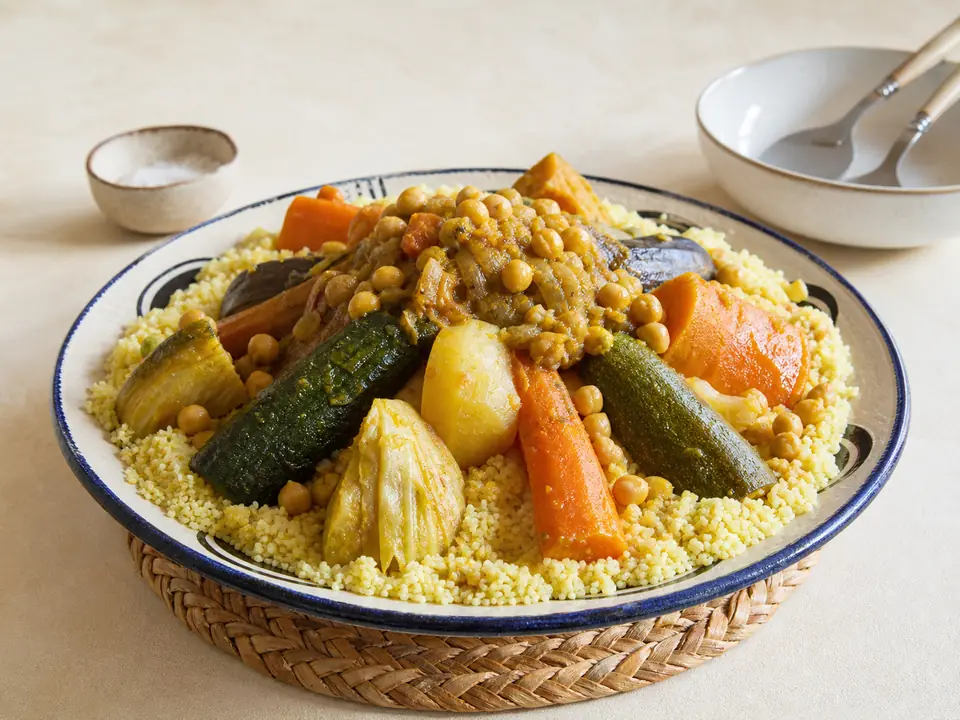
Medium-grain couscous is the everyday all-rounder and the safe default for a classic savoury couscous — the seven-vegetable Friday couscous, or couscous with lamb or chicken. It steams up light and fluffy and carries the broth well without being either too delicate or too heavy. If a recipe just says 'couscous' with no grade, medium is what to reach for.
Fine couscous is more delicate and is favoured for lighter dishes and especially for sweet preparations. Seffa — the sweet couscous mounded with cinnamon, sugar, almonds and sometimes raisins, served as a dessert or celebration dish — is traditionally made with fine or medium grain so it stays soft and mounds neatly. Coarse couscous has a more substantial, chewy bite and stands up to hearty, meaty dishes; some regions and cooks prefer it for a more rustic texture.
Beware the naming confusion. The large, round pearls often sold as 'Israeli couscous', 'pearl couscous' or 'giant couscous' are a different product — toasted pasta balls, not the fine rolled semolina of Morocco. They are tasty but they behave differently, boiled like pasta rather than steamed, and they are not what a Moroccan recipe means. Look for 'medium' or 'fine' semolina couscous, and if you want the truest result, seek out hand-rolled couscous, which has an irregular, superior texture over the uniform machine-made kind.
Practical tips
- 1
When in doubt, buy medium grain — it handles almost any savoury couscous.
- 2
Use fine grain for sweet seffa so it stays soft and mounds neatly.
- 3
Hand-rolled couscous has an irregular, superior texture over uniform machine-made.
- 4
Don't substitute pearl couscous in a Moroccan recipe — it steams and behaves completely differently.
- 5
Whatever the grade, steam it; boiling any true couscous gives a heavy, sticky result.
Frequently asked questions
What size couscous should I buy?
Medium grain for everyday savoury couscous, fine grain for delicate and sweet dishes like seffa, and coarse for a chewier, rustic bite. If a recipe doesn't specify, use medium.
Is pearl couscous the same as Moroccan couscous?
No. Pearl, 'giant' or 'Israeli' couscous is toasted pasta boiled like pasta. True Moroccan couscous is tiny rolled semolina that is steamed. They are not interchangeable in Moroccan recipes.
What couscous is used for seffa?
Fine or medium grain, so the sweet couscous stays soft and mounds well under its cinnamon, sugar and almonds. Coarse grain is too chewy for this delicate dessert.
Try the recipes
Put the tip into practice with these free step-by-step recipes: