- cooking classes
- food tours
Cooking Classes and Food Tours in Marrakech
Marrakech offers two food experiences that no other city matches at this price point: a hands-on cooking class inside a riad kitchen, and a walking food tour through the Medina lanes. Most visitors pick one or the other, but they teach different things. A food tour shows you what the city eats and where; a cooking class teaches you how and why. Do both and you leave Marrakech able to navigate a souk and reproduce the meal at home.
- Read
- 8 min
- Updated
- 23 July 2026
- Sections
- 5
Why they are different experiences
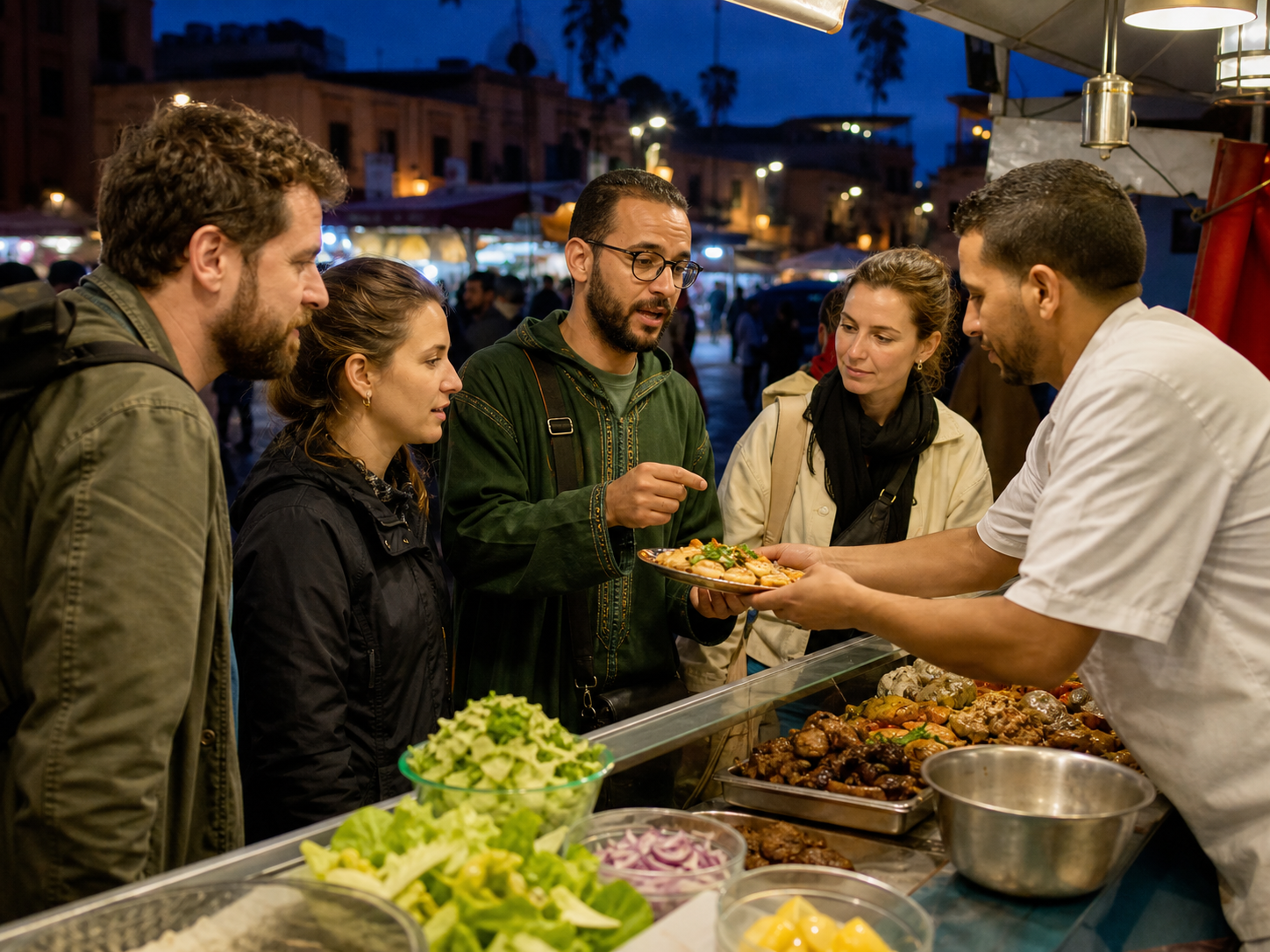
A food tour is a walking lesson in geography and taste — you graze six to ten dishes at stalls and counters you would never find alone, led by someone who explains what each thing is, why it is eaten here and not there, and what to look for. You learn to read a city through its food.
A cooking class is a kitchen lesson in technique — you prep, spice and cook a full meal from raw ingredients, usually a tagine, a salad and bread. You learn the logic behind the flavours you tasted on the tour. The two experiences are complementary, not interchangeable.
The ideal order: tour first, then class
Do the food tour on your first or second day. It orients you: you learn the names of the breads, soups and pastries, and you know which stalls to revisit alone. Then book the cooking class for mid-trip or later, when you have context — you will understand why the recipe calls for ras el hanout and not just cumin, because you have already tasted the difference at the spice stall.
If your schedule only allows one day, book a morning food tour and an afternoon cooking class. The gap lets you digest and changes the energy: you go from passive tasting to active cooking.
What a food tour covers that a class does not
Street food — msemen, maakouda, snails, khlii — is almost never taught in a cooking class because it relies on equipment home cooks do not have (a commercial griddle, a snail pot the size of a bathtub). A food tour is the only way to learn about these foods first-hand.
- The geography of the Medina: which lane for bread, which for olives, which for meat
- How to order and eat at a counter with no menu and no English
- Dishes that are eaten standing up and do not translate to a sit-down kitchen
- The souk spice stalls: what is real, what is tourist-mix, and how to buy
What a cooking class covers that a tour does not
The slow, layered cooking that defines Moroccan home food — building a tagine from the base up, steaming couscous by hand, rolling pastilla dough — is invisible on a food tour because it happens behind closed doors. A class is the only way to learn how these dishes actually work.
- Spice ratios: how much cumin, how much ginger, when to add saffron
- The onion-and-oil base that starts almost every Moroccan braise
- Hand-steaming couscous in a couscoussier (three passes, not one)
- Preserved lemon and olive: the finishing grammar of a tagine
- A take-home recipe you have actually executed once, from memory
Combining both on a short trip
On a two-day Marrakech stopover, book a late-afternoon food tour on day one and a morning cooking class on day two. On a four-day trip, add a second food tour (a night tour or a market tour covers different ground). On a week-long stay, try a specialist class — pastry, bread baking, or a vegetarian session — to go deeper than the standard tagine-and-couscous menu.
Budget-conscious travellers can do a self-guided food walk using our self-guided Medina route and save the booking budget for a cooking class, which benefits far more from a live instructor than a food tour does.
Frequently asked questions
Should I do a cooking class or a food tour in Marrakech?
Both, if you can. A food tour shows you what Marrakech eats and where to find it; a cooking class teaches you how the food is made and gives you recipes to take home. If you must pick one, a food tour is better for a short visit (you taste more variety), and a cooking class is better if you cook at home and want to reproduce the flavours.
Can I do a food tour and cooking class on the same day?
Yes. The most comfortable schedule is a morning food tour (or late afternoon) followed by an afternoon or evening cooking class. Leave at least two hours between them so you arrive at the class with an appetite — you eat a full meal at the end.
How much does it cost to do both?
A food tour typically runs 300-500 MAD per person; a group cooking class is 400-800 MAD. Together that is roughly 700-1300 MAD (about 65-130 EUR) for two of the best food experiences in Morocco. Private versions cost more but are worth it for couples or families who want flexibility.