Class type
Traditional Moroccan Bread Baking Workshop in Marrakech
Bread is the foundation of every Moroccan meal — more important than the tagine, more ubiquitous than couscous, and more culturally loaded than any other food. A Moroccan household may skip meat for a week, but it will never skip bread. This workshop teaches the four breads you see everywhere in Marrakech: khobz (the round daily loaf), msemen (layered square flatbread), baghrir (the thousand-hole semolina pancake), and harcha (griddled semolina cake). Each has a different dough, a different technique, and a different place in the Moroccan day.
- Duration
- 3-4 hours
- Group size
- Small group (2-8)
- Level
- All levels — bread-making is taught from scratch
- Price
- Mid-range
- Pickup
- Can be included in the quote
What this class covers
Khobz is the starting point — a round, slightly dense loaf made from a mix of white and whole-wheat flour, shaped by hand and traditionally baked in a communal neighbourhood oven called a ferrane. In the workshop, you learn to mix and knead the dough, shape it into rounds, and — if the class includes a ferrane visit — carry it on a wooden board to the communal oven down the alley, where the baker stamps it with your mark and slides it in alongside the neighbourhood's loaves.
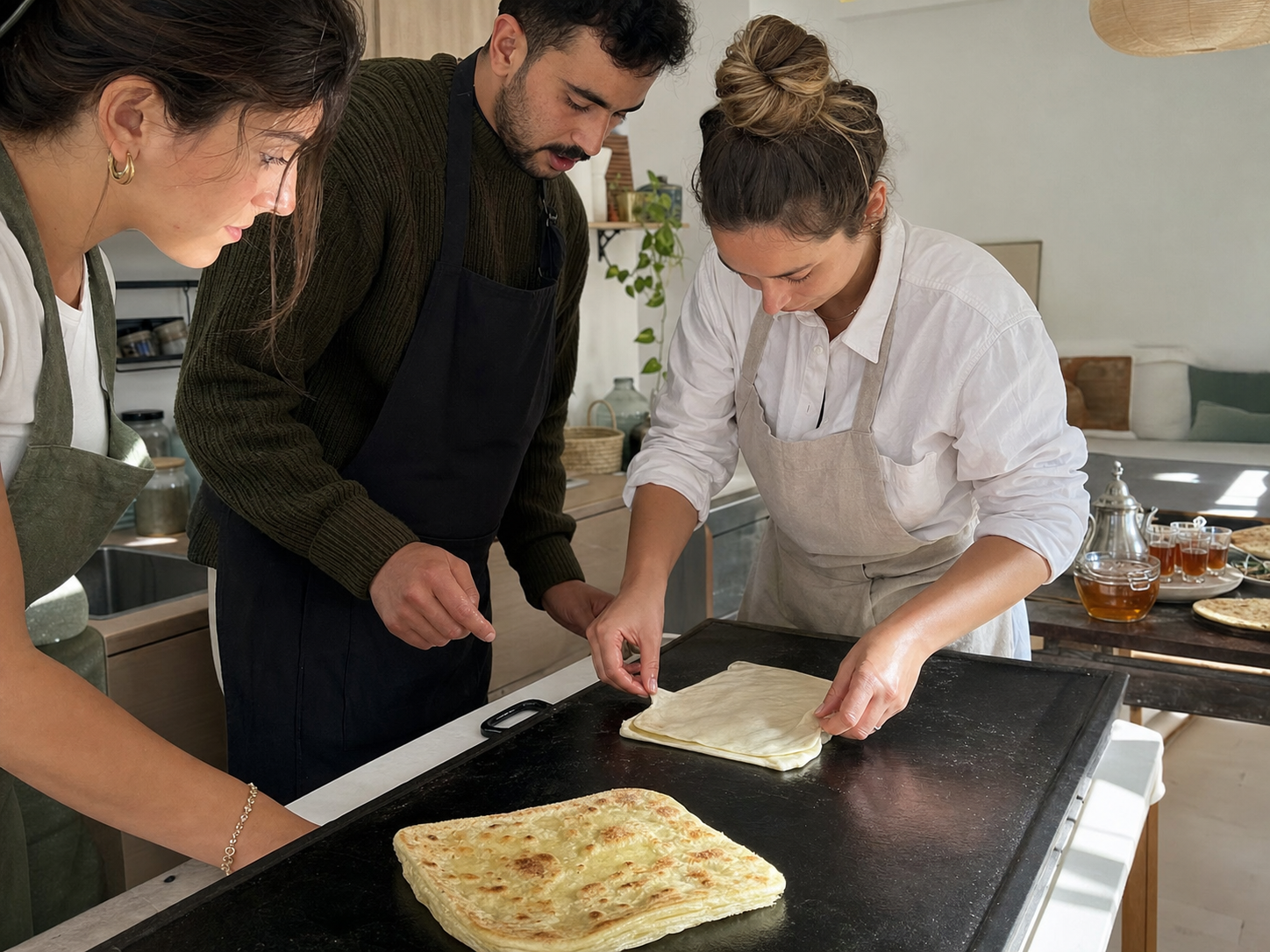
Msemen is the most technically rewarding bread to learn. The dough is stretched paper-thin on an oiled surface, folded into a square, and then cooked on a flat griddle until flaky and golden. The stretching technique requires practice — the dough must be thin enough to see through without tearing. Once you master it, you can make msemen at home with nothing more than flour, oil, salt, and a frying pan.
Baghrir (often called the thousand-hole pancake) is made from a batter of fine semolina and flour, fermented briefly with yeast, and cooked on one side only so that hundreds of tiny bubbles rise and set, creating a spongy surface that absorbs butter and honey. Harcha is denser — a semolina cake cooked on both sides on a dry griddle, with a texture somewhere between a scone and a cornbread. Both are breakfast and snack breads, served with butter, honey, or soft cheese.
What you'll cook
- Khobz — The round daily bread, mixed, kneaded, shaped, and baked — the bedrock of every Moroccan meal.
- Msemen — Layered square flatbread, stretched thin and folded, then griddled until flaky and golden.
- Baghrir — The thousand-hole semolina pancake, cooked on one side only, served with butter and honey.
- Harcha — A dense semolina griddle cake, crisp on the outside and crumbly inside — Moroccan comfort food.
- Rghaif (variation) — A rolled and stuffed version of msemen, filled with onion and herbs or with almond paste for a sweet version.
How the class runs & how long it takes
-
Dough preparation
Mix and knead four different doughs — each bread uses a different flour blend, hydration, and technique.
-
Shaping
Shape khobz rounds, stretch and fold msemen squares, pour baghrir batter, and form harcha cakes.
-
Cooking and baking
Griddle the flatbreads, bake the khobz (in an oven or ferrane), and cook baghrir one-sided until the bubbles set.
-
Tasting with accompaniments
Eat your breads fresh with butter, honey, olive oil, amlou (argan-almond paste), and mint tea.
What to expect
Expect to get your hands in dough. This is a physical class — you knead, stretch, fold, and shape four different breads. The msemen stretching technique takes practice, and your first attempts will probably tear. That is normal and expected.
Expect to learn the role of bread in Moroccan culture, not just the recipes. Your instructor will explain why bread is never thrown away, why it is torn by hand rather than cut with a knife, and why the communal oven is a social hub in every Medina neighbourhood.
Expect to eat an enormous amount of fresh bread. Four breads, each cooked and tasted with accompaniments, is a carbohydrate feast. Come with an appetite.
Usually included
- All flour, semolina, and ingredients
- Hands-on shaping and cooking instruction
- Visit to a communal oven (ferrane) where possible
- Bread to eat fresh and take away
Who this class suits
- Home bakers who want to learn a new bread tradition
- Travellers fascinated by the bread they see in every Moroccan cafe and home
- Families with children — bread-making is tactile and fun for all ages
- Anyone who wants a focused workshop rather than a broad cooking class
Maybe not for you if: Travellers who are gluten-free — all four breads contain wheat or semolina. See the gluten-free class for an alternative.
How to choose the right class
- Ask whether the class includes a visit to a communal ferrane (neighbourhood oven) — this is a unique cultural experience you cannot replicate at home.
- Confirm you make all four bread types, not just one or two — the variety is the point of a dedicated bread workshop.
- Check whether you take bread home — freshly baked khobz and msemen make an excellent edible souvenir for the same evening.
- Ask about accompaniments — amlou (argan and almond paste), local honey, and fresh butter are the traditional partners.
Frequently asked questions
What is a ferrane?
A ferrane is a communal neighbourhood oven found in every Medina quarter. Families bring their shaped dough on wooden boards, the baker stamps each loaf with the family's mark, and bakes them in a wood-fired oven. It is a social institution as much as a bakery.
Can I make these breads at home without special equipment?
Yes. Msemen, baghrir, and harcha need only a flat pan or griddle. Khobz can be baked in a standard home oven. No special equipment is required — the techniques are hand-based.
Is this class suitable for children?
Very much so. Kneading dough, stretching msemen, and pouring baghrir batter are all tactile, fun activities. Children as young as five can participate with supervision.
How is this different from the bread and msemen workshop?
This workshop covers four breads in depth (khobz, msemen, baghrir, harcha) with a focus on baking technique and cultural context. The bread and msemen workshop may cover fewer varieties or include bread as part of a broader class.
Try the recipes at home
Booked, or just browsing? These free step-by-step recipes cover the dishes this class teaches: