Rituals & etiquette
The Role of Bread in Moroccan Life
In Morocco, bread is never just bread. It is the first thing on the table and the last to leave. It is the utensil you eat with, tearing pieces to scoop tagine and wipe sauce. It is considered sacred — never thrown away, never placed upside down, never wasted. Understanding bread is understanding Moroccan food culture at its most fundamental.
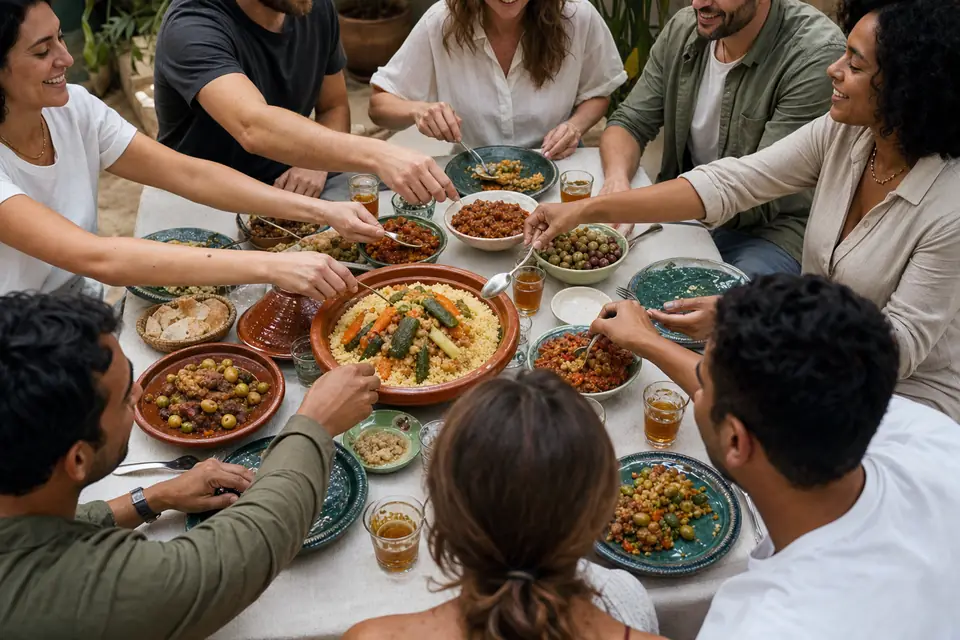
Bread as the centre of the table
Every Moroccan meal, from the simplest breakfast to the grandest feast, begins with bread. Khobz — the round, dense, slightly chewy loaf — is present at every sitting. It is torn by hand into pieces and used to scoop food from shared dishes: tagine, salads, soups, dips. In most meals, bread is the primary utensil; forks and spoons are secondary or absent. The bread absorbs sauce, carries meat and acts as the physical bridge between plate and mouth.
A meal without bread is inconceivable. Even when rice or couscous is served, bread accompanies it. The phrase 'there is no meal without bread' (ma kayn ta wajba bla khobz) is not a proverb — it is a statement of fact. Bread is so central that the Arabic word for it, khobz, is colloquially used to mean 'food' or even 'livelihood' in general.
Sacred status and daily reverence
Bread carries a quasi-sacred status in Moroccan culture, rooted in Islamic reverence for sustenance as a divine gift. Bread must never be thrown in the rubbish — leftover bread is dried and given to animals, or crumbled for birds. A loaf found on the ground will be picked up and placed on a wall or ledge, out of the path of feet. Bread should not be placed upside down on the table. These are not superstitions but deeply held expressions of respect for what sustains life.
The daily rhythm of bread-making — kneading, shaping, baking — was traditionally a defining activity of the Moroccan household, performed by women every morning. In many homes it still is. The warm loaf coming out of the oven or returning from the communal bakery is one of the most fundamental daily rituals of Moroccan domestic life.
Varieties and the communal oven
Beyond everyday khobz, Morocco has a rich bread repertoire: msemen (layered, pan-fried), harcha (semolina griddle bread), batbout (pillowy pocket bread), baghrir (honeycomb pancake), and regional specialities. Each has its place — msemen for breakfast, khobz for lunch and dinner, batbout for street sandwiches.
The ferran — the communal bread oven — is a neighbourhood institution. Families shape their loaves at home, mark them for identification, and send them to the ferran for baking. The baker knows each family's bread. This communal system is still alive in medinas and traditional neighbourhoods, a daily thread connecting homes to community through the shared act of baking.
Good to know
- Bread is the primary eating utensil — tear pieces to scoop and carry food.
- Never throw bread away or place it upside down — it is treated as sacred.
- Offer bread first to guests; it signals the beginning of the meal.
- Leftover bread is dried and given to animals, never wasted.
- Learn to tear khobz with one hand while eating from a shared dish with the other.
Frequently asked questions
Why is bread so important in Moroccan culture?
Bread is the primary eating utensil, the constant companion to every meal, and is considered sacred — a divine gift that must never be wasted. It is central to daily life, to hospitality and to the act of eating itself.
What happens to leftover bread in Morocco?
It is never thrown away. Leftover bread is dried and given to animals, crumbled for birds, or sometimes repurposed in dishes. Wasting bread is considered deeply disrespectful.
Do Moroccans bake bread every day?
Traditionally yes — daily bread-making was a defining household activity. Many families still bake daily, either at home or by sending shaped loaves to the communal oven (ferran).
From the kitchen
Explore the food behind the culture with these recipes: