Grains, flour & pulses · كسكس · kuskus
Moroccan Couscous Grain
The hand-rolled semolina grain that is the foundation of Morocco's Friday meal and most important communal dish
Couscous is not pasta and it is not a grain — it is tiny granules of semolina flour, moistened, rolled by hand, dried and then steamed over a fragrant broth. In Morocco it is the national dish, the Friday meal, the food of celebration and mourning alike. The quality of the grain itself — hand-rolled versus factory-made, fine versus medium versus coarse — determines the texture of the finished dish more than anything else you do to it.
- Darija
- kuskus
- Base
- Durum wheat semolina
- Sizes
- Fine, medium (standard), coarse (mhamsa)
- Prep
- Triple-steamed over broth
What it is
Couscous is made by sprinkling water over fine semolina flour and rubbing the moistened grains between the palms in a circular motion. The friction rolls the semolina into tiny, irregular granules. These are sieved, dried in the sun, and the process is repeated until the granules reach the desired size. Traditional hand-rolled couscous has an irregular texture that catches and absorbs broth beautifully — each granule is slightly different, which is part of the charm.
Factory-made couscous (including 'instant' couscous) is pre-steamed and dried, so it only needs rehydrating with boiling water. It is convenient but produces a flatter, more uniform texture that cannot match the lightness of properly steamed hand-rolled grain. In Morocco, families still hand-roll couscous for special occasions, though many now buy machine-made grain for everyday use.
Mhamsa (also called berkoukes) is a larger, pearl-sized couscous used in soups and stews rather than the classic Friday dish. It has a chewier, more substantial bite.
In the Moroccan kitchen
The canonical use is Friday couscous royale — triple-steamed over a seven-vegetable broth. The grain is worked between steamings with butter and salted water, producing an impossibly light, fluffy result. This is the benchmark for Moroccan home cooking.
Couscous also appears in sweet preparations: seffa (sweet couscous with cinnamon and icing sugar) is served at weddings and celebrations. Fine couscous is used in some desserts as a base for fresh fruit and nuts.
Mhamsa goes into hearty soups — particularly winter bean soups and rfissa — where its larger size holds up to long simmering without dissolving.
- Friday couscous with seven vegetables and lamb or chicken
- Seffa — sweet couscous with butter, cinnamon and icing sugar
- Couscous tfaya — with caramelised onions, raisins and chickpeas
- Mhamsa soup — pearl couscous in a thick bean broth
- Couscous with buttermilk (leben) — a summer afternoon meal
- Base for salads — fine couscous with raw vegetables, herbs and lemon
How to choose & store
For the classic Friday dish, choose medium-grain couscous — it is the standard size and the easiest to steam properly. Fine grain is better for seffa and sweet dishes; coarse grain (mhamsa) is for soups.
Hand-rolled couscous (look for irregular, slightly rough granules) absorbs broth better than machine-made. In Marrakech, you can buy hand-rolled couscous from women's cooperatives and specialist grain stalls — it costs more but the difference in texture is significant.
Avoid instant couscous for traditional dishes — it rehydrates rather than steams, and the result is flat and uniform. It is fine for quick weeknight meals but not for Friday couscous.
Storage — Dried couscous keeps indefinitely in an airtight container in a cool, dry place. Once steamed, couscous should be eaten the same day or refrigerated and reheated within 2 days.
Buying it in Marrakech
What to look for at the stall — and how to buy well without invented prices to anchor you.
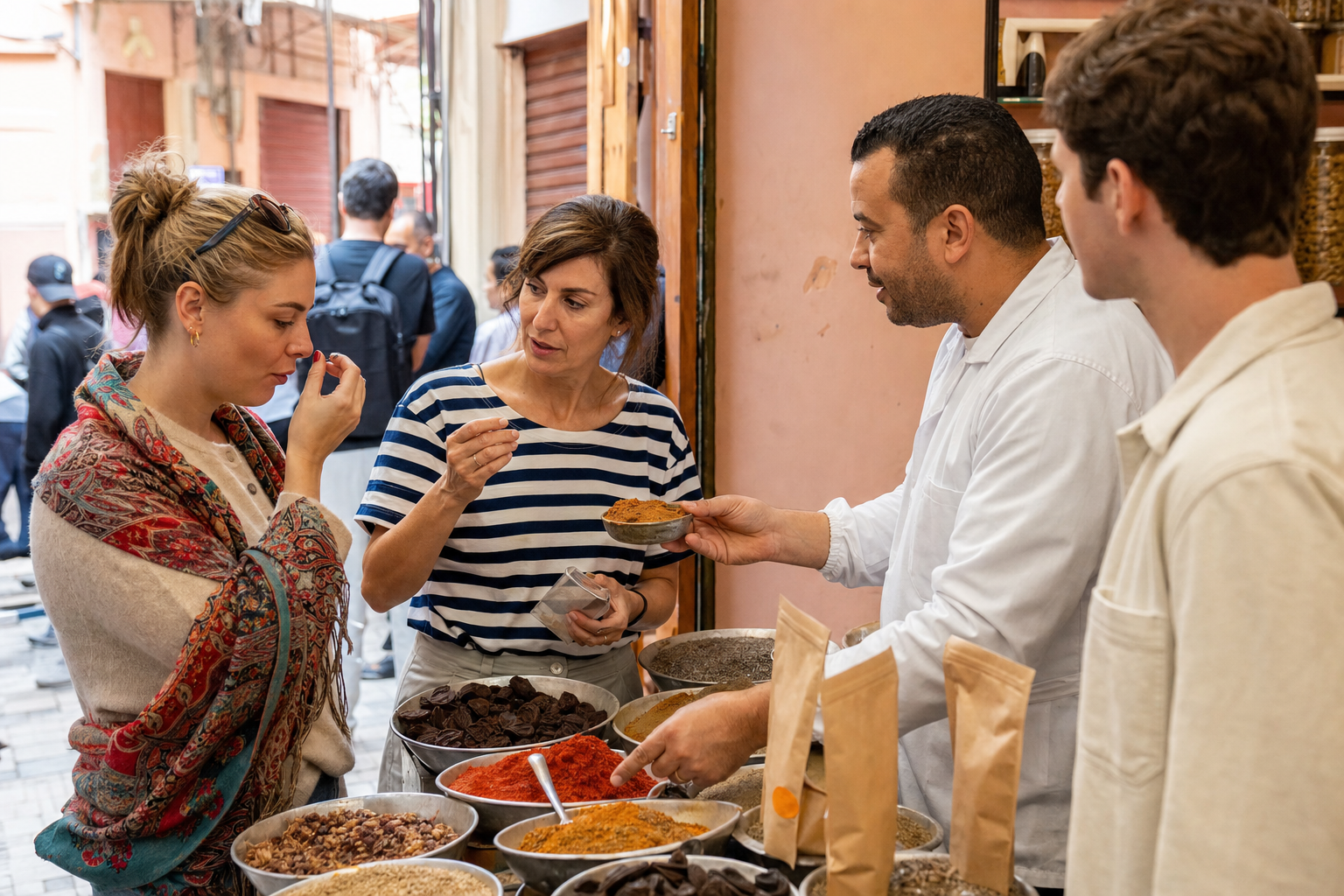
- Grain stalls in the mellah and souk sell couscous by the kilo in fine, medium and coarse grades. Point at the grade you want and ask for the weight.
- Women's cooperatives (particularly in the Ourika Valley and Essaouira) sell hand-rolled couscous in bags — these are often the highest quality available.
- Supermarkets stock machine-made and instant couscous in boxes — convenient but not the same as souk-bought grain.
Substitutes
- Bulgur wheat — similar size, nuttier flavour, does not need steaming
- Israeli (pearl) couscous — much larger, closer to mhamsa in use
- Quinoa — different flavour entirely but works as a grain substitute
Frequently asked questions
Is couscous a pasta or a grain?
Neither, exactly. Couscous is made from semolina (which comes from durum wheat, the same wheat used for pasta), but it is not extruded — it is hand-rolled and steamed. It occupies a category of its own.
Why does my couscous come out clumpy?
Either it was not broken and raked between steamings (the butter-and-fork step is essential), or it was over-moistened. Each steaming should use less water than the last.
Can I use instant couscous for a tagine?
Yes — instant couscous is fine as a side for tagines. The triple-steaming method is mainly important for Friday couscous, where the grain is the star rather than a supporting player.