Couscous & grains
How to Prepare Couscous Royale with Seven Vegetables
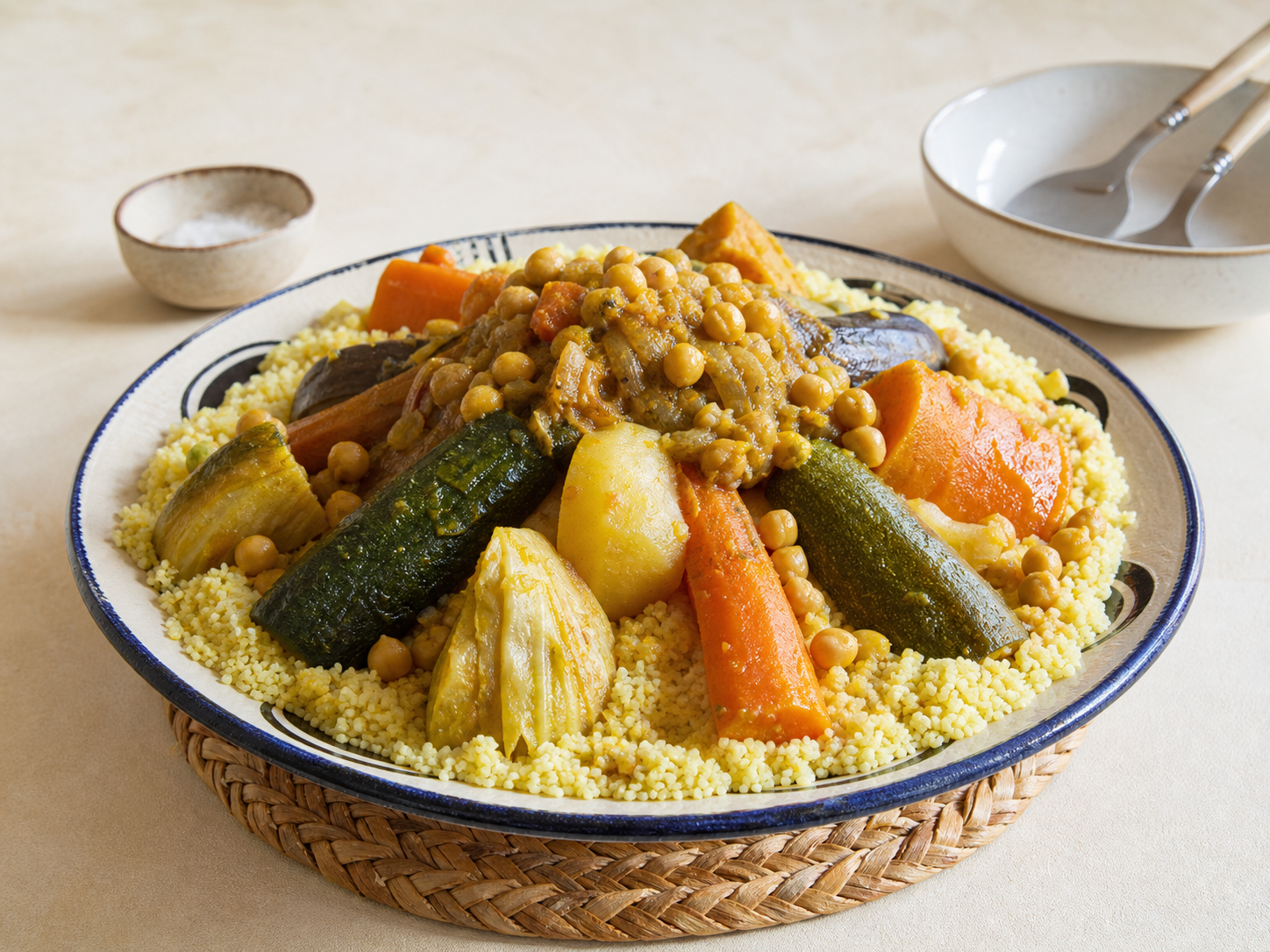
Couscous royale — the grand Friday meal of Morocco — is not a recipe so much as a technique. The grain is steamed in three passes over a slow-simmered broth of seven vegetables and meat, each steaming making it lighter and fluffier. The vegetables are layered by cooking time so nothing is overcooked, and the final plating is architectural: a dome of couscous, topped with arranged vegetables and meat, drenched in broth. Getting it right is the defining test of a Moroccan cook.
- Difficulty
- Advanced
- Active time
- 2 hours
- Yields
- Serves 8–10
- Best tool
- Couscoussier (two-part steaming pot)
What you need
- Couscoussier — a two-tier pot with a perforated upper basket
- Large wide bowl (gsaa) for working the couscous
- Clean tea towel
- Large serving platter
Why it matters
Friday couscous is Morocco's most important communal meal. Families gather after noon prayers to eat from a shared platter, and the quality of the couscous reflects the cook's skill and the household's hospitality. It is never rushed — the three-steaming method takes time but produces a grain that is impossibly light, each granule separate and infused with the steam of the broth below.
The couscous royale title means the broth includes multiple meats (lamb, chicken, merguez) and the canonical seven vegetables. The number seven is traditional and loosely observed — it typically includes turnips, carrots, courgettes, pumpkin, cabbage, onions and chickpeas, but families vary it by season.
Step-by-step method
-
Prepare the grain
Spread 500 g medium couscous in a wide bowl. Sprinkle with salted water (1 tsp salt in 150 ml water), rake through with your fingers and let it absorb for 10 minutes. Add 1 tbsp olive oil and 1 tbsp butter, and rub the grains between your palms to coat and separate them.
-
Start the broth
In the bottom of the couscoussier, brown 500 g lamb shoulder (cubed) and 1 whole chicken leg in olive oil. Add 2 large onions (quartered), 4 tomatoes (grated), 1 tsp turmeric, 1 tsp black pepper, a pinch of saffron, salt, and enough water to fill the pot two-thirds. Bring to a boil, then simmer.
-
First steaming
When the broth is simmering, seal the join between the two tiers with a strip of cloth dipped in flour-and-water paste (this prevents steam escaping sideways). Tip the couscous into the upper basket and steam uncovered for 20 minutes from the moment steam rises through the grain.
-
First break
Tip the couscous back into the wide bowl. Sprinkle with 100 ml cold salted water, rake and toss with a fork to break any clumps. Add root vegetables to the broth now: carrots, turnips, and drained chickpeas. Rest the couscous 10 minutes.
-
Second steaming
Return the couscous to the basket, re-seal the join, and steam for another 20 minutes. Meanwhile add pumpkin to the broth.
-
Second break
Tip out again, sprinkle with 50 ml cold water and 1 tbsp butter, rake, and rest 10 minutes. Add courgettes and cabbage to the broth now — they need less time.
-
Third steaming
Return to the basket for a final 15–20 minutes of steaming. The couscous should now be extremely light, fluffy and each grain separate.
-
Plate
Mound the couscous into a dome on a large platter. Arrange the vegetables around and over it in a symmetrical pattern — root vegetables at the base, softer ones higher up, meat on top. Ladle broth generously over everything and serve the remaining broth in a bowl alongside.
Common mistakes
- Skipping the seal between the tiers — steam that escapes sideways is steam that does not cook the couscous. The flour-paste seal is essential.
- Not breaking the couscous between steamings — without the cold-water break and raking, the grains clump into a dense, stodgy mass.
- Adding all vegetables at once — each vegetable has a different cooking time. Adding them in stages ensures nothing is mushy.
- Covering the couscous during steaming — the basket should be open on top so steam passes through and out. Covering traps condensation and makes the grain wet.
Tips
If you do not have a couscoussier, a colander lined with muslin set over a large stockpot works.
The broth should be well seasoned — it is the primary flavour delivery for the couscous, which is relatively bland on its own.
Recipes and dishes that use this
Keep exploring
Frequently asked questions
Why three steamings?
Each steaming hydrates and fluffs the grain a little more. One steaming produces dense, heavy couscous; two is acceptable; three is the traditional standard and produces the lightest result. It is the difference between good and extraordinary.
Can I use instant couscous?
Instant couscous is pre-steamed and just needs hot water. It works for a weeknight dinner but lacks the texture and flavour absorption of triple-steamed couscous. For couscous royale, the traditional method is strongly recommended.
What are the traditional seven vegetables?
Turnips, carrots, courgettes, pumpkin, cabbage, onions and chickpeas are the most common combination, but families vary it by season and preference. Some include broad beans, artichokes or sweet potatoes.