Travel tips
How to Choose Your First Cooking Class in Marrakech
Marrakech has dozens of cooking classes, and they are not all the same. Location, group size, menu focus, instructor style, and price vary widely. This guide gives you a clear framework for narrowing the options, asking the right questions, and picking the class that matches your interests, schedule, and budget.
At a glance
- Medina classes offer atmosphere and souk walks; Gueliz and Palmeraie classes offer space and modern kitchens.
- Small-group classes (4-8 people) hit the sweet spot of social atmosphere and personal attention.
- Ask about the specific menu before booking -- some rotate daily, others offer fixed programmes.
- Private classes cost more but allow complete customisation of pace, menu, and dietary needs.
- Read recent reviews, not just star ratings -- look for comments on the instructor and the depth of explanation.
Location: Medina, Gueliz, or Palmeraie
Medina-based classes are the most atmospheric. The kitchen is usually in a traditional riad, and the souk walk that opens the class is part of the experience -- you pass through narrow lanes, buy from local vendors, and return through the same passages you will navigate for the rest of your trip. The trade-off is that riad kitchens can be small, access is sometimes up steep stairs, and the souk walk takes longer.
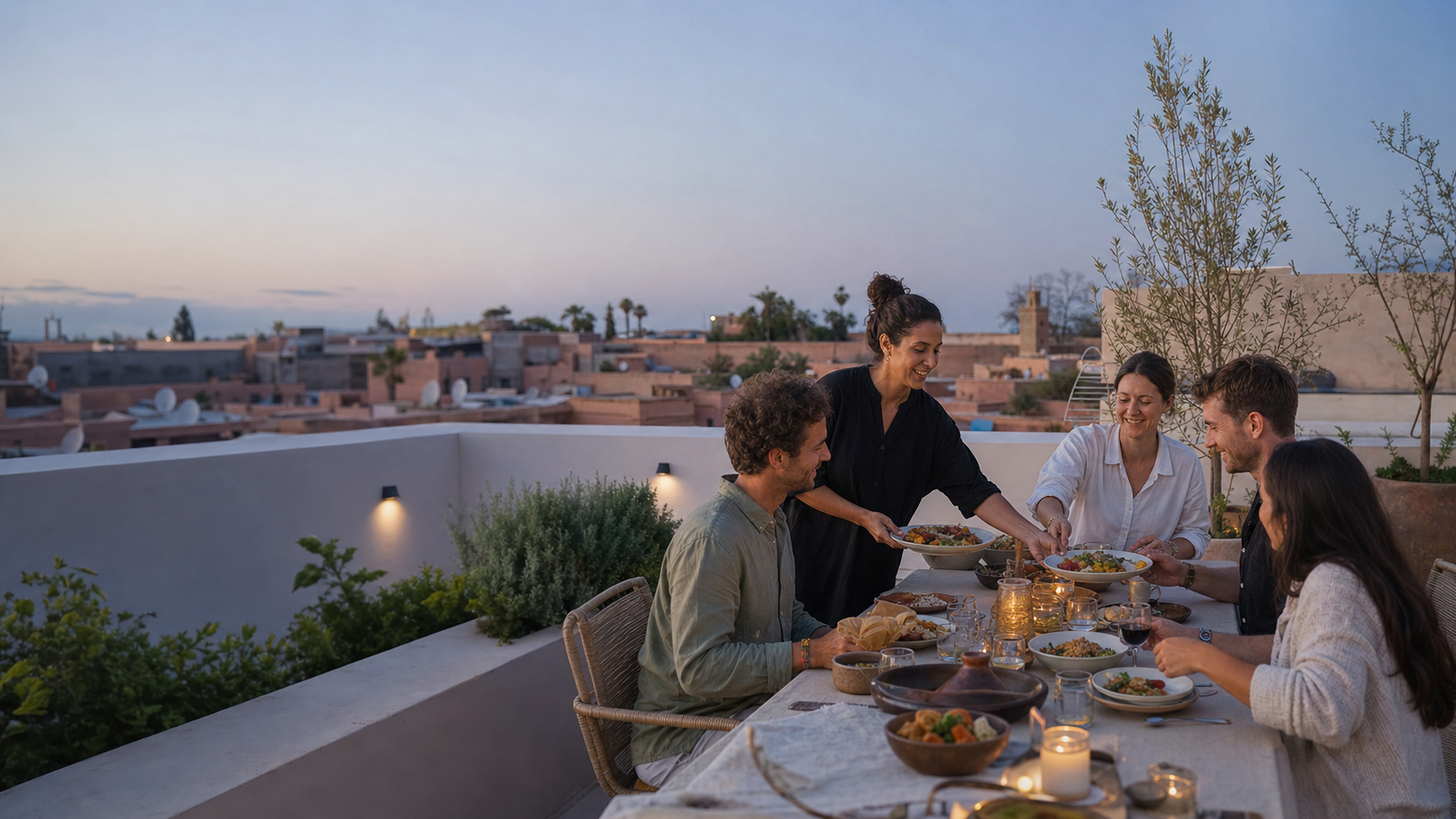
Classes in Gueliz (the new city) or the Palmeraie tend to have purpose-built kitchens with more counter space, better ventilation, and easier access. Some have rooftop terraces or garden settings. The market visit may be replaced by a trip to a modern produce market or pre-purchased ingredients, which is less picturesque but more efficient.
Neither is objectively better. If the souk atmosphere is a priority, go Medina. If comfort, space, and ease of access matter more -- especially for travellers with mobility concerns or families with young children -- consider Gueliz or the Palmeraie.
Group size and format
Most classes fall into three formats: small group (four to eight people), standard group (eight to twelve), and private (just you, or your party). Small groups are the sweet spot for most visitors: enough people to be social, few enough for personal attention from the instructor.
Private classes are worth considering if you have specific dietary needs, want to choose the menu, or prefer a slower pace. They cost more -- typically a meaningful premium over a group class -- but you get the instructor to yourself and can ask unlimited questions. For couples, a private class can be a memorable shared experience.
Very large group classes (twelve-plus) are less common in Marrakech and generally less satisfying. In a big group, you may only handle one or two tasks yourself while watching the rest. If a school advertises groups of fifteen or more, it is worth asking how the hands-on work is divided.
Menu and dish focus
The standard Marrakech cooking class teaches tagine, couscous, Moroccan salads, and sometimes bread or pastry. If that mix sounds good, any reputable school will deliver. But if you have a specific interest -- learning pastilla, mastering bread and msemen, or focusing on Moroccan desserts -- you need a school that offers that focus.
Some schools rotate their menu daily or weekly. This can be an advantage if you are flexible (you might get a dish you would not have chosen yourself) or a disadvantage if you have your heart set on a specific item. Ask the school what is on the menu for your chosen date before you book.
Vegetarian and vegan menus are widely available. Most schools can substitute meat with vegetable-based dishes if you request it at booking. For a fully plant-based class, look for a dedicated vegetarian and vegan class rather than hoping a standard class can adapt on the fly.
Questions to ask before booking
A few direct questions will tell you most of what you need to know. Ask: What dishes are on the menu for my date? Is a market visit included? What is the maximum group size? Who is the instructor, and do they speak English? Can you accommodate my dietary needs? What time does the class start and finish? Is pickup from my hotel included?
Read the cancellation policy carefully. Some schools offer free cancellation up to 24 or 48 hours before; others are non-refundable. In a city where weather, transport, and stomach bugs can disrupt plans, flexibility matters.
Finally, check recent reviews on multiple platforms -- not just the booking site. Look for comments that mention the instructor by name, describe the depth of cultural explanation, and say whether the class felt rushed or well-paced. A high star rating with no detail tells you less than a four-star review that explains exactly what the reviewer learned.
Frequently asked questions
How much does a cooking class in Marrakech cost?
Prices vary widely. Budget group classes sit at the lower end of the range, while private and luxury experiences command a significant premium. The difference usually reflects group size, ingredient quality, kitchen setting, and whether a souk walk is included. Mid-range group classes are the most popular and generally offer good value.
Is a morning or afternoon class better?
Morning classes are more popular because the souk is busiest and freshest in the morning, and you eat what you cook as lunch. Afternoon and evening classes are quieter, cooler in summer, and end with dinner. Neither is better -- it depends on your schedule.
Should I book a half-day or full-day class?
A half-day class (three to four hours) suits most visitors and covers three to five dishes. A full-day class (six to seven hours) goes deeper, with more dishes, longer technique segments, and sometimes a tea ceremony. Full-day classes are best for food enthusiasts who want maximum immersion.
Can I book a couples cooking class?
Yes. Several schools offer couples classes, which are usually private sessions with a romantic setting -- sometimes on a rooftop terrace. These are popular for honeymoons and anniversaries.