- culture
- guides
- dishes
A Brief History of Moroccan Food: From Berbers to Modern Cuisine
Moroccan cuisine is one of the most complex and layered in the world — and that complexity has a historical explanation. Over two millennia, wave after wave of cultural influence has added to the base layer of indigenous Berber cooking, creating a cuisine that is simultaneously African, Mediterranean, Arab and European. This is the story of how that happened.
- Read
- 8 min
- Updated
- 23 July 2026
- Sections
- 5
Ancient Berber foundations (before 7th century)
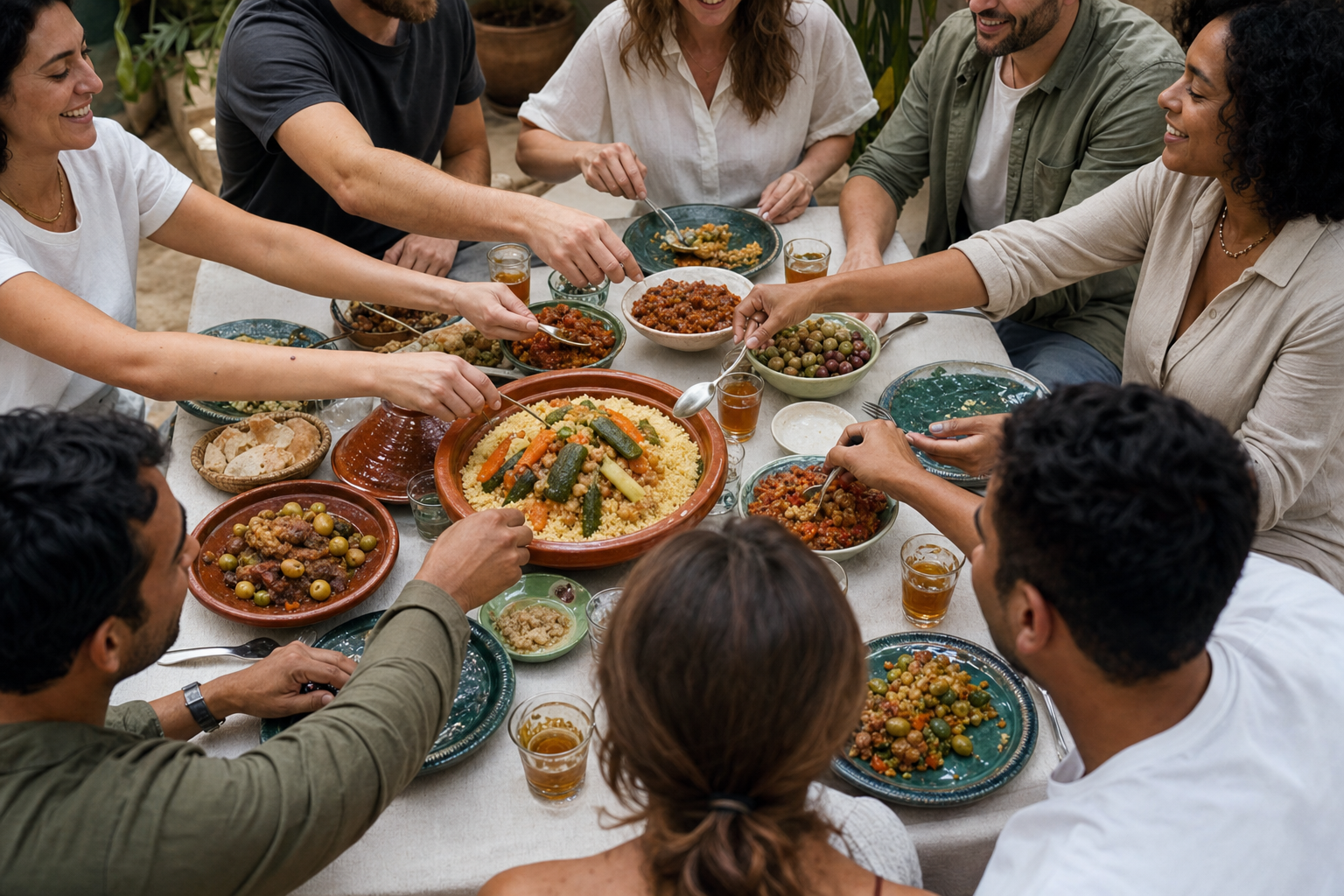
The foundation of Moroccan cooking is Berber (Amazigh) — the indigenous people of North Africa who have been cooking on this land for thousands of years. The Berber contribution is the most fundamental layer: couscous (the technique of steaming semolina over a broth), tagine cooking (slow-braising in clay pots), preserved meats (khlea), fermented butter (smen), and the use of local ingredients like argan oil, olives, barley and mountain herbs.
Many of the dishes that tourists consider 'Moroccan' are actually Berber in origin: couscous, tagine, harcha, and the tradition of communal eating from a shared dish.
Arab conquest and the spice revolution (7th-11th century)
The Arab conquest of North Africa in the 7th century brought Islam, the Arabic language, and a transformative culinary influence: spices. Through Arab trade networks, Moroccan cooking gained access to saffron, cumin, cinnamon, ginger, turmeric, coriander and black pepper — the spice palette that defines Moroccan cuisine today.
The Arab influence also brought: the sweet-savoury flavour principle (meat with fruit, sugar in savoury dishes), rice pilaf techniques, and the elaborate ceremonial dining culture that Moroccan riads still celebrate.
Andalusian refinement (13th-17th century)
When the Moors were expelled from Spain during the Reconquista, hundreds of thousands of Andalusian Muslims and Jews fled to Morocco — bringing with them the most refined cuisine in the medieval Mediterranean. The Andalusian contribution is the layer of elegance: pastilla (from the Spanish 'pastela'), the elaborate pastry tradition, the use of almonds and dried fruits in savoury dishes, and the refined, multi-course meal structure.
Fes, where many Andalusian refugees settled, became the culinary capital of Morocco — and its cuisine (sweeter, more elaborate, more pastry-intensive) still reflects this Andalusian influence today.
French colonial influence (1912-1956)
French colonialism brought café culture, baguettes, patisserie techniques, wine production and the modern restaurant concept to Morocco. The French influence is most visible in the Ville Nouvelle (new city) districts of Marrakech, Casablanca and Rabat — where French-style cafés, brasseries and patisseries still thrive.
The most lasting French contribution is probably the café: the ritual of coffee, croissants and people-watching that is now as Moroccan as mint tea.
Modern Moroccan cuisine (21st century)
Today, Moroccan cuisine is experiencing a renaissance. A new generation of Moroccan chefs — trained internationally but rooted in tradition — is reinterpreting classic dishes with modern techniques. At the same time, the rise of food tourism has brought global attention to traditional cooking, ensuring that the old techniques survive alongside the new.
The result is a cuisine that honours its Berber, Arab, Andalusian and French layers while continuing to evolve — one of the most exciting food stories in the world.
Frequently asked questions
Is Moroccan food Arab or African?
Both — and also Mediterranean and European. Moroccan cuisine is a synthesis of Berber (African), Arab, Andalusian (European) and French influences. It cannot be reduced to a single tradition.
Why is Moroccan food so different from other North African cuisines?
Geography and history. Morocco's Atlantic coast, Atlas mountains, Sahara proximity and Andalusian refugee population created conditions that no other North African country shares. The result is a cuisine with more variety and complexity than its neighbours.