Themed food days
Marrakech After Dark: A Late-Night Food Crawl
Marrakech does not sleep hungry. While most tourist restaurants close by 11pm, the medina's street food scene is just getting started. From the theatrical smoke stalls of Jemaa el-Fna to hole-in-the-wall snail soup vendors and dawn bakeries, this crawl covers the city's best eating from sundown to the small hours.
- Duration
- 6–8 hours (8pm–2am+)
- Pace
- Leisurely, with long breaks
- Best for
- Night owls, street food lovers
- Budget
- 150–250 MAD total
- Walking
- ~3 km total
Before you start
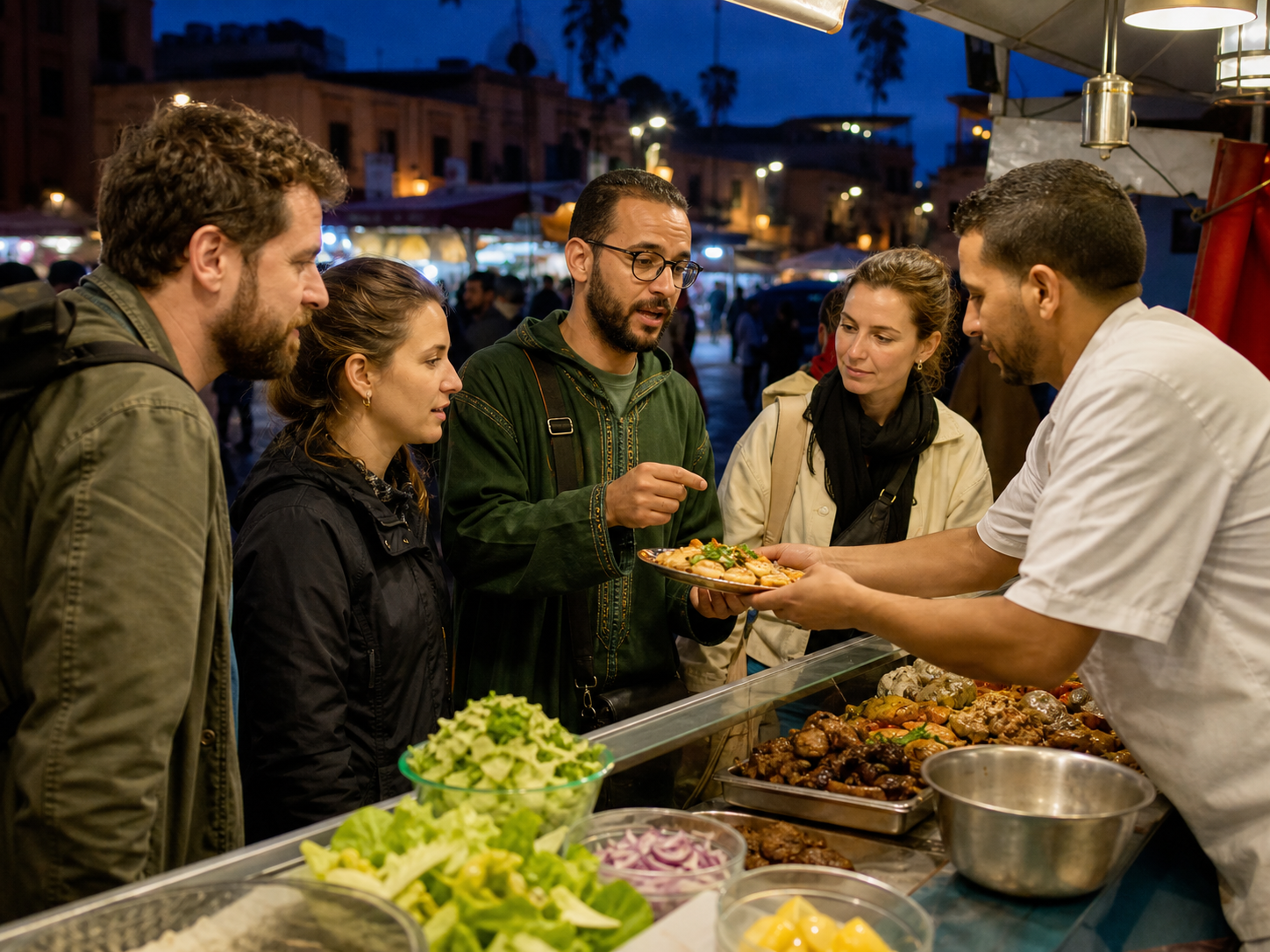
Marrakech after dark is a different city. The heat drops, the medina lights up, and the food scene shifts from sit-down restaurants to street stalls, carts, and tiny hole-in-the-wall joints that serve a single dish to perfection. This itinerary follows the natural rhythm of Marrakchi night eating — starting with the early-evening spectacle of Jemaa el-Fna, moving through the lesser-known streets for specialist snacks, and ending at the dawn bakeries where the next day's bread is already coming out of the oven.
Safety note: the medina is generally safe at night, especially around Jemaa el-Fna and the main arteries. Stick to lit, busy streets. Avoid empty derbs (alleyways) after midnight. Eating at stalls with other Moroccans present is both safer and a guarantee of food quality.
The plan, in order
9 stops, timed morning to night — follow it top to bottom.
Evening
8:00pm – 10:00pm
The Jemaa el-Fna spectacle: smoke stalls, fresh juice, and the harira round.
-
Jemaa el-Fna smoke stalls
Arrive as the stalls are fully set up and the smoke is billowing. Choose a stall with good turnover (the busier, the fresher). Order a mixed grill plate — lamb chops, merguez, kefta — with bread, harissa, and a side salad. The stalls are numbered but interchangeable in quality. Let the touts pitch you but choose based on crowd size, not persuasion. Budget: 40-70 MAD per plate.
Tip: Stalls near the centre of the square are pricier and more aggressive. Walk to the edges for better prices and calmer service. -
Fresh juice and dried fruit
Walk to the juice stalls on the north side of the square. Orange juice is the classic (4-5 MAD per glass fresh-squeezed). Some stalls offer mixed juices — avocado, banana, almond milk blends (10-20 MAD). Pair with a handful of dried figs and dates from a nearby vendor (10 MAD). This is your palate cleanser between savoury rounds.
-
Harira and bread
Find a harira vendor — they are scattered around the square's periphery, often with a large bubbling pot and a stack of bowls. A bowl of thick, spiced harira with a piece of bread is 5-10 MAD. This is Morocco's national soup: tomato-based, with chickpeas, lentils, and herbs. During Ramadan this is the first food eaten at iftar; outside Ramadan it is a warming late-evening snack. Drink it standing up, Moroccan style.
About harira
Late night
10:30pm – 12:30am
Beyond the square: snail soup, head meat, and the sardine alleys.
-
Snail soup (babbouche)
Head into the medina side streets off Jemaa el-Fna to find the snail soup vendors. You will spot them by the distinctive large pot and the small wooden toothpicks. A bowl of snails in peppery, cumin-scented broth costs 10-15 MAD. Pick the snails from their shells with the toothpick, then drink the spicy broth — it is considered medicinal, good for digestion and warming in cool evenings. This is one of Morocco's most distinctive street foods.
Tip: If snails are not your thing, the broth alone is delicious — ask for just the soup. -
Kefta sandwich
Small sandwich shops in the medina stay open until 1-2am. Order a kefta sandwich — spiced ground beef, grilled over charcoal, stuffed into a half-baguette with tomato, onion, and harissa. This is Morocco's equivalent of the late-night kebab. A full sandwich costs 15-25 MAD. Look for shops where the grill is active and the meat is being shaped to order, not pre-cooked.
-
Tanjia joints
A few spots near the tanneries and in the Bab Doukkala area serve tanjia through the night — the pot has been slow-cooking in the hammam ashes since morning and is at its most tender by midnight. Ask for a quarter portion with bread (50-80 MAD). Tanjia is Marrakech's signature dish: beef or lamb shoulder cooked with preserved lemons, garlic, saffron, and smen in a sealed clay pot. The meat will be falling apart.
About tanjia
After midnight
1:00am – 2:30am
The dawn bakery run and mint tea nightcap.
-
Bessara cart
Street vendors selling bessara — a thick, creamy dried fava bean soup — set up in the small hours around the medina. A bowl costs 5-8 MAD, drizzled with olive oil, cumin, and a dusting of paprika. This is working-class food: filling, cheap, and deeply comforting. The carts operate from around midnight until dawn, serving bakers, night workers, and nocturnal wanderers.
About bissara -
Night bakery visit
Medina bakeries fire up their wood ovens around 1-2am to have fresh bread ready for the morning rush. Find one with the oven going — the smell of baking khobz is unmistakable. Some bakeries sell hot msemen (layered flatbread) and harcha (semolina griddle bread) straight from the griddle for 2-5 MAD each. Eating fresh bread at 2am, standing in a flour-dusted bakery watching the baker work by the light of the oven, is one of Marrakech's most authentic food experiences.
-
Final mint tea
A handful of cafés in the Jemaa el-Fna area stay open 24 hours. Order a pot of mint tea (10-15 MAD) and sit. The square is quieter now but not empty — there are still clusters of people, the odd musician, and the vast sky above. The tea is your signal to decompress. You have eaten your way across Marrakech's full nocturnal food cycle.
Practical tips
- Carry small bills (5, 10, 20 MAD notes). Street vendors rarely have change for 200 MAD.
- Eat where Moroccans eat. An empty stall at 10pm is a red flag — move on.
- Drink bottled water between stops. Tap water is safe in Marrakech but bottled is easier to carry.
Make it your own
Skip the square entirely
Start directly in the medina side streets for a more local experience — Bab Doukkala area has excellent late-night kefta and tanjia without the tourist markup.
Add a hammam break
Some hammams accept late-night visitors (until midnight). A hammam between the evening and late-night rounds resets your appetite — and you will need it.
Frequently asked questions
Is it safe to eat street food at midnight?
Yes — the vendors serving at midnight have been there for hours and the food is freshly cooked. The risk is the same as daytime street food (minimal). Choose stalls with high turnover, meat cooked to order, and other Moroccan customers present.
Is Jemaa el-Fna safe at night?
The square itself is safe and well-lit until 2-3am, with police presence. The main medina arteries are safe. Avoid unlit derbs (narrow alleys) after midnight if you are unfamiliar with the area. Petty theft (pickpocketing) is the main risk — keep valuables secure.
Make it happen
Ready to turn the plan into a trip? Book the hands-on parts, find a food tour to fill an afternoon, or read up before you go.