- Moroccan tea
- mint tea
- atay
Moroccan Mint Tea: History, Ceremony and How to Make It
Moroccan mint tea (atay b'nana) is not just a drink — it is a social ritual, a gesture of hospitality and an art form. The tea, the pouring technique, the glasses and the timing all carry meaning. Refusing a glass is a social affront; accepting it is the beginning of a conversation. This guide covers the history, the ceremony and the practical technique.
- Read
- 6 min
- Updated
- 23 July 2026
- Sections
- 4
History: how tea came to Morocco
Tea is not native to Morocco — it arrived via British trade in the 18th century, when the British were looking for markets for surplus Chinese gunpowder green tea. Moroccans adopted it with spectacular enthusiasm, combining it with fresh mint and generous amounts of sugar to create a drink that became central to their culture within a few generations.
Today, Morocco is one of the world's largest importers of Chinese green tea — a remarkable cultural adoption for a country with no historical tea-growing tradition.
The three glasses
The Moroccan proverb says: 'The first glass is as gentle as life, the second is as strong as love, the third is as bitter as death.' Traditionally, three glasses are served, each from the same pot but tasting slightly different as the tea steeps longer. Accepting all three is polite; leaving after one is abrupt.
In practice, the tea continues flowing as long as guests are present. The three-glass structure is a minimum, not a maximum.
The pouring technique
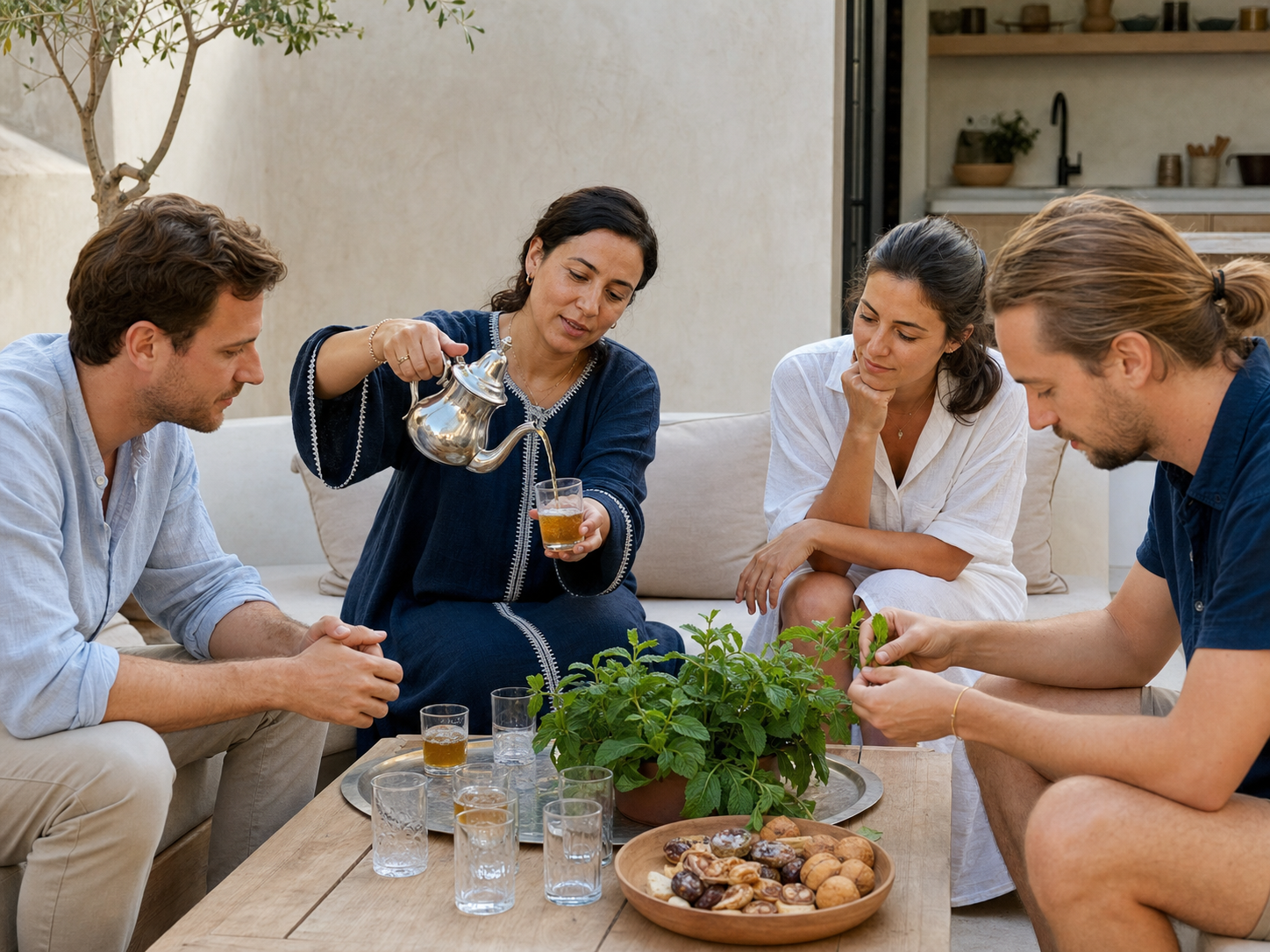
The tea is poured from a height — the teapot is raised 30-50cm above the glass. This is not showmanship: the height aerates the tea, cools it slightly and produces the characteristic foam (razwa) on top. A glass without foam is poorly made.
The first pour is returned to the pot (this rinses the leaves and mixes the sugar). Only the second and subsequent pours are served to guests.
How to make Moroccan mint tea at home
Use Chinese gunpowder green tea (2 tablespoons per pot), a large bunch of fresh spearmint and sugar to taste (Moroccans use 4-6 sugar cubes per small pot — adjust to your preference). Rinse the tea leaves with a splash of boiling water, discard the rinse water, then add fresh boiling water, mint and sugar. Steep for 3-4 minutes. Pour from a height into small glasses.
- Use spearmint (nana), not peppermint — the flavour is completely different.
- The pot should be metal (stainless steel or traditional silver-plated) — it retains heat and allows the high pour.
- In winter, Moroccans add fresh wormwood (sheeba) or verbena (louisa) instead of or alongside mint.
Frequently asked questions
Is it rude to refuse Moroccan tea?
Yes — refusing tea is a social rebuff in Morocco. If you genuinely cannot drink (medical reasons, etc.), explain politely and your host will understand. Otherwise, accept at least one glass.
How sweet is Moroccan tea?
Very sweet by Western standards. The traditional amount is 4-6 sugar cubes per small pot (serving 3-4 glasses). You can politely ask for less sugar (qalil sukkar) without causing offence.
What kind of tea is used?
Chinese gunpowder green tea — rolled into small pellets that unfurl when steeped. This specific variety is essential; other green teas produce a different result.