- guides
- neighbourhoods
- culture
A Guide to Moroccan Food Markets and Souks
The souk is the beating heart of Moroccan food culture. Before there were restaurants, before there were supermarkets, there was the souk — the daily market where everything is bought, sold, tasted and argued over. This guide covers how to navigate, shop and eat in a Moroccan food market.
- Read
- 8 min
- Updated
- 23 July 2026
- Sections
- 4
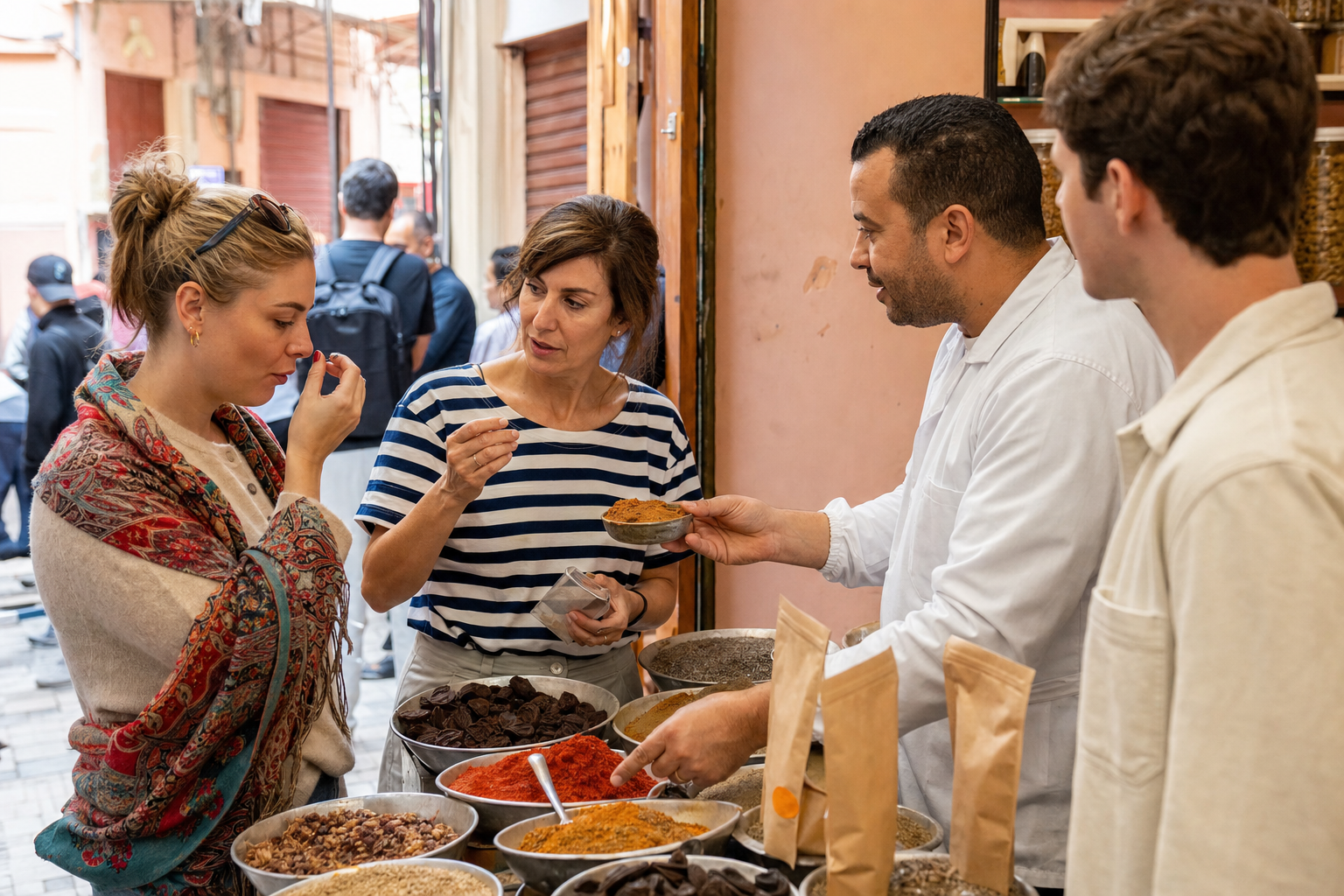
The structure of a Moroccan souk
Moroccan souks are not random — they are organised by trade, a system dating back centuries. The food sections cluster together: spice sellers (attarin) occupy one quarter, produce sellers another, olive and preserved food sellers another, and butchers and poultry sellers are always on the periphery (for hygiene and animal welfare reasons).
In Marrakech, the main food souk areas are: the spice quarter near Rahba Kedima (the old slave market), the olive stalls along Souk Semmarine, the produce market near Bab Doukkala, and the fish and meat sections near the tanneries.
What to buy in a Moroccan food souk
The best food purchases in a Moroccan souk — things that are fresher, cheaper or better than you will find elsewhere:
- Spices — saffron, cumin, ras el hanout, paprika. Buy from reputable sellers who grind to order.
- Olives — dozens of varieties, cured in-house. Taste before buying.
- Preserved lemons — soft, golden and incredibly cheap compared to Western shops.
- Argan oil — culinary (roasted, nutty) and cosmetic (unroasted, milder). Buy from cooperatives.
- Dried fruits and nuts — dates, figs, almonds, walnuts. Quality is excellent.
- Honey — thyme honey from the Atlas mountains is the premium variety.
- Amlou — argan-almond-honey paste. The Moroccan Nutella.
Bargaining and prices
Bargaining is expected in the souk, but it is not the aggressive sport that guidebooks describe. The basic principle: the first price quoted to a tourist is usually 2-3x the real price. A fair price is somewhere in between. A reasonable strategy: offer 50% of the quoted price and settle around 60-70%.
For spices and staples, prices are more fixed — the margins are smaller and the sellers know that tourists can check prices at the next stall. For tourist items (tagine pots, tea glasses, textiles), the markup is higher and bargaining is more expected.
The most important tip: do not feel pressure to buy. Walk away if the price does not feel right. The seller will still be there tomorrow, and there are dozens of others selling the same thing.
Eating in the souk
The souk is not just for shopping — it is also a place to eat. Street food vendors set up within the market, selling freshly squeezed juices, grilled meats, fried pastries and snacks. The best strategy is to shop first and eat second — you will work up an appetite navigating the alleys.
Look for: juice stalls (5-10 MAD for fresh orange or pomegranate), msemen stands (hot griddle bread, 2-5 MAD), grilled kefta (15-25 MAD), and roasted nuts (sold by the cone, 10-15 MAD).
Frequently asked questions
What time do Moroccan souks open?
Most souks open by 9-10am and close by 7-8pm. Some food sections (butchers, produce) open earlier. The best time for shopping is mid-morning (10am-12pm) when everything is open and the crowds are manageable.
Are souk prices cheaper than supermarkets?
For spices, olives and dried goods, generally yes — but only after bargaining. For staples like sugar and oil, supermarket prices are often lower.