Best of · Classes
Best Riad Cooking Experience in Marrakech 2026
There is a meaningful difference between a cooking class that happens to be held in a riad and one where the riad itself is part of the experience. The best riad cooking experiences in 2026 use a traditional courtyard kitchen — tiled surfaces, brass cookware, a charcoal kanoun — and fold the architecture, the hospitality and the history of the house into the lesson. This guide helps you find that version.
- Read
- 9 min
- Topic
- Classes
- Updated
- 23 July 2026
The short answer
The short answer
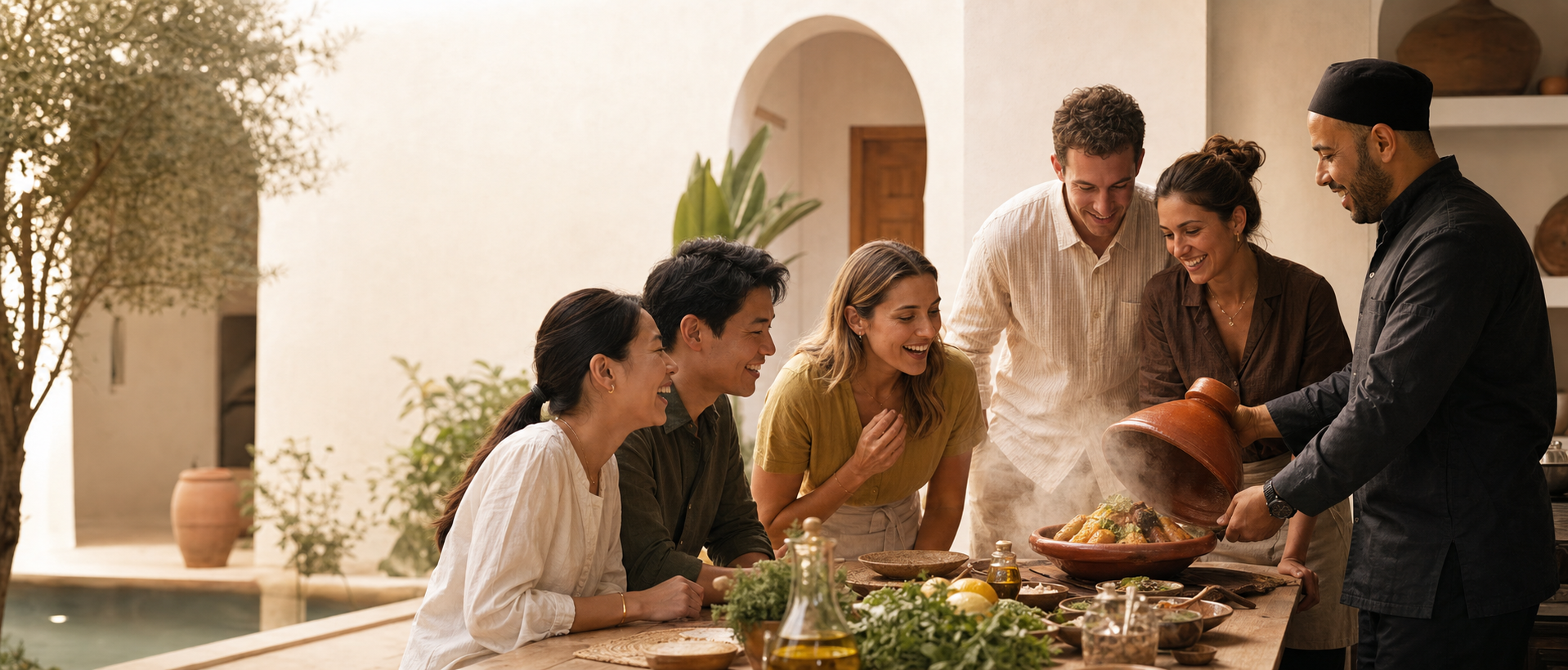
The best riad cooking experience in Marrakech for 2026 is a hands-on session in a traditional riad courtyard kitchen where the setting, cookware and hospitality are integral to the class — not just a backdrop. Look for a capped group, a real domestic kitchen (not a commercial one relocated to a riad), and a host who explains the cultural context alongside the cooking. A small-group class in a riad setting consistently delivers the strongest immersion.
At a glance
- A genuine riad kitchen — tiled, with brass cookware and a charcoal kanoun — is the defining feature.
- The best experiences fold architecture, hospitality and food history into the cooking lesson.
- Small groups (under eight) get the most from a riad setting — you need space to spread out.
- A meal eaten in the courtyard afterwards is part of the experience, not an afterthought.
What makes a riad cooking experience exceptional
-
A real riad kitchen, not a commercial set
The kitchen should feel domestic — hand-laid zellige tiles, copper and brass cookware, perhaps a charcoal kanoun alongside modern burners. If it looks like a restaurant prep kitchen relocated to a courtyard, the immersion is lost.
-
Cultural context woven in
The best hosts explain why dishes are cooked the way they are — the history of the tagine, the Friday couscous tradition, the role of preserved lemons in Moroccan households. Cooking without context is just a recipe; cooking with it is an education.
-
A courtyard meal
Eating what you cooked in the riad courtyard — surrounded by orange trees, with mint tea poured from a height — is the payoff. Classes that rush you out after cooking miss the point entirely. The meal should be leisurely and sociable.
-
A small, intimate group
A riad courtyard is not built for crowds. The best experiences cap the group at six to eight, which preserves the domestic atmosphere and gives the host space to teach properly.
Best riad cooking formats for 2026
The riad setting suits several class formats. These are the ones delivering the most memorable experiences this year.
Pick 1: Riad small-group class with market visit
Best all-round riad cooking experience
You shop the souk with your host, then return to the riad to cook a full meal in the courtyard kitchen. The contrast between the energy of the market and the calm of the riad is part of the magic. See the market-to-table class guide.
Pick 2: Private riad class for couples
Best for a romantic or special-occasion experience
A private session in a riad courtyard, with the kitchen and host entirely to yourselves, is one of the most intimate food experiences in Marrakech. The pace is unhurried, the menu is yours to shape, and the courtyard meal afterwards feels like a private dinner party. Explore couples classes.
Pick 3: Riad pastry and tea workshop
Best for a shorter, sweeter session
A half-day focused on Moroccan pastries — cornes de gazelle, chebakia, almond briouats — and the art of preparing and pouring mint tea. The riad setting suits the delicate, careful work of pastry, and you finish with an afternoon tea spread in the courtyard. Browse the pastry class page.
Pick 4: Full-day riad immersion
Best for serious food lovers with a full day to spare
A full-day session adds a deeper market visit, extra courses and often a bread-baking or spice-blending segment. It is a significant commitment but delivers the most complete riad cooking experience available. Start with the cooking classes hub to compare options.
Why the riad matters
Moroccan domestic cooking evolved inside the riad — the courtyard house with thick walls, tiled surfaces and natural ventilation. Cooking in this setting is not a tourist gimmick; it is how the food was designed to be made. The thick walls keep the kitchen cool in summer, the tiles clean easily, and the courtyard provides a natural dining room with light and air.
When a class uses this architecture intentionally — pointing out the ventilation design, the water channels, the traditional placement of the kitchen relative to the courtyard — the cooking lesson becomes an architecture lesson too. That layering of context is what separates a riad experience from a class that simply has a riad address.
Frequently asked questions
What makes a riad cooking class different from a regular cooking class?
The setting and the integration of cultural context. A genuine riad cooking experience uses the traditional courtyard kitchen, brass and copper cookware, and the architecture of the house as part of the lesson. A regular class may be held in a riad but use a commercial kitchen that could be anywhere.
Are riad cooking classes suitable for beginners?
Yes — the domestic setting actually makes them more beginner-friendly. The pace is calmer, the kitchen less intimidating than a commercial one, and the host is typically someone who learned to cook in exactly this kind of kitchen. Browse all class types to compare.
How long is a typical riad cooking experience?
A half-day session runs three to four hours including the meal. A full-day immersion with a market visit can stretch to six hours. Both include eating everything you cook in the courtyard.