Class type
Moroccan Spice Blending Workshop in Marrakech
The spice stalls of Marrakech's souks are one of the city's most photographed sights — pyramids of turmeric, paprika, and cumin in terracotta bowls. But most visitors leave without understanding what those spices do or how to combine them. A spice blending workshop takes you behind the display, teaching you to identify, toast, grind, and blend the spices that define Moroccan cooking — then cook something with them so you taste the difference fresh-ground makes.
- Duration
- 3-4 hours
- Group size
- Small group (2-8)
- Level
- All levels — no experience needed, though cooks will get more from it
- Price
- Mid-range
- Pickup
- Can be included in the quote
What this class covers
The centrepiece of any Moroccan spice workshop is ras el hanout — literally 'head of the shop,' the shopkeeper's signature blend. There is no single recipe. A ras el hanout can contain anywhere from twelve to thirty spices, and every spice vendor, family, and region has its own version. In this workshop, you learn the core components (cumin, coriander, turmeric, ginger, cinnamon, black pepper, paprika) and the aromatics that distinguish one blend from another (rose petals, lavender, long pepper, cubeb, grains of paradise).
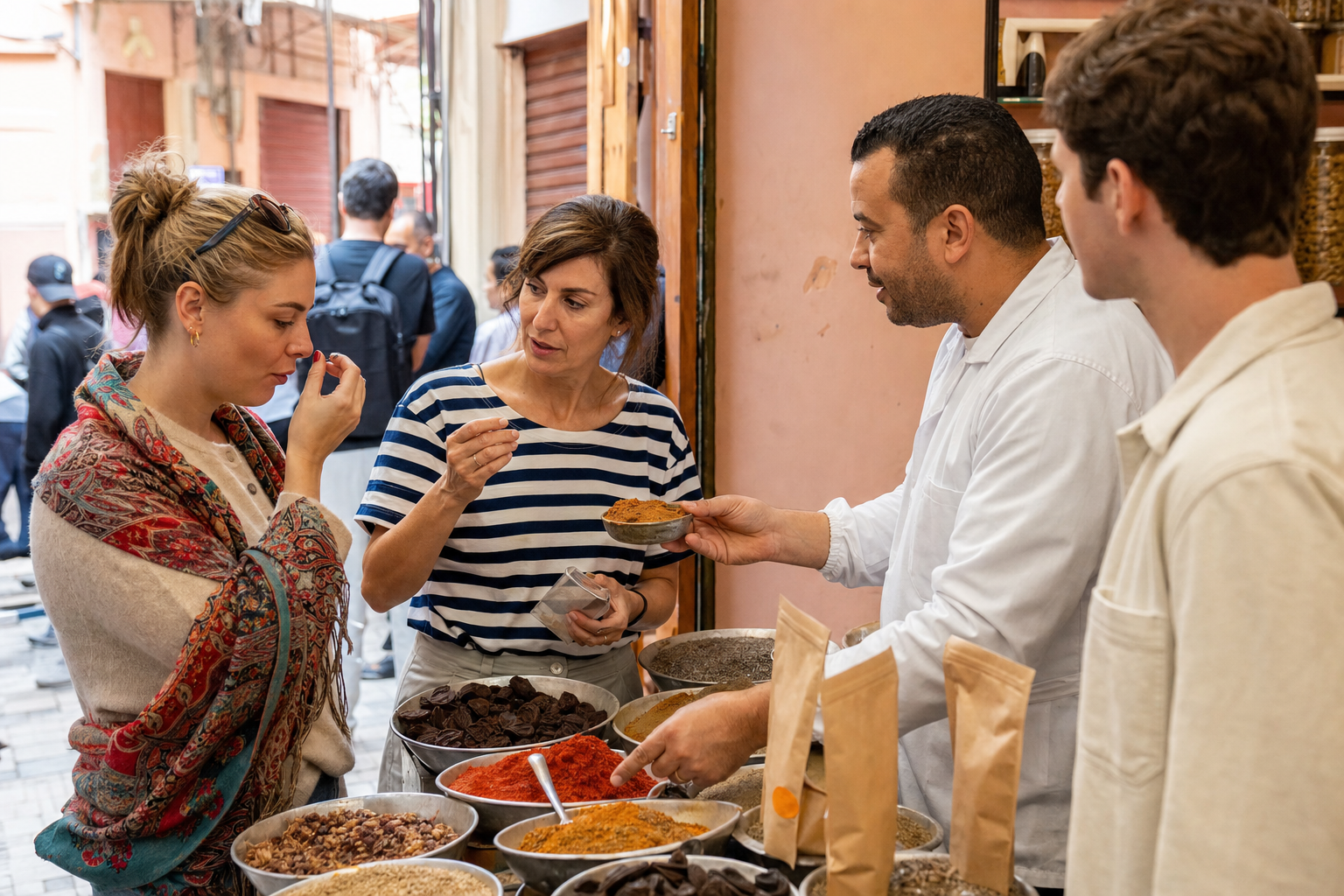
You start by smelling and identifying individual spices — learning to distinguish cumin from caraway, Ceylon cinnamon from cassia, and real saffron from safflower. Then you toast whole spices to release their volatile oils, grind them in a mortar (or a spice grinder, depending on the kitchen), and blend them in proportions your instructor guides you through.
The workshop does not stop at blending. You cook a simple dish — usually a tagine or a chermoula-marinated fish — using your freshly made blend, so you experience the flavour difference between a just-ground mix and a pre-made one. Most hosts package your remaining blend in small jars for you to take home, along with the recipe so you can rebuild it from spices available in your home country.
What you'll cook
- Custom ras el hanout — Your own blend of 15-25 spices, balanced and ground fresh during the workshop.
- Chermoula paste — A fresh herb-and-spice marinade — coriander, parsley, garlic, cumin, paprika, lemon — pounded in a mortar.
- Simple tagine — A chicken or vegetable tagine seasoned exclusively with your just-made ras el hanout to demonstrate the blend.
- Spiced tea variations — Beyond mint tea — blends using fresh herbs, spices, and orange blossom water.
How the class runs & how long it takes
-
Souk visit
Walk through the spice market with your instructor, identifying spices, smelling differences, and buying any specialty items.
-
Spice identification
Back in the kitchen, lay out 20-30 individual spices and learn to identify each by sight, smell, and taste.
-
Toasting and grinding
Toast whole spices in a dry pan, then grind and blend them in a mortar or spice grinder to create your personal ras el hanout.
-
Cook and taste
Use your blend in a simple dish, eat together, and package remaining spices to take home.
What to expect
Expect to be surprised by how different freshly ground spices taste compared to pre-ground powders. The volatile oils in whole cumin, coriander, and cinnamon dissipate within weeks of grinding — a fresh blend is sharper, more aromatic, and more complex than anything from a jar.
Expect a sensory-heavy experience. You will smell, taste, and touch dozens of individual spices before combining them. By the end, you should be able to identify the core Moroccan spices by nose alone.
Expect to take something tangible home. Unlike a cooking class where the product is a meal you eat, a spice workshop gives you physical jars of blended spices and the knowledge to recreate them from ingredients available in your home city.
Usually included
- Guided visit to a spice souk stall
- All whole spices for blending
- Mortar and pestle technique instruction
- Your own spice blends to take home
- A simple dish cooked with your blend
Who this class suits
- Spice enthusiasts and home cooks who want to understand Moroccan flavour building
- Food photographers and writers looking for a visually rich, story-driven experience
- Travellers who already know basic Moroccan cooking and want a focused deep dive
- Gift-seekers — the take-home spice jars make this workshop a practical souvenir experience
Maybe not for you if: If you want a full multi-course cooking class, this is more focused — it concentrates on spices rather than a complete menu.
How to choose the right class
- Ask whether the workshop includes a souk visit or starts in the kitchen — the market context adds a valuable layer.
- Check how many spices you work with. A serious workshop uses 20-30 individual spices; a basic one might blend only 8-10.
- Confirm you take home your blends — this is a key part of the value.
- Ask whether you cook a dish with your blend or just blend and taste. Cooking something makes the flavour difference concrete.
Frequently asked questions
Can I take the spices home in my luggage?
Yes. Ground spices in sealed jars are fine for carry-on and hold luggage. There are no restrictions on bringing spice blends into the EU, UK, US, or most other countries.
What is ras el hanout exactly?
Literally 'head of the shop' — the best blend the spice merchant has. There is no fixed recipe; it varies by vendor, family, and region. Common components include cumin, coriander, turmeric, cinnamon, ginger, pepper, rose petals, and lavender, but a complex version can contain 25 or more spices.
Do I need cooking experience for a spice workshop?
No. The blending and identification skills are accessible to anyone. However, experienced cooks will get more from the session because they can immediately apply the knowledge to their own recipes.
How is this different from buying spices in the souk?
You learn what you are buying. Souk vendors sell pre-mixed blends with no recipe or ratio information. In the workshop, you understand every component, its role in the blend, and how to adjust proportions to your taste.
Try the recipes at home
Booked, or just browsing? These free step-by-step recipes cover the dishes this class teaches: