Audience
Corporate Team-Building Cooking Challenge in Marrakech
Marrakech has become one of the top incentive travel destinations for European and international companies, and a cooking class is the most popular team activity after the classic riad dinner. It works because it is inherently collaborative — you cannot cook a Moroccan feast alone. Teams divide into stations, each preparing a different dish, and come together at the end to eat what everyone made. The shared effort and shared meal create the kind of informal bonding that conference rooms cannot.
- Duration
- 3-5 hours (flexible to group schedule)
- Group size
- Medium to large (10-50+)
- Level
- All levels — no cooking experience required from any participant
- Price
- Premium (per-head pricing, volume discounts typical)
- Pickup
- Can be included in the quote
What this class covers
A corporate cooking class in Marrakech is scaled up from the standard small-group format. Instead of one kitchen station, there are multiple — one team shapes bread, another builds the tagine, a third prepares salads, and a fourth handles dessert. Each station has its own instructor or assistant. The teams rotate or work in parallel, depending on the format, and the competition (or collaboration) between stations provides the team-building dynamic.
Venues range from large riad courtyards to hotel function spaces to purpose-built cooking schools with industrial kitchens. For groups over twenty, a dedicated event space is usually necessary — standard riad kitchens cannot accommodate that many people cooking at once. Some providers set up outdoor cooking stations in gardens or courtyards with temporary gazebos for shade.
The format is flexible. A high-energy group might want a competitive cook-off with judging and prizes. A more relaxed team might prefer a collaborative format where everyone contributes to one shared meal. The cooking itself is adapted to the group — simpler dishes for non-cooks, more complex options for food-enthusiast groups. Dietary requirements across the group (vegetarian, halal, gluten-free) are managed by the provider.
What you'll cook
- Station 1: Tagine — One or two tagine varieties assembled by a team — the centrepiece of the meal.
- Station 2: Salads and mezze — Four or five Moroccan salads and dips, prepared by a team working in parallel.
- Station 3: Bread — Khobz and msemen shaped, folded, and cooked by a team at the griddle station.
- Station 4: Dessert and tea — Pastries, fruit, and the mint tea ceremony — prepared by the final team.
How the class runs & how long it takes
-
Arrival and briefing
Group welcome, apron distribution, station assignments, and a brief overview of the Moroccan menu.
-
Station cooking
Teams work at their stations for 60-90 minutes, with instructors guiding each group through their dishes.
-
Assembly and plating
All dishes come together on a shared table, with each team presenting what they made.
-
Group meal
Everyone sits together for a communal Moroccan meal of the combined dishes, with tea to close.
What to expect
Expect a professionally managed event, not a casual cooking class. Providers who handle corporate groups are experienced in managing large numbers, dietary requirements, and the logistics of feeding 20-50 people simultaneously. The cooking is real, but the event management behind it is polished.
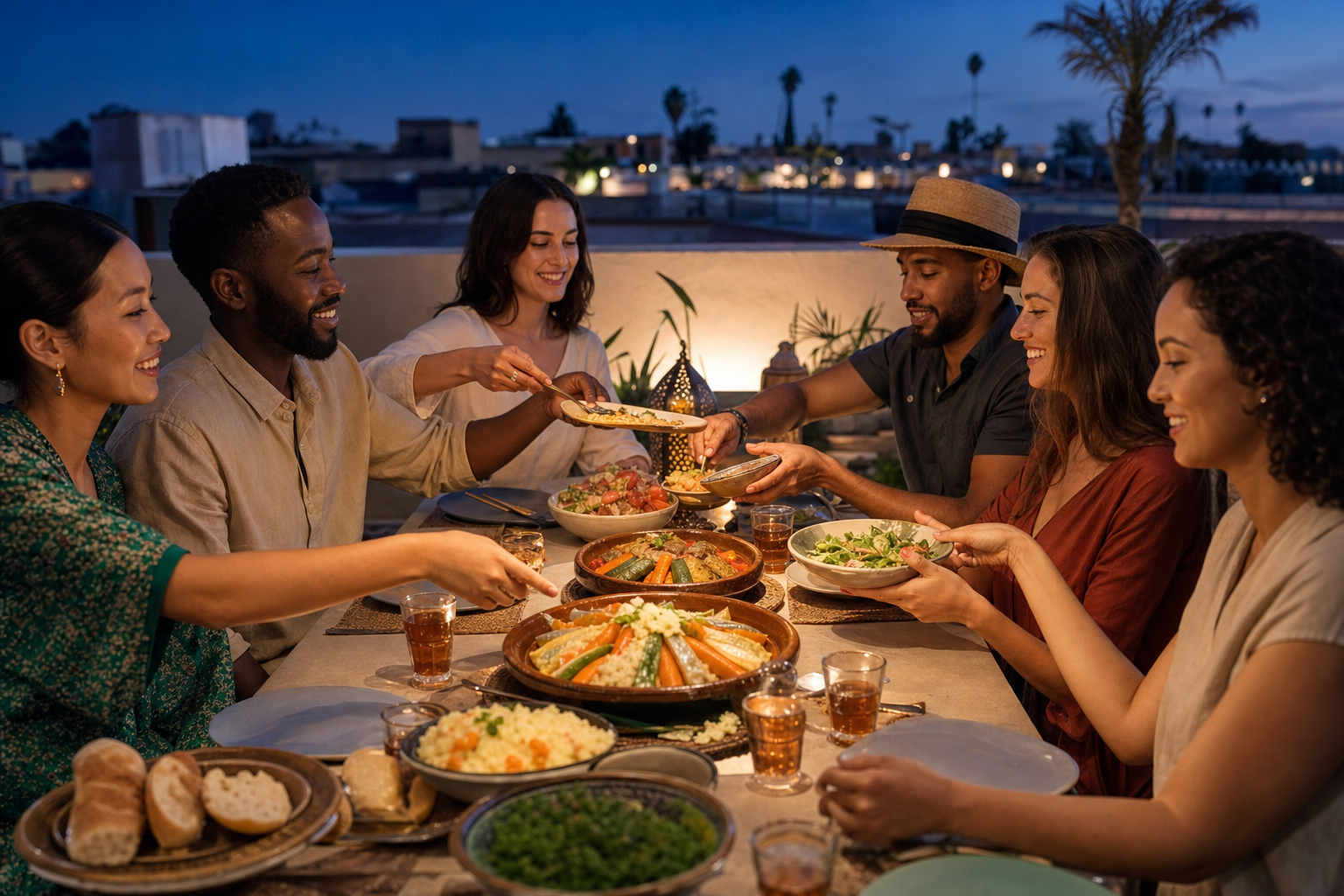
Expect the team-building dynamic to emerge naturally from the cooking. Moroccan food is communal by design — multiple dishes, shared plates, eaten together. The format forces collaboration without artificial team-building exercises.
Expect dietary flexibility. A good corporate provider will manage vegetarian, vegan, gluten-free, and halal requirements across the group without making a fuss — the Moroccan menu naturally accommodates most needs.
Usually included
- Venue hire with capacity for the full group
- All ingredients and cooking equipment
- Professional instruction with multiple teaching stations
- Group meal of everything prepared
- Optional: branded aprons, printed recipe booklets, group photographs
Who this class suits
- Corporate incentive groups visiting Marrakech for offsites or reward trips
- Company team-building events looking for a cultural activity
- Conference groups seeking a memorable group dinner with a participatory element
- Large family celebrations, wedding groups, or reunion events
Maybe not for you if: Individuals or couples — this format is designed for groups of ten or more. For small groups, see the small-group or private class options.
How to choose the right class
- Confirm the venue can accommodate your full group comfortably — ask for photos or a site visit if possible.
- Ask whether the format is competitive or collaborative, and whether it can be adjusted to your team's culture.
- Check the instructor-to-participant ratio. One instructor per 8-10 participants is a reasonable standard for hands-on involvement.
- Discuss dietary requirements in advance — a professional provider will ask for a headcount of vegetarian, vegan, halal, gluten-free, and allergy needs.
- Ask about add-ons: branded aprons, group photographs, printed recipe booklets, or a market tour for a smaller delegation before the main event.
Frequently asked questions
How many people can a cooking class accommodate?
Standard riad classes handle up to 10-12 people. Purpose-built venues and hotel spaces can accommodate 20-50 or more, with multiple cooking stations and instructors. For very large groups (50+), discuss logistics directly with the provider.
Can the class be competitive?
Yes — a cook-off format with judging and prizes is popular for corporate groups. Teams compete to produce the best tagine, the most creative salad, or the most photogenic bread. Alternatively, a collaborative format where everyone contributes to one shared meal works well for less competitive teams.
What about dietary requirements across the group?
Professional corporate providers manage multiple dietary needs as standard. Moroccan cuisine naturally accommodates halal (it is halal by default), vegetarian (many dishes are plant-based), and can be adapted for gluten-free and vegan guests.
Can we combine the cooking class with other activities?
Yes. Many providers offer packages that combine cooking with a guided souk tour, a riad lunch, or cultural activities. Discuss your schedule with the provider — they are accustomed to fitting cooking into a broader incentive programme.
Is there a minimum group size?
The team-building format works best with ten or more participants, enough to form multiple cooking stations. Smaller groups (under ten) may prefer a standard group or private class instead.
Try the recipes at home
Booked, or just browsing? These free step-by-step recipes cover the dishes this class teaches: